



Cigarette tax hike debate reignites amid worsening health insurance finances
Aug 14, 2026, 09:26 am


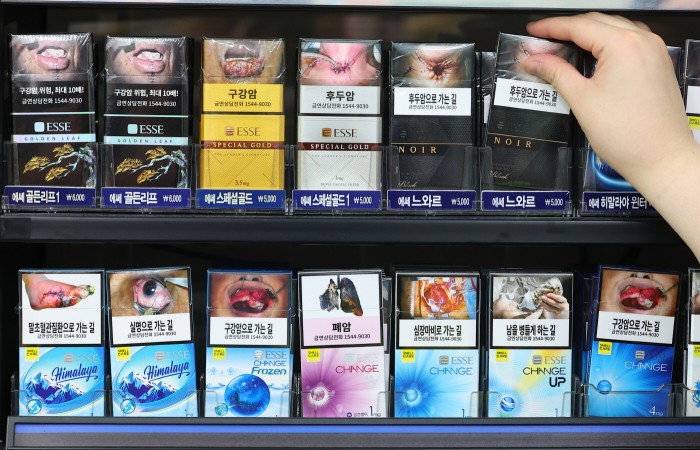 |
| A cigarette display at a convenience store in Seoul. / Yonhap |
National Health Insurance's first-quarter finances posted a 3.8989 trillion won deficit this year, reigniting arguments that cigarette prices — frozen at 4,500 won for 11 years — need to rise to shore up the fund's finances. The government currently maintains it is not considering a price hike, but with an annual deficit looking likely, tobacco taxes could resurface in discussions over medium- to long-term funding measures.
According to the government on the 13th, National Health Insurance's first-quarter cash-flow revenue totaled 22.4416 trillion won against expenditures of 26.3405 trillion won, resulting in a deficit of 3.8989 trillion won. The accumulated balance also fell from 30.2217 trillion won at the end of last year to 26.3228 trillion won.
While first-quarter cash flow alone cannot determine the full-year outcome, the rapidly shrinking annual surplus is a growing source of concern. The health insurance system's annual surplus fell from 4.1276 trillion won in 2023 to 1.7244 trillion won in 2024, and further to 499.6 billion won last year. The Ministry of Health and Welfare, in its Second Comprehensive National Health Insurance Plan, also projected that this year's annual balance would turn into a deficit.
Given this situation, tobacco taxes are once again being floated as a potential funding source. Domestic cigarette prices rose from 2,500 won to 4,500 won in 2015 and have remained unchanged for 11 years since. Of the 4,500 won price per pack, taxes and levies account for about 3,323 won, or 73.85% of the total price. The national health promotion levy alone accounts for 841 won.
Under the National Health Promotion Act, up to 65% of expected revenue from the tobacco levy can be allocated from the health promotion fund to support the health insurance system. Not all revenue from a tobacco tax increase would go directly to health insurance, but a higher levy would create room to expand the funding available to support it. Indeed, taxes and levies from cigarette sales totaled about 11.7 trillion won in 2024.
Malaysian think tank Centre for Market Education (CME) estimated that gradually raising cigarette prices to 10,000 won by 2030 could generate roughly an additional 3.58 trillion won in health insurance support funding in that year alone. This estimate, however, is based on a policy scenario assuming reduced smoking rates and a certain health insurance support ratio, and is not an official government revenue projection.
Still, the government has ruled out an imminent price increase. The Ministry of Health and Welfare said in March that it is not currently considering raising cigarette prices, and the 2026 tax reform plan did not include a hike to the tax on regular cigarettes. This is seen as reflecting the difficulty of significantly raising prices in the short term, given concerns over inflation and criticism that such a hike would disproportionately burden lower-income consumers.
Still, tobacco price policy remains listed as a medium- to long-term review item in the government's Comprehensive National Health Promotion Plan. If health insurance's annual deficit and shrinking reserves become a reality, a tobacco tax hike could resurface as an option for financial measures, alongside raising premiums and expanding government funding.
Lee Se-mi
Most Read
-
1
Celltrion nears additional contract with major U.S..

-
2
"Aren't those foreigners on welfare?": M..

-
3
U.S. weighs dropping MOAB, world's most powerful n..

-
4
Houthis launch successive attacks on Saudi airport..

-
5
Saudi Arabia, Iran hold first diplomatic talks to..

-
6
Saudi airport in Riyadh struck again, leaving at l..

-
7
Five ASEAN countries welcome Myanmar coup leader

PEOPLE






HEADLINE NEWS

-
Address : In-Young Bldg., 34, Uisadang-daero 1-gil, Yeongdeungpo-gu, Seoul
Copyright by ASIATODAY CO., LTD. All rights resereved