



Government mobilizes response to secure farm, livestock, fishery supplies
Aug 13, 2026, 09:58 am


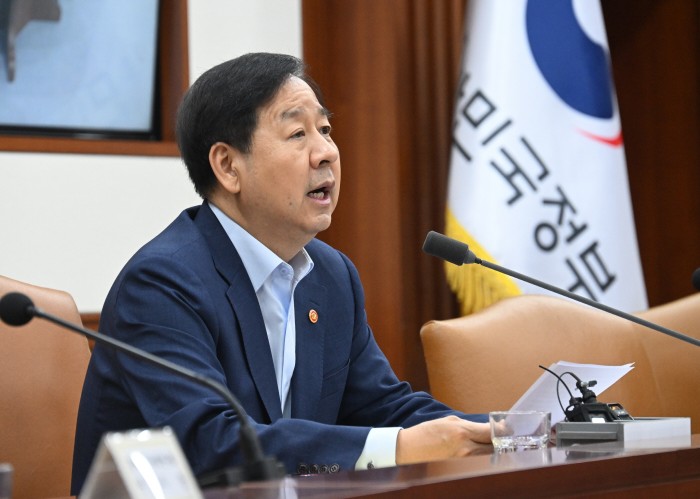 |
| Deputy Prime Minister and Minister of Economy and Finance Koo Yun-cheol delivers opening remarks at a joint meeting of the Emergency Economic Response Headquarters, the ministers' meeting on economic affairs, and the special task force on managing prices affecting people's livelihoods, held at the Government Complex Seoul on the 13th. / Courtesy of the Ministry of Economy and Finance |
In response to record-breaking heat and drought in some regions, the government will supply discounted agricultural pesticides and fertilizers and expand support for heat-tolerance equipment to its largest scale yet. It will also release stockpiled supplies of cabbage and radish in a timely manner and continue offering discounts of up to 50% on key agricultural, livestock, and fishery products through the Chuseok holiday peak season. In addition, the government will support the swift execution of pending corporate investment, particularly in advanced industries like semiconductors, secondary batteries, and bio, while easing related regulations.
Deputy Prime Minister and Minister of Economy and Finance Koo Yun-cheol chaired a joint meeting of the Emergency Economic Response Headquarters, the ministers' meeting on economic affairs, and the special task force on managing prices affecting people's livelihoods at the Government Complex Seoul on the 13th, discussing measures to stabilize prices and supply of agricultural, livestock, and fishery products amid the heatwave and drought, along with a first round of field-focused measures to support corporate investment and innovation.
First, the government decided to actively work to stabilize prices and supply of agricultural, livestock, and fishery products in response to the recent heat and drought. Since the 7th, the government has been operating a special management period for heat and drought, continuously monitoring crop growth and damage. It will supply 2.2 billion won worth of discounted pesticides and fertilizers for cabbage, radish, fruit trees, and fruit vegetables, along with 360 million won worth of shading coating agents. Support for cooling equipment and emergency water supply for vulnerable farms will also continue.
To reduce damage to fish farms from high water temperatures, the budget for response equipment such as liquid oxygen supply devices and shading nets will be expanded from 5.8 billion won last year to 9.4 billion won this year. Depending on supply and demand conditions, the government plans to release stockpiled cabbage, radish, and other items to the market, and continue offering discounts of up to 50% on major agricultural, livestock, and fishery products through the Chuseok peak season.
The government also decided to ease regulations hindering corporate investment on the ground. Currently, only secondary battery manufacturing companies can locate in the Gumi and Pohang national industrial complexes, but going forward, secondary battery resource recycling companies will also be allowed to locate there, supporting about 100 billion won in new investment.
For large-scale industrial complexes like the Yongin semiconductor cluster, the government plans to allow factory expansions to receive separate permits apart from existing building permits, enabling roughly 2.5 trillion won in investment to be executed quickly. At Ochang Science Industrial Complex, bio companies will be allowed to use adjacent land to expand their factories, supporting about 530 billion won in new investment.
The government will also revise regulations related to advanced and emerging industries. It will improve industrial robot safety standards, currently centered on fixed-type robots, to promote the use of collaborative and mobile robots in the field. For six advanced strategic industries — semiconductors, secondary batteries, displays, bio, robotics, and defense — the government will introduce performance-based design using computer simulation and other tools.
The cap on designating "restricted-industry planning zones" within industrial complexes — areas where any industry can locate if needed for new industries or RE100 initiatives — will also be raised from the current 30% to 50%. The government plans to prepare a second round of measures to support corporate investment and innovation going forward, focused on projects leading Korea's hyper-innovative economy and the green industry.
Lee Ji-hoon
Most Read
-
1
Celltrion nears additional contract with major U.S..

-
2
Putin proposes trilateral U.S.-China-Russia summit..

-
3
U.S. weighs dropping MOAB, world's most powerful n..

-
4
"Aren't those foreigners on welfare?": M..

-
5
Attention centers on APEC for possible Trump-Xi-Pu..

-
6
Saudi Arabia, Iran hold first diplomatic talks to..

-
7
China tightens grip on boosting domestic demand an..

PEOPLE







-
Address : In-Young Bldg., 34, Uisadang-daero 1-gil, Yeongdeungpo-gu, Seoul
Copyright by ASIATODAY CO., LTD. All rights resereved