



Nationwide cooling shelters expand to 93,000 locations
Aug 13, 2026, 09:15 am


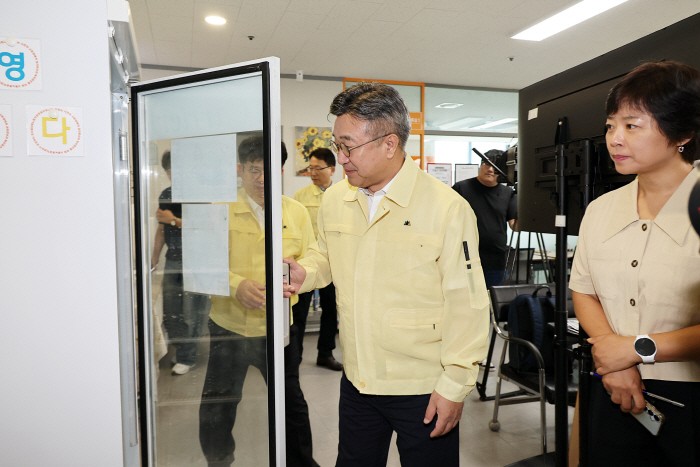 |
| Minister of the Interior and Safety Yun Ho-jung visits Hapjeong shelter for mobile workers in Mapo-gu, Seoul, on August 10 to gather on-site feedback and inspect facility operations. / Courtesy of Ministry of the Interior and Safety |
Nationwide designated cooling shelters have expanded to around 93,000 locations this year. Beyond public facilities such as senior centers and community service centers, everyday spaces including convenience stores, financial institutions, and railway stations are being utilized as shelters. When heatwave warnings remain in effect, around 13,000 shelters extend their operating hours into the night.
The Ministry of the Interior and Safety announced on August 12 that 93,375 cooling shelters are currently operating nationwide amid persistent heatwaves and tropical nights. This represents an increase of roughly 26,000 locations from last year's 67,459 sites.
Cooling shelters originated under the comprehensive heatwave measures introduced by the National Emergency Management Agency in 2006. At the time, 20,448 public facilities—including township offices, senior centers, and village halls—were designated as "heatwave shelters" to help vulnerable groups, such as elderly individuals living alone, escape the heat. The following year, the official designation changed to cooling shelters, accompanied by an expanded scope of operations.
Recently, the designation scope has broadened to include everyday spaces like financial institutions, public libraries, railway stations, and mobile worker shelters. Eligibility has likewise expanded from vulnerable demographics to the general public. Among this year's total shelter count, senior centers account for the largest portion at 70,495, followed by 15,098 community-based private facilities and 7,373 public facilities.
Shelters tailored to regional characteristics are also on the rise. Jeonju, North Jeolla Province, designated eight "Jeonju Together Ramyeon" community spaces—which provide instant noodles funded by the Hometown Love Donation Fund—as cooling shelters. Yuseong District in Daejeon operates mentoring and certified labor attorney counseling programs by trade at its mobile worker shelters.
As heatwaves and tropical nights persist, operating hours are being extended. When heatwave warnings are issued, around 13,000 cooling shelters across the country lengthen their hours into the night. Seoul designated 16 CU convenience stores as "Climate Companion Shelters" operating 24 hours on weekdays, while Seongnam, Gyeonggi Province, opened three underground shopping centers as shelters until 10:00 p.m. Jeju City operates seven "Hondi Chumpang" mobile worker shelters 24 hours on weekdays.
The Ministry of the Interior and Safety provides real-time locations of nearby cooling shelters through Safety Korea 24, local government websites, Naver Map, Kakao Map, and Tmap. In coordination with local voluntary disaster prevention corps, the ministry also inspects air conditioner operations, signage installations, and location data accuracy.
Kim Kwang-yong, Head of the Disaster and Safety Management Headquarters at the Ministry of the Interior and Safety, stated, "Cooling shelters serve as key heatwave response spaces where citizens can seek relief from the heat close to their daily lives. We will continue to identify shelters tailored to regional and user needs while ensuring thorough operational management so citizens can access them conveniently when needed."
Kim Nam-hyung
Most Read
-
1
Celltrion nears additional contract with major U.S..

-
2
Putin proposes trilateral U.S.-China-Russia summit..

-
3
U.S. weighs dropping MOAB, world's most powerful n..

-
4
"Aren't those foreigners on welfare?": M..

-
5
Attention centers on APEC for possible Trump-Xi-Pu..

-
6
Saudi Arabia, Iran hold first diplomatic talks to..

-
7
China tightens grip on boosting domestic demand an..

PEOPLE






-
Address : In-Young Bldg., 34, Uisadang-daero 1-gil, Yeongdeungpo-gu, Seoul
Copyright by ASIATODAY CO., LTD. All rights resereved