



4.5-day workweek boosts hiring and cuts working hours, driving expanded government support
Aug 13, 2026, 09:04 am


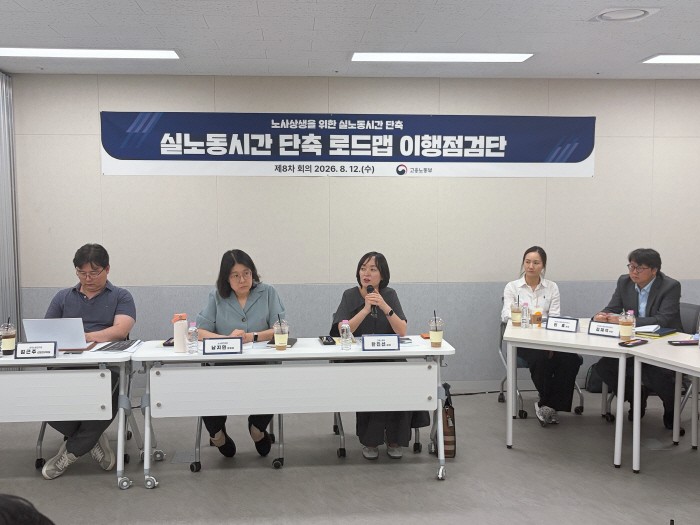 |
| Participants discuss best practices and implementation strategies for reducing working hours at the 8th meeting of the Working Hours Reduction Roadmap Inspection Task Force, held at the Korea Labor-Management Foundation in Seodaemun-gu, Seoul, on August 12. / Courtesy of Ministry of Employment and Labor |
Companies that reduced working hours through measures such as a 4.5-day workweek and shift system overhauls are seeing positive changes, including increased new hiring, shorter working hours, and reduced worker fatigue.
The Ministry of Employment and Labor announced on August 12 that it held the 8th meeting of the Working Hours Reduction Roadmap Inspection Task Force to share cases of working hour reductions from companies including IBK Industrial Bank of Korea, Ecoworld Pharm, Busan Rapid Transit Operation Service, and Shincheon Union Hospital. At the meeting, labor and management from each company presented the background, process, and outcomes of their working hour reductions and discussed strategies to establish the system on-site based on productivity improvements.
Ecowold Pharm, located in a rural industrial complex far from downtown Gwangju, faced commuting challenges and hiring difficulties, prompting the company to introduce a 4.5-day workweek for all employees in June. Employees work from 8:00 a.m. to 12:00 p.m. every Friday, with the remaining 4 hours of the afternoon designated as paid time off.
To mitigate operational gaps resulting from reduced working hours, the company reorganized departmental job responsibilities to eliminate unnecessary tasks and provided AI subscription fees to all employees. AI was utilized across various tasks, including contracts, 4 major social insurances, cost calculation, profit and loss reporting, customer service, and courier application development. As a result, 3 new employees were hired, and total weekly working hours for 18 office workers dropped by 48 hours, from 648 to 600. The company plans to continue operating the 4.5-day workweek without wage cuts after completing workflow redesigns.
Busan Rapid Transit Operation Service overhauled its shift system to reduce long hours and night shifts for middle-aged and older cleaning staff. Of the 1,065 cleaning workers, 973 (91.1%) are aged 50 or older, and the occupational accident rate in 2024 stood at 2.23%, higher than the industry average of 0.47%.
Following a labor-management agreement in December last year and a pilot run from January to March this year, the company reduced morning and afternoon shift hours from 45 hours across 6 days a week to 40 hours across 5 days starting in April. The night mobile team was eliminated and reassigned to day shifts. To address operational gaps, the company grouped 3 to 4 subway stations together for integrated management, hired 43 new staff members, and introduced automated cleaning machinery. In an employee survey following the shift system overhaul, 85% responded "very satisfied" with the 5-day workweek, and 72% reported being able to perform tasks in a healthy physical state. Customer service satisfaction also rose by 1.77 points compared to the previous year, with no occupational accidents occurring since the overhaul.
Shincheon Union Hospital reduced working hours to prevent high turnover among experienced medical personnel. The labor union first proposed the reduction to management, and the hospital accepted it, implementing a 2-hour voluntary shift reduction per week starting this month in daytime departments such as the health screening center and outpatient nursing department. The policy applies to 63 staff members, including 15 nurses and 19 certified nursing assistants.
Employees can choose their schedule, such as leaving 2 hours early on Monday afternoons or arriving 2 hours late on Wednesday mornings. To prevent gaps in patient care, department members rotate their reduced hours while standardizing work manuals and cross-training staff. The hospital is considering expanding working hour reductions to shift workers in high-hour, night-shift departments such as the emergency room and inpatient wards.
IBK Industrial Bank of Korea represents a case where working hours were reduced through labor-management agreement without government subsidies. It became the first in the financial sector to fully introduce a 1-hour early leave system every Wednesday and Friday. Unlike other commercial banks that reduced Friday working hours by 1 hour, IBK extended the reduction to Wednesdays as well.
During the reduced hours, the bank operates "Edge Training Program," a non-face-to-face job training initiative. To maintain customer service quality, digital and video consultation systems were introduced, alongside expanded flexible branch operations. New hiring is also underway to maintain in-person services for financially vulnerable groups.
Based on these cases, the government plans to expand the "Work-Life Balance +4.5 Project." The initiative supports companies pursuing actual working hour reductions, including 4.5-day workweeks. As of late last month, 293 companies had reduced working hours through the project, surpassing the annual target of 220.
Lee Hyun-ok, Director General of the Labor Policy Bureau at the Ministry of Employment and Labor, stated, "As demand on the ground has been confirmed, we will secure a larger budget for the Work-Life Balance +4.5 Project. Through the ongoing performance evaluation research, we will analyze the positive effects of working hour reductions and share them with companies while continuing to identify and spread best practices."
Kim Nam-hyung
Most Read
-
1
Celltrion nears additional contract with major U.S..

-
2
Putin proposes trilateral U.S.-China-Russia summit..

-
3
U.S. weighs dropping MOAB, world's most powerful n..

-
4
"Aren't those foreigners on welfare?": M..

-
5
Attention centers on APEC for possible Trump-Xi-Pu..

-
6
Saudi Arabia, Iran hold first diplomatic talks to..

-
7
China tightens grip on boosting domestic demand an..

PEOPLE







-
Address : In-Young Bldg., 34, Uisadang-daero 1-gil, Yeongdeungpo-gu, Seoul
Copyright by ASIATODAY CO., LTD. All rights resereved