



Hayoung's great-grandfather faces pro-Japanese collaboration allegations
Aug 12, 2026, 09:50 am


 |
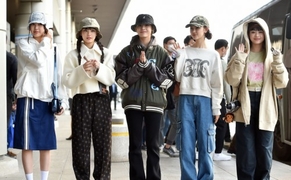
| Actress Hayoung / KBS YouTube |
Allegations of pro-Japanese collaboration have surfaced surrounding the late Ahn Sang-ho, actress Hayoung's great-grandfather. While Hayoung's side has denied the allegations as groundless, controversy has spread after an old interview with Ahn published in a Japanese colonial government mouthpiece resurfaced.
Hayoung recently appeared on KBS 2TV's "Problem Children in Rooftop Room" and spoke about her family background. She said her great-grandfather, after studying in Japan, opened Hanyang's first Western-style hospital and served as a physician to Emperor Gojong. She also revealed that her grandfather, father, and older sister are all doctors, describing her family as spanning four generations of physicians.
However, after her appearance, old records about great-grandfather Ahn resurfaced, and separate from the family's medical lineage, questions about his conduct during Japanese colonial rule have become a point of controversy.
On December 10, 1918, the Maeil Sinbo — the official organ of the Japanese Government-General of Korea — ran an article titled "The Fully Japanized Household of Dr. Ahn Sang-ho."
According to the Maeil Sinbo, Ahn graduated from Tokyo Jikei Medical School in 1902 and became the first Korean to obtain a Japanese medical license. After returning to Korea in 1904, he served as a court physician to Emperor Sunjong and as a contracted physician for the Yi Royal Household Office, and opened Korea's first Western-style clinic.
The controversial part is what Ahn said in his interview with the Maeil Sinbo at the time.
Describing his lifestyle, Ahn said he lived essentially as a Japanese person — wearing Japanese clothing, married to a Japanese woman, and running his household and diet entirely in the Japanese style.
He went on to stress that his family didn't even own a single piece of traditional Korean clothing, actively emphasizing his Japanese way of life.
He also said that while his family lacked the etiquette and conversational polish of people from mainland Japan, they followed Japanese language and customs. Regarding Korean-language use and contact with other Koreans, he said his children naturally didn't know Korean since it wasn't spoken at home, and that he had far more contact with Japanese people and, surprisingly, rarely interacted with Koreans.
The Maeil Sinbo also reported Ahn's death in its January 5, 1928 edition.
The paper reported that Ahn, who had served as personal physician to the late Emperor Gojong, died at his home around midnight on the 31st of the previous month. It noted he opened a clinic in Jongno 3-ga in 1909 and had also devoted significant effort to public service, serving as a member of the Gyeongseong Municipal Council and head of the Gyeongseong Jongno Credit Union.
The Maeil Sinbo added that after opening his clinic, Ahn built his wealth from scratch to become so rich he was said to own "2,000 seok" worth of land, and that a monument was even erected in his honor.
Hayoung's agency, Bstars Entertainment, has stated that the allegations regarding the late Ahn Sang-ho's pro-Japanese collaboration are groundless.
However, as Ahn's old Maeil Sinbo interview continues to circulate online, public sentiment has not settled down even after the agency's denial.
Jeong A-reum
Most Read
-
1
Celltrion nears additional contract with major U.S..

-
2
Putin proposes trilateral U.S.-China-Russia summit..

-
3
U.S. weighs dropping MOAB, world's most powerful n..

-
4
"Aren't those foreigners on welfare?": M..

-
5
Attention centers on APEC for possible Trump-Xi-Pu..

-
6
Saudi Arabia, Iran hold first diplomatic talks to..

-
7
China tightens grip on boosting domestic demand an..

PEOPLE






-
Address : In-Young Bldg., 34, Uisadang-daero 1-gil, Yeongdeungpo-gu, Seoul
Copyright by ASIATODAY CO., LTD. All rights resereved