



Food poisoning cases near 10,000, government's salmonella crackdown falls flat
Aug 11, 2026, 09:13 am


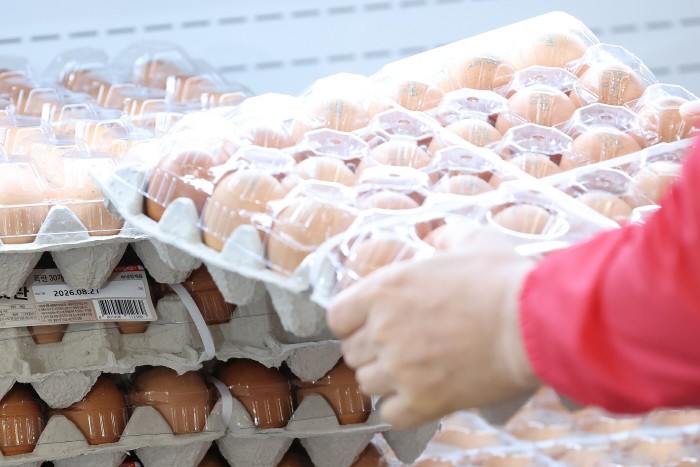 |
| Eggs on display at a large supermarket in Seoul. / Yonhap |
Despite designating salmonella as a priority target for food poisoning management and tightening inspections at the egg production and distribution stages, the government appears to be struggling, as related cases more than doubled in a year. The total number of food poisoning patients also far exceeded the government's target of keeping cases under 6,000, coming in close to 10,000.
According to the Ministry of Food and Drug Safety's recently released "2025 Food Poisoning Statistics" on the 10th, there were 319 food poisoning incidents last year involving a total of 9,780 patients. Compared with 265 incidents and 7,624 patients in 2024, this marks an increase of 54 incidents and 2,156 patients, representing growth rates of 20.4% and 28.3%, respectively.
This falls significantly short of the management targets the government set earlier last year. In February of last year, the government held a meeting of the cross-government food poisoning response council and set a goal of no more than two large-scale outbreaks affecting 300 or more people, and keeping total patients under 6,000. It designated salmonella, norovirus, kimchi, delivered food, and international events as five priority areas, pledging to strengthen management at the production, manufacturing, and distribution stages.
However, the actual number of patients exceeded the target by 3,780 — a 63% overshoot of the 6,000 goal. Both salmonella and norovirus, which the government had designated as priority targets, increased in tandem, driving up the overall total. Salmonella-related food poisoning alone accounted for 79 incidents and 4,248 patients last year.
By comparison, salmonella-related food poisoning in 2024 totaled 58 incidents and 1,907 patients. In just one year, incidents rose by 21 (up 36.2%) and patients rose by 2,341 (up 122.8%) — a sharp surge that suggests the government's efforts last year to trace contamination at egg farms and strengthen inspections of eggs from older hens and brush-washed eggs proved largely ineffective. Full inspections of liquid egg processing facilities and checks on cold-chain distribution of water-washed eggs were also carried out, but did not translate into a statistical decline in salmonella cases.
Against this backdrop, the Ministry of Food and Drug Safety has once again expanded the scope of egg-related salmonella management this year. It increased the number of egg farm inspections related to salmonella-linked food poisoning from 10 last year to 50 this year, and has been conducting sample testing targeting egg suppliers and food establishments such as restaurants. The ministry is also pushing forward a system requiring businesses to directly verify whether eggs are contaminated with salmonella before they are distributed to market.
Still, given that September saw the highest number of food poisoning cases last year, it remains to be seen whether this year's expanded egg farm inspections, sample testing at the distribution and preparation stages, and mandatory self-quality testing will actually translate into a reduction in cases.
A Ministry of Food and Drug Safety official said the ministry will continue to strengthen preemptive sanitation inspections at vulnerable facilities and tailored prevention outreach, and will steadily push forward safety management measures that reflect the seasonal and causal characteristics of food poisoning outbreaks.
Lee Se-mi
Most Read
-
1
Celltrion nears additional contract with major U.S..

-
2
Putin proposes trilateral U.S.-China-Russia summit..

-
3
"Aren't those foreigners on welfare?": M..

-
4
U.S. weighs dropping MOAB, world's most powerful n..

-
5
Houthis launch successive attacks on Saudi airport..

-
6
Saudi Arabia, Iran hold first diplomatic talks to..

-
7
Saudi airport in Riyadh struck again, leaving at l..

PEOPLE






HEADLINE NEWS
- [Exclusive] U.S. military steel frame work at Gwangju Airport casts cloud over planned semiconductor industrial complex
- Momentum grows for mid-next month U.S.-China-Russia summit with mounting is..
- Elon Musk formalizes review of SpaceX-Tesla merger
- [Exclusive] 10 SNUs pledged, but three regional universities take half the..

-
Address : In-Young Bldg., 34, Uisadang-daero 1-gil, Yeongdeungpo-gu, Seoul
Copyright by ASIATODAY CO., LTD. All rights resereved