



Government pushes national asset framework to protect the vulnerable
Aug 07, 2026, 09:45 am


 |
The government, having called for reviving Korea's potential growth rate, is moving forward with economic innovation aimed at addressing downward pressure and the "K-shaped" polarization visible across society. The plan is to pursue AI-driven manufacturing innovation in core industries while also preparing measures to stabilize the livelihoods of vulnerable groups, ensuring the benefits of economic growth reach everyone.
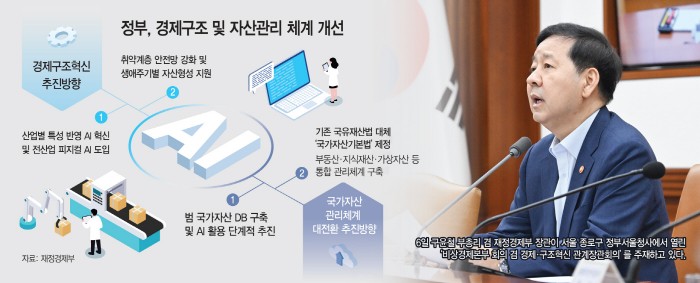
According to the Ministry of Economy and Finance on the 6th, the joint "Direction for Economic Structural Innovation" was announced at a joint meeting of the Emergency Economic Response Headquarters and ministers on economic and structural reform, chaired by Deputy Prime Minister and Minister of Economy and Finance Koo Yun-cheol. Aimed at reviving Korea's potential growth rate, the plan centers on two main pillars: "industrial structure innovation" and "growth for everyone."
As part of industrial structure innovation, the government will pursue AI-driven manufacturing process innovation tailored to the characteristics of core industries such as steel and petrochemicals, while simultaneously advancing high-value-added, eco-friendly technology development. It also plans to prepare a plan to supply about 1,000 AI robots annually to introduce physical AI across all industries, and aims to secure a world-class physical AI foundation model.
To address the polarization that has deepened this year, the government will draw up a plan to strengthen the safety net for vulnerable groups in the fourth quarter, alongside institutional reforms such as revising eligibility criteria for livelihood and medical benefits, in order to ease vulnerable groups' concerns over livelihood and finances.
To build the infrastructure needed to support economic structural innovation, the government plans to provide a policy package combining fiscal, tax, and regulatory improvements, and to expand fiscal sustainability through restructuring of education finance grants and spending.
Deputy Prime Minister Koo said, "We will put everything into economic structural innovation to revive our potential growth rate and achieve growth for everyone," adding, "We need to create change the public can actually feel, through structural innovation in existing core industries, fostering new industries, and closing gaps across assets, income, labor, generations, and regions."
The meeting also discussed the "Direction for Transforming National Asset Management (K-Asset Innovation Project)." At the core of this transformation is a full revision of the existing State Property Act, enacted in 1950, into a new basic law on national assets, along with building an AI-based national asset management system.
The government noted that while total state property has grown more than sevenfold — from 188.3 trillion won in 2001 to 1,402.7 trillion won at the end of last year — the current law still reflects the real estate-centered management framework set up when it was enacted in 1950, and has failed to keep pace with the changed asset landscape. Accordingly, the government plans to redefine "state property" as "national assets" and build an integrated management system covering not just real estate but also financial assets, intellectual property, and virtual assets. In particular, it will establish separate regulatory frameworks for each core asset category to systematically manage the full lifecycle from acquisition to management and disposal.
For virtual assets, which will be included in national asset management for the first time, the government will establish a legal basis to clarify procedures for management, entrustment, and disposal. The general policy will be to auction such assets immediately after acquisition, while also considering measures such as staggered sales to minimize market disruption.
A data-driven management system will also be built. Within this year, the government plans to link asset information from the national government, local governments, and public institutions through the dBrain system, and introduce an AI chatbot to support legal interpretation and administrative work. Starting next year, it plans to pursue the construction of a dedicated AI-based national asset database, tentatively named "K-Asset Cloud."
Lee Ji-hoon
Seo Byeong-ju
Most Read
-
1
Celltrion nears additional contract with major U.S..

-
2
Putin proposes trilateral U.S.-China-Russia summit..

-
3
U.S. weighs dropping MOAB, world's most powerful n..

-
4
"Aren't those foreigners on welfare?": M..

-
5
Attention centers on APEC for possible Trump-Xi-Pu..

-
6
Saudi Arabia, Iran hold first diplomatic talks to..

-
7
China tightens grip on boosting domestic demand an..

PEOPLE







-
Address : In-Young Bldg., 34, Uisadang-daero 1-gil, Yeongdeungpo-gu, Seoul
Copyright by ASIATODAY CO., LTD. All rights resereved