



Government targets 40 million foreign tourists, aims to nurture K-culture
Aug 06, 2026, 09:56 am


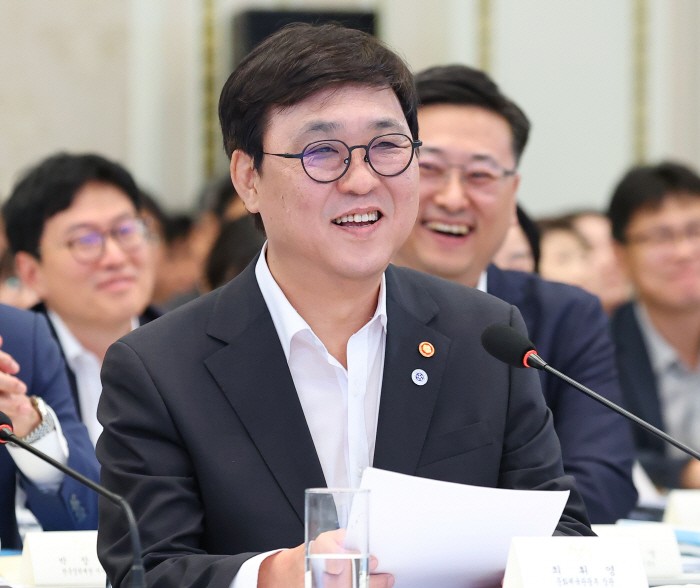 |
| Culture, Sports and Tourism Minister Choi Hwi-young reports at a briefing session presided over by President Lee Jae-myung, held at the state guest house of the presidential office on the 5th. / Yonhap |
The Ministry of Culture, Sports and Tourism will speed up efforts in the second half of the year to build an "irreplaceable cultural powerhouse," with a focus on growing the K-culture industry, revitalizing regional culture, and strengthening tourism competitiveness.
At the state guest house of the presidential office on the 5th, the ministry gave its second-half 2026 policy briefing under the vision of "K-culture, sports, and tourism that revitalize the regions and spread across the world," outlining six key priorities: strengthening the foundation for a cultural powerhouse, intensively fostering the K-culture industry, using culture, sports, and tourism to improve regional living conditions, building the foundation for 40 million foreign tourist arrivals, realizing K-sports, and innovating public-centered policy communication.
The biggest pillar is strengthening the competitiveness of the K-culture industry. The ministry plans to expand policy financing such as loans, guarantees, and funds, and shift its support system toward major intellectual property (IP) and works aimed at overseas markets. It also plans to expand AI-based support for creation and production and train specialized personnel to build growth momentum for the content industry.
The ministry will actively support overseas expansion in key sectors including film, broadcasting, games, popular music, and publishing. It plans to expand international co-productions and global cooperation, establish K-culture hubs in major overseas cities, and push forward a large-scale K-culture event called "FANOMENON" to broaden the reach of Hallyu.
Support for artists will also be strengthened, with expanded social insurance and financial support, and increased funding for artistic activity preparation and young creators to build a stronger safety net for creative work. Support for independent film, indie music and games, and diverse comics and webtoons will be expanded across the entire cycle, from production to distribution and overseas expansion.
In tourism, the ministry aims to build toward an era of 40 million foreign visitors annually by expanding infrastructure such as airports, ports, and lodging, and improving entry convenience through measures like multiple-entry visas and expanded visa-free group tourism. It plans to build a "K-Tourism Golden Route" connecting regional tourism around five major regional airports, and expand tourism products linked to K-pop concerts and drama and film filming locations.
Regional revitalization policy also features prominently, with plans to strategically expand cultural facilities such as museums, art galleries, and libraries, improve aging culture and sports facilities, and create environments where residents can enjoy culture in daily life through programs like "Culture Day" and the "Our Neighborhood Project."
In sports, the ministry plans to pursue reforms including improved governance at sports organizations and strengthened sports ethics, while expanding community sports programs and public sports facilities to broaden access to sports for everyone.
The ministry noted achievements from the first half of the year, including using an emergency content-blocking system to prompt the voluntary shutdown of the country's largest illegal webtoon piracy site, and a 21.3% year-on-year increase in foreign tourist arrivals, reaching 10.71 million visitors.
Minister Choi Hwi-young said, "While the first half of this year focused on laying the groundwork for recovery and growth in culture, sports, and tourism, the second half will focus on delivering results the public can actually feel," adding, "We will move quickly on key initiatives so that culture can bring vitality to regional life and K-culture can spread further across the world, realizing an irreplaceable cultural powerhouse, Korea."
Jeon Hye-won
Most Read
-
1
Celltrion nears additional contract with major U.S..

-
2
Putin proposes trilateral U.S.-China-Russia summit..

-
3
U.S. weighs dropping MOAB, world's most powerful n..

-
4
"Aren't those foreigners on welfare?": M..

-
5
Attention centers on APEC for possible Trump-Xi-Pu..

-
6
Saudi Arabia, Iran hold first diplomatic talks to..

-
7
China tightens grip on boosting domestic demand an..

PEOPLE







-
Address : In-Young Bldg., 34, Uisadang-daero 1-gil, Yeongdeungpo-gu, Seoul
Copyright by ASIATODAY CO., LTD. All rights resereved