



Prosecutors' investigative power abolished after 72 years
Aug 05, 2026, 09:07 am


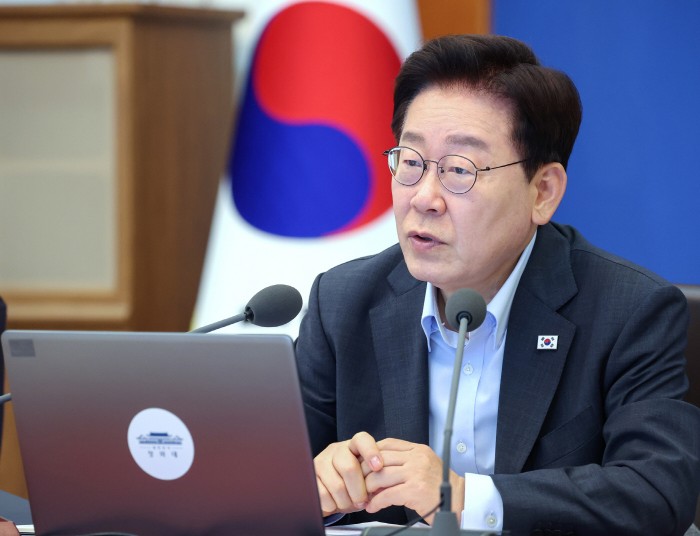 |
| President Lee Jae-myung speaks at a Cabinet meeting at the presidential office on the 4th. / Yonhap |
A revised Criminal Procedure Act fully abolishing prosecutors' investigative authority cleared a Cabinet meeting on the 4th, marking a full overhaul of Korea's criminal justice system 72 years after the Criminal Procedure Act was first enacted in 1954.
President Lee Jae-myung, presiding over the Cabinet meeting at the presidential office that day, approved the revised bill sent over from the National Assembly, saying, "Despite much controversy and disagreement, it is difficult to see this bill as reaching a level of severity — through unconstitutionality, unenforceability, harm to national interest, or infringement on the executive branch's inherent authority — that would justify denying the National Assembly's legislative power." In particular, President Lee described separating investigation and prosecution as "the first step toward normalizing an abnormal system" and "the starting point for normalizing the judicial system," lending his backing to the full abolition of prosecutors' investigative authority. He added, "Separating investigation and prosecution is an inevitable measure that sets things right — placing all power institutions under the public's control, without exception."
President Lee's remarks appear intended to put an end to the controversy surrounding the revised Criminal Procedure Act. After the bill passed the National Assembly on the 31st of last month, calls emerged both within and outside political circles for the president to exercise his veto power. Lee himself had previously suggested that prosecutors' supplementary investigative power should be retained for some exceptional cases. However, having consistently said he would leave the final decision to the National Assembly, he appears to have judged that further prolonging the controversy would not be desirable once the Assembly had concluded on fully abolishing prosecutors' investigative authority.
President Lee said, "Is the police truly taking on responsibility commensurate with the scope of their authority? I'm still not entirely confident," adding, "Giving prosecutors too much power led to abuse and chaos, and the outcome was far from pretty."
He went on to say he has significant concerns about the concentration of authority in the police, calling for self-driven reform and institutional checks to prevent a monopoly on investigative power, organizational bloat, and corruption in the investigative process.
The revised bill removes the legal basis for prosecutors' direct investigative authority based on their own recognition of crimes, as well as their supplementary investigative power over cases referred by police. However, prosecutors may still request supplementary investigation from judicial police officers, who must, in principle, complete it within two months. The revision takes effect on October 2. Some detailed provisions will take effect in phases — within six months, one year, and three years after promulgation — to allow for preparation time.
Hong Sun-mi
Most Read
-
1
Alteogen secures European patent for Keytruda SC,..

-
2
Trump shares map on social media labeling Strait o..

-
3
Celltrion seeks rheumatoid arthritis indication ex..

-
4
Kia Sportage outperforms Mazda CX-5 in German auto..

-
5
Chinese e-commerce giants AliExpress, Temu and She..

-
6
China expels No. 2 military official Zhang Youxia..

-
7
U.S. deploys carrier, 10,000 more troops to Middle..

PEOPLE







-
Address : In-Young Bldg., 34, Uisadang-daero 1-gil, Yeongdeungpo-gu, Seoul
Copyright by ASIATODAY CO., LTD. All rights resereved