



Hyundai Engineering overcomes headwinds to rank fourth in construction capability evaluation
Aug 03, 2026, 10:17 am


 |
Hyundai Engineering has climbed to fourth place in the Ministry of Land, Infrastructure and Transport's construction capability evaluation, overcoming the aftermath of safety accidents and concerns over a contraction in its housing business. Although its trustworthiness evaluation value decreased, improved construction performance and financial management evaluations allowed the company to re-enter the top tier of the construction industry after two years. The company plans to use this rise in ranking as a stepping stone for business normalization, overhauling its housing business competitiveness while nurturing future energy and high-tech sectors—such as small modular reactors (SMRs), hydrogen, and artificial intelligence (AI) data centers—as next-generation growth drivers.
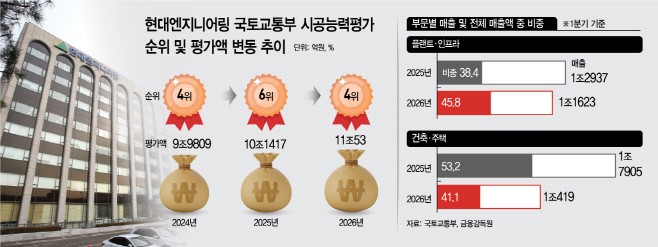
According to the construction industry on August 2, Hyundai Engineering recorded an evaluation value exceeding 11 trillion won in the Ministry of Land, Infrastructure and Transport's 2026 construction capability evaluation, rising two spots from sixth place last year. After sliding one spot from fifth place in 2024 to sixth last year, the company pulled its ranking back up this year as its construction performance and financial condition evaluations improved.
The industry had widely predicted that Hyundai Engineering's construction capability evaluation ranking would likely drop due to the impact of safety accidents that occurred early last year. Indeed, its trustworthiness evaluation value—which reflects reputation, customer satisfaction, and corporate social responsibility (CSR)—decreased by more than 10% from 2.1283 trillion won to 1.9002 trillion won. However, its construction performance evaluation value grew by about 9.6% from 5.5179 trillion won to 6.0459 trillion won, and its financial management evaluation newly entered the top 10, offsetting the drop in the trustworthiness evaluation value.
Nevertheless, the company's atmosphere following the accidents was far from easy. Rumors at one point emerged regarding a withdrawal from the civil engineering business, and as new order acquisitions slowed in the housing sector, including urban renewal projects, the possibility of business downsizing was raised.
In response, the company recently held a corporate value system declaration ceremony and announced plans to revamp its overall decision-making framework—spanning new business discovery, investment, technology acquisition, and business operations—starting from the second half of the year. This is evaluated as an effort focused on establishing a foundation for sustainable growth rather than simple business expansion.
In particular, the blueprint aims to reorganize its business portfolio around future energy and high-tech industries. The company decided to expand support for Hyundai Motor Group's RE100 (100% renewable energy transition) implementation and discover overseas energy business opportunities. This comes as it nurtures next-generation energy fields—such as small modular reactors (SMRs), nuclear fusion, and hydrogen—alongside AI data center energy infrastructure projects as new growth axes.
It also plans to strengthen competitiveness in low-carbon plants such as carbon capture and storage (CCS), as well as high-tech industrial construction including AI data centers and battery and electric vehicle component factories. Such shifts in business portfolio are already reflected in its performance.
In the first quarter of this year, the plant and infrastructure segment accounted for the highest share of Hyundai Engineering's revenue at 45.8%, while the building and housing segment recorded 41.1%. Compared to the same period last year, when building and housing (53.2%) led plant and infrastructure (38.4%), the core axis of revenue has shifted toward the plant and infrastructure segment.
The industry evaluates the "Big Bath" executed last year as a turning point for Hyundai Engineering's structural improvement. Judging that the recoverability of funds invested in or loaned to overseas plant subsidiaries had decreased, the company preemptively reflected large-scale losses. Analysts note this decision aimed to clear potential non-performing assets early to enhance financial soundness and secure future investment capacity, even at the cost of short-term earnings deterioration.
Based on this, outlooks suggest the company will pursue a two-track strategy: overhauling its housing and infrastructure business competitiveness while sophisticatedly upgrading its business portfolio around energy and high-tech industries. A Hyundai Engineering official explained, "While expanding future energy projects and high-tech industrial construction sectors, we are also carrying out reorganizations to recover competitiveness in the housing business," adding, "Both housing and infrastructure businesses are in the process of strengthening safety and quality competitiveness."
Jeon Won-jun
Most Read
-
1
Celltrion’s Omlyclo gains ground in major European..

-
2
Trump demands rates fall below 1% as Fed hikes for..

-
3
Trump makes $1 trillion bet ahead of midterm elect..

-
4
Iran resumes ballistic missile production, assembl..

-
5
Samsung Electronics, Mistral AI to jointly develop..

-
6
Trump warns countries not helping U.S. must pay re..

-
7
Seoul faces triple squeeze over troop deployment t..

PEOPLE







-
Address : In-Young Bldg., 34, Uisadang-daero 1-gil, Yeongdeungpo-gu, Seoul
Copyright by ASIATODAY CO., LTD. All rights resereved