



Same ADR structure, different fate: SK Hynix trades at premium, financial holdcos flat
Aug 03, 2026, 10:16 am


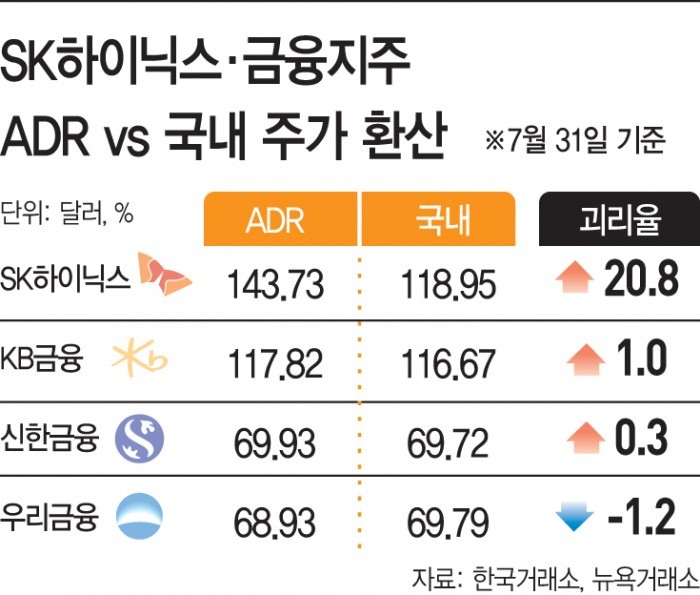 |
While SK Hynix's American Depositary Receipts (ADRs) have formed a premium of over 20% compared to its domestic underlying shares, domestic financial holding companies' ADRs are trading at levels similar to their underlying shares. Analysis suggests that although financial holding companies issued ADRs around 20 years ago to attract global investors, they have failed to generate sufficient overseas investment demand. Market evaluations diverge even for ADRs depending on a company's growth potential and global investment demand.
Experts evaluated that ADR listing itself does not increase corporate value, and that whether a premium forms is determined by how attractively global investors evaluate the company.
According to the financial investment industry on August 2, SK Hynix ADRs closed trading at $143.73 on July 31. Applying the KRW/USD exchange rate of 1,444.3 won on that day, SK Hynix ADRs were approximately 20.8% higher than the domestic underlying shares. On July 14, the ADR premium even widened up to 51%.
ADRs are securities created to allow overseas investors to invest in foreign company shares in their local market. Behind the premium attached to SK Hynix ADRs are global growth expectations for AI semiconductors. Analysis shows that as competition for High Bandwidth Memory (HBM) intensified, overseas investors' interest grew, and ADRs—which offer enhanced accessibility in the U.S. market—were utilized as an investment route.
Financial holding company ADRs were introduced after the Asian Financial Crisis to restore overseas investor confidence and attract global capital inflows. KB Financial Group listed its ADR on the New York Stock Exchange (NYSE) in 2000, while Shinhan Financial Group and Woori Financial Group introduced ADRs in 2003. However, as of July 31, KB Financial ADR was trading at about 1% higher and Shinhan Financial ADR at about 0.3% higher compared to domestic stock prices, whereas Woori Financial ADR was actually about 1.2% lower. Ultimately, financial holding company ADRs are evaluated as not receiving a distinct revaluation effect.
Analysis indicates that because domestic financial stocks possess strong characteristics as dividend stocks rather than growth stocks, expectations for growth were limited, and the low valuations received in the domestic stock market were reflected as-is in overseas markets. Some evaluate that financial holding company ADRs, which were introduced to attract overseas investors, currently fail to create a distinct revaluation effect, making them akin to a white elephant.
A financial sector official stated, "Foreigners investing in domestic financial stocks are mostly global institutional investors, but ADRs serve as a vehicle for U.S.-based investors to access them, meaning the investor base itself is different," adding, "If there is insufficient demand to buy new financial holding company shares in the U.S. market, it is difficult for an ADR premium to form."
If investment demand is not supported, the costs associated with maintaining ADRs also act as a burden. Since costs arise from disclosure obligations, legal advice, and shareholder relations following U.S. market listings, companies cannot help but weigh the cost-effectiveness.
Kim Jae-seung, a researcher at Hyundai Motor Securities, said, "ADR premiums form when market interest in a specific company grows and demand arises among U.S. investors to invest in those shares," adding, "ADRs are utilized when it is a stock people want to buy, but direct access is difficult for U.S. investors." He emphasized, "Rather than the ADR format itself, global investment demand for the company itself is ultimately what matters."
However, some evaluate that the utility value of ADRs has not completely disappeared. Overseas, there are cases like Spanish bank Santander using ADRs to engage in global mergers and acquisitions (M&A). Kim Jae-woo, team leader at Samsung Securities, said, "In the past, domestic financial holding companies had PBRs around 0.3x, making M&A using shares realistically difficult," adding, "In the future, along with valuation improvements, if clear growth opportunities arise, ADRs could become a usable tool."
Lee Bo-ra
#ADR #SK Hynix
Copyright by Asiatoday
Most Read
-
1
Celltrion’s Omlyclo gains ground in major European..

-
2
Trump demands rates fall below 1% as Fed hikes for..

-
3
Trump makes $1 trillion bet ahead of midterm elect..

-
4
Iran resumes ballistic missile production, assembl..

-
5
Samsung Electronics, Mistral AI to jointly develop..

-
6
Trump warns countries not helping U.S. must pay re..

-
7
Seoul faces triple squeeze over troop deployment t..

PEOPLE







-
Address : In-Young Bldg., 34, Uisadang-daero 1-gil, Yeongdeungpo-gu, Seoul
Copyright by ASIATODAY CO., LTD. All rights resereved