



Yangsan hits record 42.5C as heatwave scorches nation
Aug 03, 2026, 09:14 am


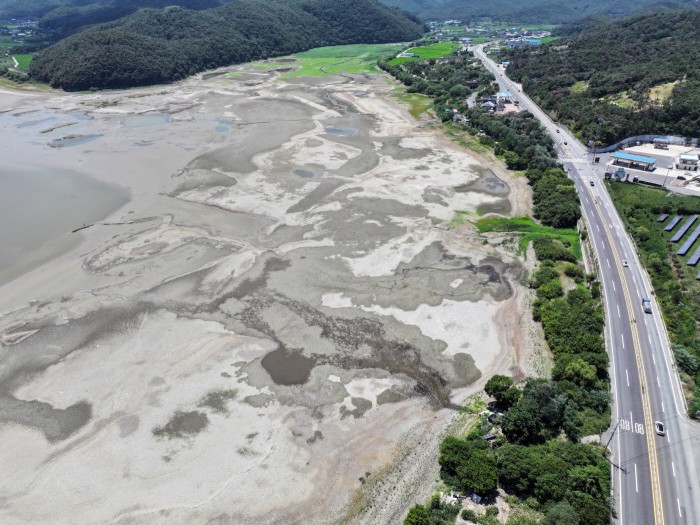 |
| Hagok Reservoir in Angang-eup, Gyeongju, North Gyeongsang Province, is drying up with most of its bottom exposed on August 2. According to the Rural Information Portal Service, the water storage of Hagok Reservoir, which supplies water to 976 hectares of nearby farmland, stands at less than 10% of its total capacity as of this day. Gyeongju has seen a continuous heatwave recently, with a severe heatwave warning issued again on this day. / Yonhap News |
Yangsan in South Gyeongsang Province exceeded 42 degrees Celsius for the first time in domestic weather observation history on the afternoon of August 2. On the same day, temperatures topped 40 degrees in 12 locations in the southern region alone, driving the nationwide heatwave to its peak.
According to the Korea Meteorological Administration on August 2, Yangsan recorded 42.5 degrees Celsius as of 1:26 p.m. at an Automated Synoptic Observing System (ASOS) station. This marks the first time Yangsan has broken the 42-degree mark since modern weather observation began in South Korea in 1904, 122 years ago.
Based on the 97 ASOS stations, the highest temperature previously recorded in South Korea was 41.6 degrees Celsius in Yangsan the day before. The highest record prior to that was 41.0 degrees Celsius in Hongcheon on August 1, 2018. Based on Automated Weather System (AWS) stations operational since 1973, the previous highest temperature was 41.9 degrees Celsius in Jiwol-ri, Chowol-eup, Gwangju-si, Gyeonggi Province, on August 1, 2018, followed by 41.8 degrees Celsius in Gangbuk-gu, Seoul, on August 1, 2018, and 41.6 degrees Celsius in Geumsa-myeon, Yeoju-si, Gyeonggi Province, on August 4, 2024. However, temperatures had never once exceeded 42 degrees Celsius.
It is also the first time that daily high temperatures in a single area have exceeded 40 degrees Celsius for five consecutive days. Based on the 97 ASOS stations, daily highs in a single area had never exceeded 40 degrees Celsius for two or more consecutive days. Even including AWS observation values, the longest streak previously recorded was four consecutive days of daily highs above 40 degrees Celsius in Sinnyeong, Yeongcheon, North Gyeongsang Province, from August 1 to 4, 2018.
 |
Most Read
-
1
Celltrion nears additional contract with major U.S..

-
2
Putin proposes trilateral U.S.-China-Russia summit..

-
3
U.S. weighs dropping MOAB, world's most powerful n..

-
4
"Aren't those foreigners on welfare?": M..

-
5
Attention centers on APEC for possible Trump-Xi-Pu..

-
6
Saudi Arabia, Iran hold first diplomatic talks to..

-
7
China tightens grip on boosting domestic demand an..

PEOPLE







-
Address : In-Young Bldg., 34, Uisadang-daero 1-gil, Yeongdeungpo-gu, Seoul
Copyright by ASIATODAY CO., LTD. All rights resereved