



Work halts by day, shelters extend hours at night — 24-hour heatwave response
Aug 03, 2026, 09:12 am


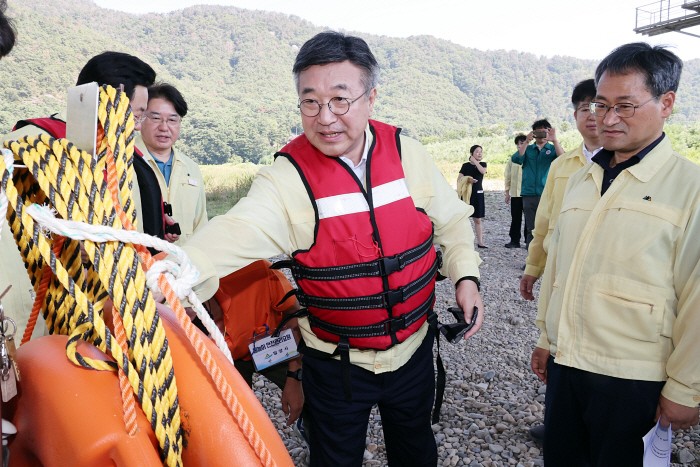 |
| Interior and Safety Minister Yoon Ho-jung inspects water safety facilities, including life jackets and life rings, at the Geumsidang recreational area during a visit to Miryang, South Gyeongsang Province on the 2nd to check on heatwave response measures. / Ministry of the Interior and Safety |
As extreme heat with daytime highs above 40 degrees and tropical nights continue, the government's response has shifted into a "24-hour system" spanning both day and night. Outdoor and farm work will halt during the day, while heat shelter hours will be extended at night to reduce harm to vulnerable groups.
According to the Central Disaster and Safety Countermeasures Headquarters (CDSCH) on the 2nd, heat warnings or stronger alerts were in effect in 179 of the country's 228 special weather advisory zones as of 11 a.m. that day. The number of areas under a heatwave critical alert grew to 22, with five more added in North Gyeongsang, Daegu, and South Gyeongsang. The temperature in Yangsan, South Gyeongsang Province, reached 42.5 degrees that day, setting a national record and marking the first time temperatures have topped 42 degrees since modern weather observation began in Korea in 1904. The nationwide average number of tropical nights stood at 9.7 days as of the end of last month, the highest since observations began in 1973.
As the heatwave persisted, the CDSCH raised its response level to Stage 2 at 1 p.m. that day. The government is strengthening its response under the newly introduced heatwave critical alert and tropical night advisory system launched this year. Interior and Safety Minister Yoon Ho-jung visited Miryang, where a heatwave critical alert was in effect, to check the on-the-ground effectiveness of heat response measures.
In areas under a heatwave critical alert, outdoor work is generally directed to stop except in urgent cases, and farmers are advised to halt work in high-heat environments such as fields and greenhouses. School classes, outdoor performances, and military training are adjusted or suspended depending on the risk level. The Ministry of Employment and Labor is disseminating alerts and safety guidelines to about 60,000 workplaces vulnerable to heat, and local labor office heads and inspectors had checked 6,137 sites as of the 29th of last month.
Nighttime heat response has also been strengthened. In areas under a tropical night advisory, operating hours for heat shelters such as senior centers, public libraries, and subway stations are being extended, and emergency sleeping spaces and on-site patrols for homeless people and residents of cramped rooming houses are being expanded. Students are guided to have flexible school start times, and farmers are advised to reduce next-day work hours and intensity.
Local governments are strengthening heat response measures tailored to their regions. South Chungcheong Province is keeping some heat shelters open until midnight, while North Jeolla Province is operating at least one shelter per town, township, or neighborhood until 10 p.m. Busan is expanding safe lodging for rooming-house residents and emergency sleeping spaces for the homeless, while Jeju is running a 24-hour system combining welfare check-ins, home visits, and AI-based care. Ulsan increased patrol checks on vulnerable elderly residents from once to twice a day and on homeless people from three to four times a day after the heatwave critical alert took effect. In Gunpo, Gyeonggi Province, the number of users at the Sanbon Library heat shelter rose by 200 after its operating hours were extended.
Local governments are also inspecting heat shelters and strengthening monitoring of elderly residents and outdoor workers using neighborhood representatives and local disaster prevention volunteer groups. Heat-mitigation facilities such as water-spraying vehicles, road sprinkler systems, shade structures, and parasol rental stations are also being operated.
In Miryang, South Gyeongsang Province, 28 of the city's 326 heat shelters are being kept open from 8 p.m. to midnight. Heat-response kits and cooling vests are being distributed to vulnerable residents and outdoor and farm workers. The Ministry of the Interior and Safety is also providing an additional 170 million won in disaster relief funding to the southern region for shelter cooling costs and relief supplies.
Minister Yoon visited a heat shelter at the Waji Senior Center in Miryang that day to check on operations, then personally made an announcement over the village's public broadcast system. Yoon urged residents to "refrain from going outside or doing outdoor work as much as possible, and to take frequent breaks during farm work and outdoor activities," adding, "Please prevent heatstroke and dehydration by drinking enough water and using cooling devices."
Kim Nam-hyung
Most Read
-
1
Celltrion nears additional contract with major U.S..

-
2
Putin proposes trilateral U.S.-China-Russia summit..

-
3
U.S. weighs dropping MOAB, world's most powerful n..

-
4
"Aren't those foreigners on welfare?": M..

-
5
Attention centers on APEC for possible Trump-Xi-Pu..

-
6
Saudi Arabia, Iran hold first diplomatic talks to..

-
7
China tightens grip on boosting domestic demand an..

PEOPLE






-
Address : In-Young Bldg., 34, Uisadang-daero 1-gil, Yeongdeungpo-gu, Seoul
Copyright by ASIATODAY CO., LTD. All rights resereved