



Southwest semiconductor water supply assured, but key river plans remain blank
Jul 30, 2026, 10:20 am


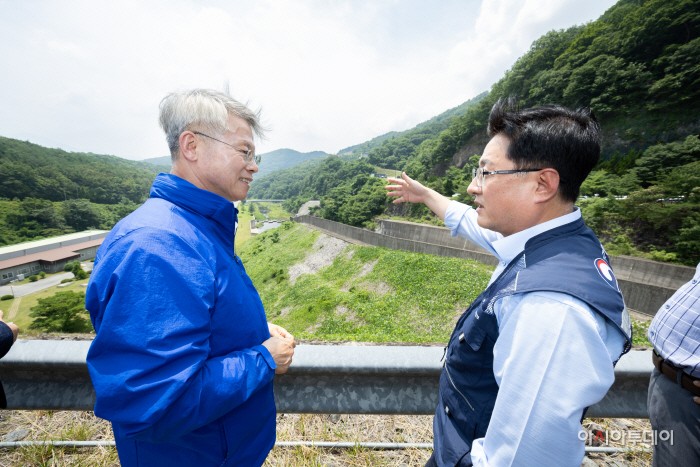 |
| Minister of Climate, Energy and Environment Kim Sung-whan visits Dongbok Dam in Hwasun-gun, Jeollanam-do on June 30 to discuss plans for utilizing Dongbok Dam to supply water / Ministry of Climate, Energy and Environment |
Although the government announced a detailed plan to supply 650,000 tons of industrial water per day to the southwestern semiconductor industrial complex, it has been confirmed that the Juam Dam and Boseong River areas—presented as core supply sources—are still re-establishing their respective basic river plans. While the Ministry of Climate, Energy and Environment maintains that a stable water supply is possible, the relevant statutory plans are still undergoing the re-establishment process.
According to the government and the National Assembly on July 29, the basic river plans for the Juam Dam and Boseong River areas, cited by the Ministry of Climate as key supply sources for the current water supply project, are still being re-established. Existing plans established in 2014 for both areas expired last year, and follow-up plans have yet to be finalized. Procedures to prepare new plans are currently under way, involving consultations with relevant authorities, strategic environmental impact assessments, and public opinion gathering.
Last month, the Ministry of Climate announced a plan to supply 650,000 tons of industrial water per day to the southwestern semiconductor industrial complex by raising the height of Dongbok Dam, utilizing surplus capacity at Juam and Jangheung Dams, converting hydroelectric generation water from Boseonggang Dam, and utilizing Naju Dam. The plan aims to secure a daily supply capacity of over 1 million tons through 300,000 tons from Dongbok Dam, 150,000 tons from Juam and Jangheung Dams, 100,000 tons from Boseonggang Dam, and 100,000 tons from Naju Dam alongside reclaimed wastewater.
However, large-scale water supply projects must clear various follow-up procedures even after announcement, including dam surveys, basic concepts, public feedback, licensing, and detailed engineering design. Indeed, schedules in other water supply projects have frequently shifted due to local opposition and public opinion gathering. Among the 14 candidate sites originally announced for the government's ongoing new dam survey and research project, seven have been suspended, while the remaining seven are currently undergoing basic conceptualization and public debate procedures. The survey task assigned to Korea Water Resources Corporation, the project manager, was also halted for a time to gather local input, delaying the overall schedule.
A basic river plan is a statutory framework that sets the direction for river use, improvement, and management, serving as an overarching plan foundational to water supply and river development. Establishing a new plan requires baseline surveys, consultations with related agencies, public briefings, and strategic environmental impact assessments; as stakeholder alignment is necessary, the process can take considerable time.
Such cases are not limited to Juam Dam and the Boseong River. Re-establishment for the Chuncheon Dam and Hantan River areas remains incomplete five years after previous plans expired, while follow-up plans for the lower Namhan River, Lower Han River/Seoul, and Lower Han River/Goyang areas have been pending for four years. The Tamjin River has been in the re-establishment process for three years, and the Anseong Stream, Naeseong Stream, and Nakdong River Estuary Barrage for two years. Out of 80 total basic river plans, 12 remain incomplete after their planning periods ended.
Regarding this, the National Assembly Budget Office noted in its recent Analysis of the FY2025 Settlement of Accounts by Committee that "the new dam survey and research project experienced delays compared to initial plans due to the suspension of certain candidate sites following public opinion gathering and debates, and survey tasks by K-water were temporarily halted." It added, "It is necessary to thoroughly review potential variables and local acceptance during project execution in advance to enhance budget execution efficiency."
Jeong Soon-young
Most Read
-
1
Celltrion’s Omlyclo gains ground in major European..

-
2
Hyundai Motor Group breaks ground on integrated st..

-
3
U.S. strikes 3 Iranian oil tankers, Iran vows reta..

-
4
S. Korea seeks redemption from World Cup setback w..

-
5
Trump makes $1 trillion bet ahead of midterm elect..

-
6
Iran resumes ballistic missile production, assembl..

-
7
Samsung Electronics, Mistral AI to jointly develop..

PEOPLE







-
Address : In-Young Bldg., 34, Uisadang-daero 1-gil, Yeongdeungpo-gu, Seoul
Copyright by ASIATODAY CO., LTD. All rights resereved