



Kakao releases 4 open-source lightweight AI language models
Jul 28, 2026, 01:57 pm


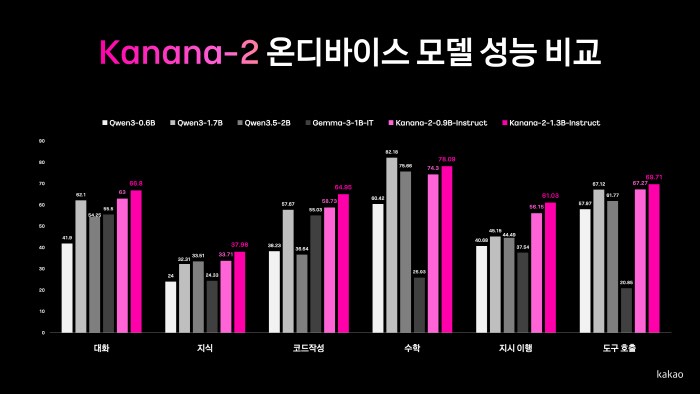 |
| Performance comparison of Kanana-2 on-device models / Courtesy of Kakao |
Kakao has open-sourced four small language models (SLMs) developed in-house. The company strategy aims to expand the domestic AI ecosystem by making on-device AI models, which run on smartphones and other devices, commercially available to everyone.
On July 28, Kakao announced that it released four models from its Kanana lightweight language model series—Kanana-2-1.3B-base, Kanana-2-1.3B-instruct, Kanana-2-3B-base, and Kanana-2-3B-instruct—as open source via Hugging Face.
Kakao explained that these models secured competitive performance compared to other open-source models of similar size across key benchmarks, including Korean, English, general knowledge, math, and code. The 1.3B and 0.9B models also showed performance on par with global models in real-world application tasks such as conversation, code generation, instruction following, and tool calling.
The company also applied a Korean-specialized tokenizer. This boosted Korean processing efficiency by more than 30% compared to previous models, processing the same sentences with fewer tokens to improve compute speed and cost competitiveness. Additionally, it adopted a sliding window attention architecture, designed to reduce memory usage by up to 72.7% even in conversations as long as 32,000 tokens.
Kakao applied the Kanana Open License, which permits commercial use so developers, startups, and research institutions can freely utilize the models. This is expected to broaden the foundation for Korean AI model deployment and accelerate the development of new AI services.
Noh Byung-seok, lead of Kakao's Unified Foundation Model team, said that both cloud-based large-scale AI and lightweight on-device AI are growing in importance. He added that he hopes this open-source release will lead to more AI service development by developers and companies, contributing to a more vibrant local AI ecosystem.
Lee Seo-yeon
Most Read
-
1
U.S. Treasury Secretary Bessent publicly warns ove..

-
2
Celltrion’s Omlyclo gains ground in major European..

-
3
Hyundai Motor Group breaks ground on integrated st..

-
4
Russia faces warning signs over prolonged war econ..

-
5
U.S. strikes 3 Iranian oil tankers, Iran vows reta..

-
6
S. Korea seeks redemption from World Cup setback w..

-
7
Trump makes $1 trillion bet ahead of midterm elect..

PEOPLE







-
Address : In-Young Bldg., 34, Uisadang-daero 1-gil, Yeongdeungpo-gu, Seoul
Copyright by ASIATODAY CO., LTD. All rights resereved