



Youth politics sidelined by ruling party's '86 Generation'
Jul 22, 2026, 09:35 am


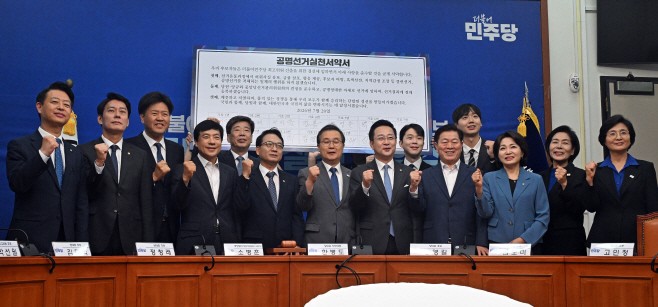 |
| Candidates running in the Democratic Party of Korea's Supreme Council election pose for a photo during a fair election pledge ceremony held at the National Assembly on July 20. From left: Candidates Kim Young-ho, Han Min-soo, Kim Yong, Lee Seong-yun, Shin Kye-ryoon, Park Sun-won, Lee Geon-tae, Park Sung-joon, Kim Hyung-nam, Park Seung-won, Jung Min-chul, Suh Mi-hwa, Choi Min-hee, and Lim Mi-ae. / Courtesy of Asia Today (Photo by Reporter Song Eui-ju) |
Although the Democratic Party of Korea emphasizes targeting 2030 voters to drive party reform, a series of decisions during preparations for the national convention blocking youth politics has spread claims of youth neglect. The shift is viewed as the result of intensifying power struggles among the dominant 86 generation to protect their vested interests, prioritizing political expediency. Concerns are rising across the political sphere that alienating younger generations could jeopardize not only general election victories but also the party's ability to retain power.
On July 21, sources across the political spectrum noted ongoing criticism that youth politics inside the party remains mere lip service. Following its defeat in the Seoul mayoral election, the Democratic Party identified the departure of 2030 voters as a primary cause and rolled out policy initiatives aimed at appealing to younger demographics. However, observers assess that the party's actual decision-making structure remains unchanged.
The label of youth neglect stems from multiple controversies that erupted during convention preparations, most notably the proposed youth Supreme Council member system. Although approved by the National Convention Preparation Committee, the measure was ultimately killed by the Supreme Council due to opposition from factional allies of influential leadership figures. Opponents cited the need for constitutional and rule amendments, but internal analysts viewed the decision as heavily influenced by factional interests.
Allegations of political trade-offs also emerged. Given the sharp division among factions over both the preferential voting system and the youth Supreme Council proposal, some suggested the youth seat was surrendered in exchange for adopting preferential voting. Critics argue that the party's established 86 generation prioritized preserving their own influence over expanding youth representation.
A recent controversy surrounding increased candidate registration fees for the national convention further fueled the debate. Setting registration fees four times higher than the previous convention raised significant barriers for off-parliament youth politicians. Although a 50% discount applies to non-parliamentary youth candidates, preliminary entry fees running into tens of millions of won remain a formidable burden.
While the party cited preventing an excessive influx of candidates and rising election administration costs as reasons for the fee hike, critics countered that high fees created a financial fortress to protect incumbents. Such moves reinforce the view that "youth politics" inside the party serves merely as a slogan, overshadowed by the mainstream faction's focus on preserving its political stronghold.
"They talk about supporting young people, but fail to demonstrate it through action," said political commentator Choi Yo-han. "The sight of the 86 generation refusing to relinquish hegemony and clinging to control does not contribute to political progress. Of course, this issue is not unique to the Democratic Party."
Experts stress that to secure general election victories and retain power, the party cannot afford to alienate young voters and must consistently deliver targeted policies and messaging. A Democratic Party insider remarked, "Voters in their 20s and 30s have already departed in large numbers. If this continues, losing power is inevitable. Given the rising turnout among younger generations, winning requires total dedication to capturing their support. Beyond listening to young people, the party must build an environment where they can actively participate as players."
Kim Dong-min
Most Read
-
1
Celltrion nears additional contract with major U.S..

-
2
Putin proposes trilateral U.S.-China-Russia summit..

-
3
U.S. weighs dropping MOAB, world's most powerful n..

-
4
"Aren't those foreigners on welfare?": M..

-
5
Attention centers on APEC for possible Trump-Xi-Pu..

-
6
Saudi Arabia, Iran hold first diplomatic talks to..

-
7
China tightens grip on boosting domestic demand an..

PEOPLE







-
Address : In-Young Bldg., 34, Uisadang-daero 1-gil, Yeongdeungpo-gu, Seoul
Copyright by ASIATODAY CO., LTD. All rights resereved