



KCC bolsters Value-up credibility with transparent dividend and capital cost strategy
Jul 21, 2026, 10:21 am


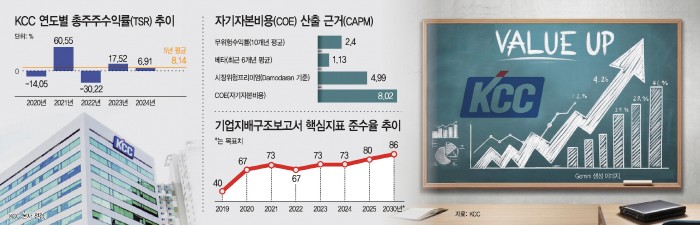 |
KCC has announced its corporate value-up plan, explicitly disclosing its cost of equity (COE)—the minimum rate of return expected by shareholders. This move holds significance as the company did not stop at promising higher dividends, but provided the market with concrete standards by which to evaluate its value-up performance going forward. The COE calculated by KCC stands at 8.02%. Put simply, this means investors expect a minimum annual return of approximately 8% as compensation for taking on the risk of holding KCC stock.
In reality, KCC shareholders earned an average annual Total Shareholder Return (TSR) of 8.14% over the past five years. The actual return achieved by shareholders slightly exceeded the company's calculated minimum expected return by 0.12 percentage points. However, the margin between the two figures remains narrow, and annual returns have fluctuated significantly. Going forward, whether KCC can consistently deliver shareholder returns exceeding 8% is expected to be the core challenge of its value-up strategy.
According to the "2025 Corporate Value-up Plan" released by KCC on July 20, the company calculated its COE using the Capital Asset Pricing Model (CAPM). It applied the recent 10-year average yield on 10-year Treasury bonds of 2.40% as the risk-free rate, alongside a six-year average beta of 1.13 and a market risk premium of 4.99%. By adding the specific risks associated with KCC stock to the Treasury yield, the company derived the rate of return required by shareholders.
It is rare for listed companies to disclose both their COE calculation methodology and detailed underlying assumptions within a value-up plan. Publicizing these details allows investors to independently evaluate whether the target set by the company reasonably reflects market conditions and stock price risks. It also enables shareholders to identify which variables drove any future shifts in the COE.
Alongside the COE, KCC also presented its TSR over the past five years. TSR combines stock price appreciation and dividend yield to represent the overall return realized by shareholders. Even if a company generates high profits, the TSR can remain low if the stock price drops or dividends fall short.
Performance varied unevenly by year. KCC recorded a TSR of negative 14.05% in 2020, 60.55% in 2021, negative 30.22% in 2022, 17.52% in 2023, and 6.91% in 2024. Although the five-year average exceeded the COE, high returns in 2021 played a major role in pulling up the average. The 2024 TSR of 6.91% fell below the currently presented COE.
COE and TSR differ in nature, representing expected return and actual return respectively. The COE serves as a baseline required by investors based on risk, whereas TSR is an outcome realized in the market over a specific period. Thus, a single year of TSR falling short of the COE does not conclusively signify a loss of corporate value. However, if TSR remains continuously below the COE over multiple years, the stock's investment appeal could weaken.
KCC also specified its dividend policy to enhance shareholder returns. The company guaranteed a minimum dividend per share of 6,000 won and decided to add supplementary dividends whenever non-consolidated operating profit exceeds 100 billion won. This structure shares a portion of profits with shareholders once earnings surpass a certain threshold.
Communication with investors will also expand. The company plans to host non-deal roadshows and security firm briefings quarterly, along with over 10 institutional investor meetings monthly. It will also introduce a dedicated hotline for individual shareholders, quarterly IR letters, and monthly IR mailings to mitigate undervaluation caused by information gaps.
A company official stated, "Disclosing the basis for our COE calculation aims to enhance the objectivity and transparency of our value-up goals, while clearly explaining the direction of capital efficiency improvements to the market."
Ultimately, continuity remains key. The fact that the five-year average TSR exceeded the COE does not mean the value-up initiative is complete. Whether KCC can consistently deliver shareholder returns surpassing its COE—backed by stable earnings, predictable dividends, active communication, and governance improvements—will determine the long-term re-evaluation of its corporate value.
Jang Ji-young
Most Read
-
1
Samsung Bioepis and PROTEINA partner to develop AI..

-
2
Iran's IRGC launches airstrikes on U.S. military f..

-
3
Trump imposes new Iran blockade and 20% Hormuz tol..

-
4
Chinese and Russian navies launch joint naval exer..

-
5
Pentagon reports roughly 100 U.S. troops injured i..

-
6
Pyongyang high-level meeting foreshadows brutal pu..

-
7
Germany to provide Ukraine with 50,000 attack dron..

PEOPLE







-
Address : In-Young Bldg., 34, Uisadang-daero 1-gil, Yeongdeungpo-gu, Seoul
Copyright by ASIATODAY CO., LTD. All rights resereved