



Triple pressure of delinquencies, bad debts, and interest rates tests banks's financial soundness
Jul 21, 2026, 09:40 am


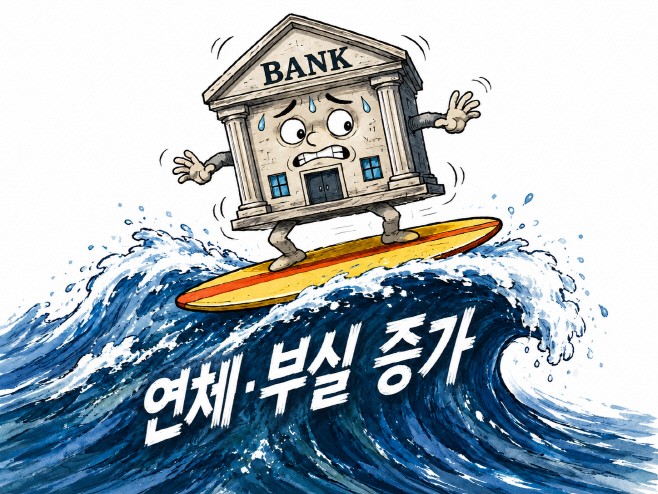 |
| This image was generated by AI. |
Amid growing defaults and non-performing loans (NPLs) concentrated in small and medium-sized enterprise (SME) loans, the Bank of Korea's benchmark interest rate hike has further heightened the burden of asset quality management across the banking sector. While banks need to expedite debt resolution to counter expanding bad loans, taking swift action is proving challenging as conditions in the NPL market deteriorate—evidenced by falling purchase prices. Analysts evaluate that the banking sector now faces a "triple whammy" in asset quality management, driven by a confluence of interest rate hikes, a rise in new bad loans, and delays in resolving existing non-performing assets.
According to the financial sector on July 20, the average corporate loan delinquency rate of the five major commercial banks—KB Kookmin, Shinhan, Hana, Woori, and NH NongHyup—stood at a simple average of 0.47% as of late June. Although this remains on par with the 0.46% recorded at the end of March, it marks a 0.10 percentage point increase from 0.37% at the end of last year. The delinquency rate for SME loans also climbed from 0.49% at the end of last year to 0.59% in June, approaching the 0.6% level.
As the number of marginal companies with diminished repayment capacity expands, non-performing loans are accumulating rapidly. The volume of corporate non-accrual loans held by these five banks surged by more than 500 billion won in just three months, rising from 3.4035 trillion won at the end of last year to 3.9249 trillion won in the first quarter of this year. During the same period, the ratio of corporate substandard-or-below loans also increased from 0.43% to 0.47%. This trend stems from deteriorating corporate financial health, caused by a combination of prolonged high interest rates and pressures from inflation and exchange rates.
However, despite the surge in bad debts, the scale of non-performing loan resolution through write-offs and sales by banks actually declined compared to last year. The total volume of NPLs written off or sold by the five major banks in the first half of this year reached 3.8128 trillion won, down 271.0 billion won from 4.0838 trillion won recorded in the first half of last year. A significant drop in loan sales was the primary driver. While the banks' NPL write-offs stood at 1.4007 trillion won—a modest decrease of 68.4 billion won year-on-year—loan sales fell by 202.6 billion won over the same period to 2.4121 trillion won.
The banking sector attributes this drop to a base effect following proactive measures taken last year against potential corporate defaults. Last year, banks substantially expanded write-offs and sales in anticipation of new bad debts stemming from the termination of COVID-19 financial support measures and vulnerable sectors. Resolving large corporate bad loans—including those related to Homeplus—and major project financing (PF) loan receivables also drove up last year's write-off and sale volumes.
The overall environment for resolving non-performing loans also remains unfavorable. According to Samjong KPMG, the average NPL purchase rate (the ratio of purchase price to principal) fell from 79.5% in 2024 to 70.8% last year, and is estimated to have dropped further to 68.2% in the second quarter of this year. As the purchase rate declines, the losses banks must recognize when selling non-performing loans increase, creating stronger incentives for banks to delay sales or pursue internal recovery instead.
The key concern is that the Bank of Korea's recent rate hike increases the likelihood of additional defaults, particularly among vulnerable businesses. The Bank of Korea estimates that a 0.25 percentage point rise in the benchmark rate increases the annual interest burden on corporations by 3.6 trillion won. With SMEs' repayment capacity already weakened, concerns are mounting that an added interest burden could worsen financial soundness and trigger a new wave of defaults.
Han Sang-wook
Most Read
-
1
Celltrion’s Omlyclo gains ground in major European..

-
2
Trump demands rates fall below 1% as Fed hikes for..

-
3
U.S. strikes 3 Iranian oil tankers, Iran vows reta..

-
4
Trump makes $1 trillion bet ahead of midterm elect..

-
5
Iran resumes ballistic missile production, assembl..

-
6
Samsung Electronics, Mistral AI to jointly develop..

-
7
Trump warns countries not helping U.S. must pay re..

PEOPLE







-
Address : In-Young Bldg., 34, Uisadang-daero 1-gil, Yeongdeungpo-gu, Seoul
Copyright by ASIATODAY CO., LTD. All rights resereved