



Chey Tae-won warns memory race has begun, calling supply expansion vital for Korea
Jul 20, 2026, 10:03 am


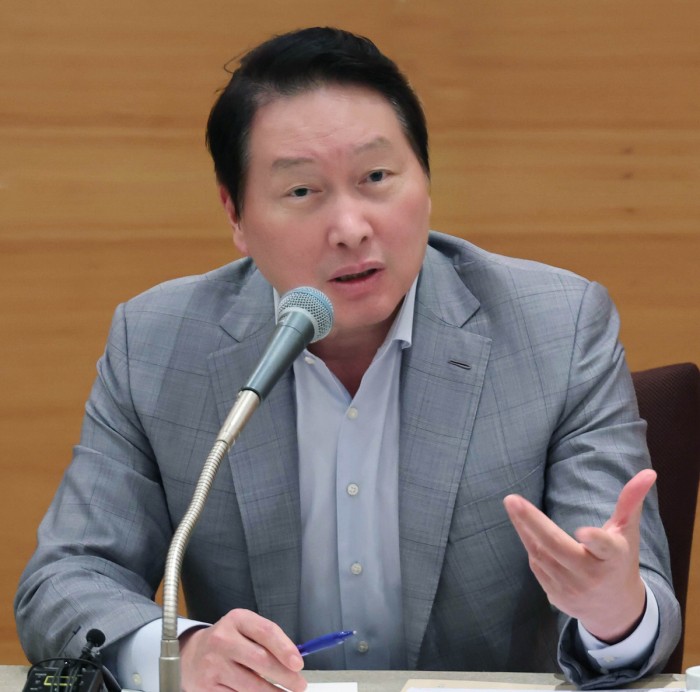 |
| Chey Tae-won, Chairman of the Korea Chamber of Commerce and Industry (KCCI), held a press conference at the KCCI Jeju Forum on July 15. / Courtesy of KCCI, Yonhap News |
Chey Tae-won, Chairman of the Korea Chamber of Commerce and Industry (and Chairman of SK Group), emphasized that the global memory semiconductor shortage fueled by the AI boom is escalating into a national security issue, stressing the need to expand both domestic and overseas production capacity as rapidly as possible. He also made it clear that stabilizing the market through supply expansion, rather than short-term price increases, is the sustainable growth strategy for the South Korean semiconductor industry.
According to industry sources on July 19, Chairman Chey stated during a press conference at the KCCI Jeju Forum on July 15, "Demand for AI semiconductors is expected to increase by at least 60 to 100 percent next year, and overall semiconductor demand will also rise by more than 50 to 60 percent." He added, "On the other hand, there is almost no increase in supply, so the supply-demand gap is bound to widen further next year."
Diagnosing the current market situation, he noted, "We are facing immense lobbying and pressure. It has come to a point where not only corporations but also governments must secure memory semiconductors to supply to their domestic companies. The pressure between governments is likely to grow even stronger in the future."
Regarding U.S. Commerce Secretary Howard Lutnick's recent demand for South Korean chipmakers to invest in the U.S., Chey remarked, "This is nothing new," and added, "We must ramp up production as quickly as possible. We need to invest in locations where factories can be built the fastest and on the largest scale globally, including both South Korea and the United States."
However, he drew the line at the notion that rising semiconductor prices are entirely positive for the industry. "Current prices are abnormally high," Chey said. "If chipflation intensifies, the entire market will ultimately take a hit." He went on to emphasize, "Increasing supply to stabilize prices is actually the way to expand the industry. If we only raise prices without increasing production capacity, the market will shrink and new competitors will enter."
Chey pointed out that his biggest concern at the moment is that "demand is exploding to the extent that prices may not drop sufficiently even if we increase supply." He explained that this supply-demand imbalance is precisely why SK Hynix is moving up the construction schedule for the Yongin Semiconductor Cluster and exploring overseas production hubs.
Following memory semiconductors, Chey identified power infrastructure as the next bottleneck for the AI industry. "Electrical equipment is already in short supply," he said. "There is a high probability that power lines, cabling materials, and even submarine cables will face shortages." He stressed, "The competitiveness of an AI data center is not determined by power plants alone. Establishing the power grid, including substations, transmission networks, and transformers, will be the core challenge."
He expressed confidence in AI data center investment plans. Regarding an ongoing mega-scale AI data center project, he explained, "The fact that the project has commenced means that long-term contracts with customers, equipment, power, and sites have already been fully secured. It will mark the first step toward an electrified society in the AI era."
On that day, Chey also shared his thoughts on the 52-hour workweek, stating, "Applying the exact same rule to all industries and job categories creates areas that do not align with reality," and noted, "A balanced social consensus is needed between worker protection and industrial competitiveness." Furthermore, regarding corporate growth policies, he argued, "The current system is structured to support small businesses but only increases burdens once they grow past a certain size. There should be proportional rewards for companies that increase revenue, investment, and employment."
Chey concluded by emphasizing, "If we want growth, we must align our systems with growth. For the South Korean economy to grow continuously, we must first create an environment where corporations can scale up."
Kim Young-jin
Most Read
-
1
Samsung Bioepis and PROTEINA partner to develop AI..

-
2
Iran's IRGC launches airstrikes on U.S. military f..

-
3
Trump imposes new Iran blockade and 20% Hormuz tol..

-
4
Netanyahu requests Trump to halt F-35 sales to Tur..

-
5
Samsung Electronics sets record with 89.4 trillion..

-
6
Chinese and Russian navies launch joint naval exer..

-
7
Pyongyang high-level meeting foreshadows brutal pu..

PEOPLE







-
Address : In-Young Bldg., 34, Uisadang-daero 1-gil, Yeongdeungpo-gu, Seoul
Copyright by ASIATODAY CO., LTD. All rights resereved