



North Korea steps up bloc-building efforts to counter US-South Korea-Japan cooperation
Jul 20, 2026, 10:06 am


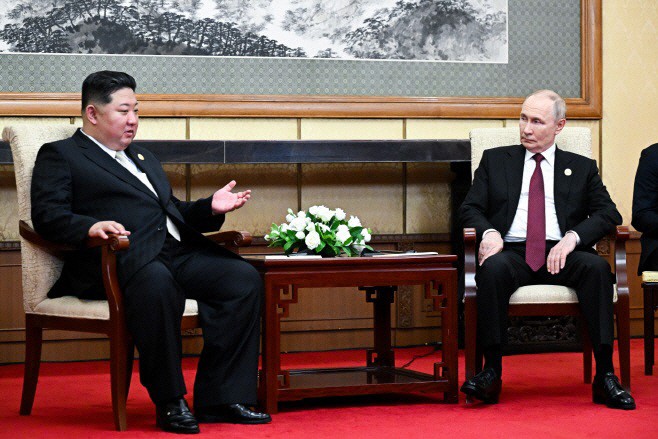 |
| North Korean Leader Kim Jong-un (left) and Russian President Vladimir Putin hold a bilateral summit at the Diaoyutai State Guesthouse in Beijing on September 3, 2025, ahead of a military parade marking the 80th anniversary of China's Victory Day. / TASS, Yonhap News |
North Korea has recently flaunted its close ties with Beijing on the occasion of the 65th anniversary of the signing of the North Korea-China Treaty of Friendship, Cooperation, and Mutual Assistance, while simultaneously dispatching Foreign Minister Choe Son-hui to Russia to manage its relations with Moscow. This sequence of moves is interpreted as an intentional effort by Pyongyang to counter the trilateral cooperation between South Korea, the United States, and Japan—which recently expanded its scope to include an SMR (Small Modular Reactor) Strategic Export Alliance—by solidifying a North Korea-China-Russia bloc and showcasing Beijing and Moscow as its geopolitical backings.
According to the Korean Central News Agency (KCNA) on July 19, Foreign Minister Choe Son-hui departed Pyongyang on a private jet the previous day at the invitation of Russian Foreign Minister Sergey Lavrov. The state media did not disclose the specific purpose or itinerary of Choe’s visit. Prior to this, the Russian Foreign Ministry also announced that Choe was arriving in Russia on an official visit starting July 18 (local time). This trip marks Choe's first visit to Russia in about nine months; her previous trip in October last year was a working visit—a lower diplomatic protocol than the current official visit—during which she traveled to Moscow to deliver a speech at a Eurasian international security conference. This also represents the first high-level exchange between Pyongyang and Moscow since the completion ceremony of the North Korean Troop Deployment Memorial Hall in Russia back in April.
Choe’s current visit to Russia is drawing significant attention because it takes place in the absence of any special anniversaries or pre-scheduled diplomatic events between the two nations. Analysts suggest the trip may be aimed at pre-arranging a potential visit by North Korean leader Kim Jong-un to Russia. Russian President Vladimir Putin has repeatedly invited Kim to visit Russia, notably during the North Korea-Russia summit in June 2024 and the Victory Day military parade in China in September last year, making it highly probable that discussions on this matter will take place. Furthermore, observations indicate that Choe might brief Moscow on the recently tightened North Korea-China relations and discuss matters requiring trilateral coordination, such as the issue of securing Chinese and Russian access to the East Sea via the Tumen River.
Park Won-gon, a professor at Ewha Womans University, analyzed, "For North Korea, it is far easier to achieve military and diplomatic milestones rather than economic results. If a visit to Russia by Kim Jong-un follows President Xi Jinping's visit to Pyongyang, it can be touted as a massive achievement, suggesting this trip serves to coordinate Kim's travel to Russia." Professor Park added, "While substantial trilateral cooperation among North Korea, China, and Russia has faced friction in the past, the Tumen River Project could serve as a catalyst for practical three-way cooperation."
Regarding North Korea-China relations, cooperation is expected to expand across all fronts—including the economy, science and technology, healthcare, and culture—following the latest visit to Pyongyang by Wang Huning, Chairman of the National Committee of the Chinese People's Political Consultative Conference. Notably, Chairman Wang toured the Wonsan-Kalma Coastal Tourist Zone, a massive resort complex developed by North Korea, before returning to China. Given past concerns that relying solely on Russian tourists would leave the Wonsan-Kalma complex operating at a deficit, it is highly anticipated that talks on this matter took place. Tourism to North Korea is generally not viewed as a violation of UN sanctions, meaning Beijing faces less of a political burden in providing support in this area.
Oh, a senior research fellow, noted, "Attracting Chinese tourists is an avenue that avoids UN Security Council sanctions, making it a vital issue for North Korea. To vitalize the Wonsan-Kalma Coastal Tourist Zone, a massive influx of Chinese tourists is essential, which suggests bilateral discussions on this topic have likely been ongoing."
Assessments also show that North Korea is increasingly focusing not just on its diplomacy with China and Russia, but also on expanding ties with the Global South.
In a recent report titled Significance and Implications of North Korea's Post-COVID-19 Diplomacy in Southeast Asia, Seo Bo-hyuk, a senior research fellow at the Korea Institute for National Unification (KINU), and Seo Eun-sung, a specialized researcher, analyzed that "among North Korea's external moves since the pandemic, the diplomatic weight given to Global South nations has been rising."
According to the report, North Korea engaged in 51 diplomatic interactions with the Global South post-COVID-19: 23 in Asia, 3 in the Middle East and Africa, 3 in Latin America, and 22 listed as others. Within this framework, diplomatic efforts targeting Vietnam and Laos have stood out prominently. Senior Research Fellow Seo Bo-hyuk advised, "For the Kim Jong-un regime, diplomacy with China and Russia shares anti-Western sentiments and carries a high necessity for mutual cooperation, but a latent concern over dependency remains, creating a need for complementary diplomatic options. We must monitor the future status and direction of North Korea's Southeast Asian diplomacy and prepare appropriate responses."
Mok Yong-jae
Most Read
-
1
Celltrion nears additional contract with major U.S..

-
2
Putin proposes trilateral U.S.-China-Russia summit..

-
3
U.S. weighs dropping MOAB, world's most powerful n..

-
4
"Aren't those foreigners on welfare?": M..

-
5
Attention centers on APEC for possible Trump-Xi-Pu..

-
6
Saudi Arabia, Iran hold first diplomatic talks to..

-
7
China tightens grip on boosting domestic demand an..

PEOPLE






-
Address : In-Young Bldg., 34, Uisadang-daero 1-gil, Yeongdeungpo-gu, Seoul
Copyright by ASIATODAY CO., LTD. All rights resereved