



Indonesian caterers protest free school lunch cuts, threaten legal action
Jul 15, 2026, 03:10 pm


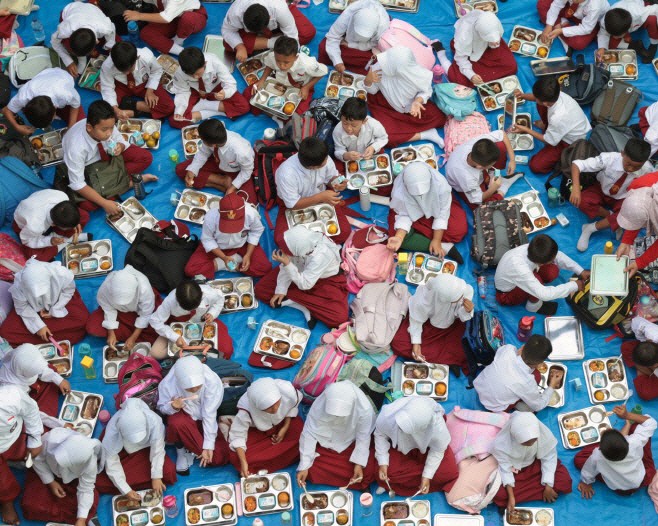 |
| Students eating free nutritious meals provided by the government at an elementary school in Indonesia in January of last year. / Photo by EPA, Yonhap. |
As Indonesia's free school lunch program—the flagship policy of President Prabowo Subianto—is drastically downsized amid corruption allegations and budget waste, catering operators are demanding the return of their investments and threatening legal action.
According to reports by Reuters and local media on July 15, three associations representing Indonesian catering operators attended a parliamentary hearing yesterday to protest the government's moratorium on building new kitchen centers.
Currently, around 28,000 kitchen centers are operating across Indonesia, but the National Nutrition Agency (BGN) has temporarily halted the construction of 13,000 new facilities. On top of that, the Indonesian government is considering plans to slash the budget by over $2 billion by reducing both the number of beneficiaries and kitchen centers.
Catering representatives complained that they built the facilities and even secured operating permits at the request of the BGN, but now cannot start operations due to the moratorium. Yusuf Supriyadi, head of the Kitchen Partners Association, pointed out that the BGN requested them to build the facilities and approved the permits, only to block their operations, urging that the government should support them rather than drive them into bankruptcy. The three groups stated that if they do not receive their investments back or are not allowed to operate, they will consider legal action against the BGN.
According to sources, operators in remote areas spent at least 1.5 billion rupiahs per facility, having to secure funds through bank loans or by selling their assets. While 1,200 kitchen centers in remote areas are already fully prepared to run, they remain idle due to the moratorium. Operators are urging the government to let already-approved facilities operate, stating that if they cannot run them, they should at least get their investments back.
Indonesia's free school lunch program was President Prabowo's key campaign pledge, aiming to prevent malnutrition and stunting among 83 million students, pregnant women, and toddlers. The budget for this year alone reaches $15 billion.
However, since its rollout in January of last year, the program has faced continuous criticism over poor management and a lack of budget transparency. Early last month, three former BGN officials were arrested by prosecutors on charges of inflating budgets and corruption during the construction of kitchen centers. Zulkifli Hasan, Coordinating Minister for Food Affairs, also pointed out that the number of kitchen centers swelled from the initial 21,000 to 27,877, with unlicensed operations wasting more than 1 trillion rupiahs every month.
Despite the backlash, the Indonesian government maintains that it will restructure the program rather than scrap it. State Secretary Prasetyo Hadi announced last month that the government would prioritize support for underdeveloped and remote areas while expanding the target audience from students to pregnant women and toddlers. However, university students and civic groups are staging protests in several cities calling for the program's abolition, calling it a major driver of the fiscal crisis, which is adding to the political burden.
Experts predict that since this program is President Prabowo's signature policy, a complete shutdown is unlikely because the resulting political blow would be too severe. However, some point out that real improvements cannot be made without a temporary halt. Agus Sarwono, a researcher at Transparency International Indonesia, argued that if a car breaks down, it must go to a repair shop first, as you cannot fix it while driving, and urged a 30-day suspension of kitchen center operations to conduct a comprehensive audit.
Jeong Ri-na
Most Read
-
1
Celltrion’s Omlyclo gains ground in major European..

-
2
Trump demands rates fall below 1% as Fed hikes for..

-
3
Trump makes $1 trillion bet ahead of midterm elect..

-
4
Iran resumes ballistic missile production, assembl..

-
5
Samsung Electronics, Mistral AI to jointly develop..

-
6
Trump warns countries not helping U.S. must pay re..

-
7
Apple launches first foldable, 1 million won prici..

PEOPLE






HEADLINE NEWS
- Trump to roll out ‘unprecedented welcome’ for Xi with B-2 bombers, F-22 fighters
- S. Korea, U.S., and Japan form united front on Taiwan and economic coercion..
- Trump administration moves to impose sweeping sanctions on International Cr..
- Xi to make state visit to U.S. Sept. 23-25, dispelling rumors over his heal..

-
Address : In-Young Bldg., 34, Uisadang-daero 1-gil, Yeongdeungpo-gu, Seoul
Copyright by ASIATODAY CO., LTD. All rights resereved