



Trump reinstates Iran blockade while dropping Strait of Hormuz toll
Jul 15, 2026, 09:20 am


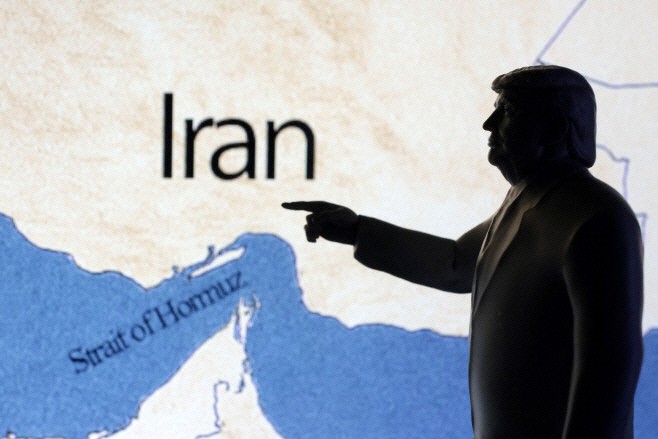 |
| An illustration taken on June 22 (local time) shows a 3D-printed miniature of U.S. President Donald Trump set against a map displaying the Strait of Hormuz and Iran. / Photo courtesy of Reuters, Yonhap News |
U.S. President Donald Trump announced on July 14 (local time) that he is dropping his proposal to levy a 20% toll on the value of cargo transiting the Strait of Hormuz just one day after its introduction, opting instead to replace it with trade and investment agreements with Gulf nations.
Meanwhile, the U.S. Central Command (CENTCOM) reinstated a maritime blockade on vessels traveling to and from Iranian ports and coasts starting at 4:00 p.m. on the same day (5:00 a.m. on July 15, KST) and launched additional airstrikes in southern Iran. In response, Iran attacked U.S. military facilities within airbases in Bahrain and Kuwait, as well as tankers linked to the United Arab Emirates (UAE), pushing the implementation of the ceasefire memorandum of understanding (MOU) that took effect on June 18 to the brink of collapse.
Trump drops 20% Hormuz toll at Gulf nations' request, replacing it with US investment pacts
President Trump wrote on his social media platform, Truth Social, that the "20% United States Reimbursement Fee" would be replaced by trade and investment agreements with Gulf nations. During a White House meeting with Iraqi Prime Minister Ali Al-Zaidi, Trump explained that the leaders of Saudi Arabia, the UAE, Qatar, Bahrain, and Kuwait had requested an alternative approach. The scale of the new investments and specific commitments remain unconfirmed. U.S. Energy Secretary Chris Wright told CNBC that the toll proposal is now "off the table."
The International Maritime Organization (IMO), a United Nations agency, stated that there is no legal basis to levy mandatory transit fees on vessels merely passing through straits used for international navigation.
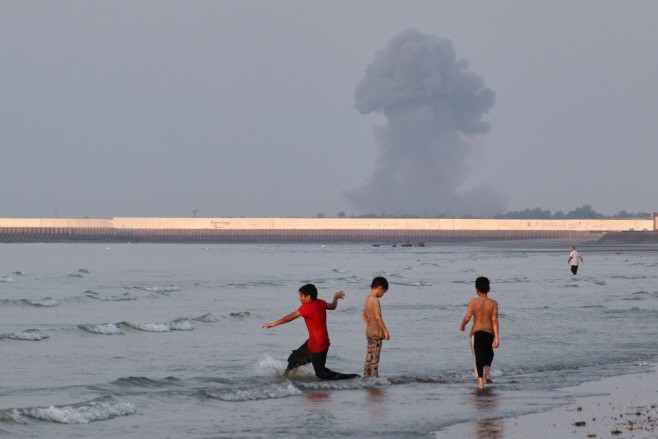 |
| Iranian boys and a man play in the shallow waters of the Strait of Hormuz off Bandar Abbas, Iran, on July 13 (local time), as a plume of smoke from an explosion billows in the background. / Photo courtesy of AP, Yonhap News |
CENTCOM launches additional airstrikes one hour before blockade: Southern Iranian coastal cities hit repeatedly
U.S. Central Command (CENTCOM) announced on X (formerly Twitter) that it initiated additional airstrikes at 3:00 p.m.—one hour before the blockade took effect—to degrade Iran's capability to attack merchant vessels. Iranian authorities reported that strikes hit four locations in Bushehr, as well as Bandar Abbas, Qeshm Island, Sirik, Abadan, and Mahshahr. Reuters reported that the U.S. military continued its night raids for a fourth consecutive day, while the Financial Times (FT) identified this latest operation as the seventh wave of airstrikes.
In tandem with the military action, the U.S. Department of the Treasury's Office of Foreign Assets Control (OFAC) imposed additional sanctions targeting over 50 individuals, entities, and vessels linked to the sanctions-evading shipping network of Iranian shipping tycoon Mohammad Hossein Shamkhani. The Treasury also issued general licenses for certain sanctioned individuals and vessels, permitting limited transactions for winding down existing operations, addressing safety and environmental concerns, and offloading cargo.
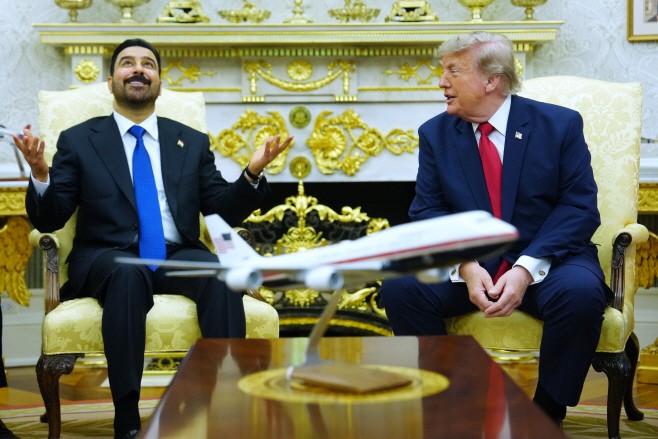 |
| U.S. President Donald Trump (right) meets with Iraqi Prime Minister Ali Al-Zaidi in the Oval Office of the White House in Washington, D.C., on July 14 (local time). / Photo courtesy of AP, Yonhap News |
IRGC attacks U.S. military facilities inside airbases in Bahrain and Kuwait
The Islamic Revolutionary Guard Corps (IRGC) claimed that in its third wave of attacks under "Promise 2," it struck weapon and parts storage facilities at Sheikh Isa Air Base in Bahrain and a U.S. military MQ-9 drone operations area at Ali Al Salem Air Base in Kuwait. Kuwait reported detecting and intercepting one ballistic missile, five cruise missiles, and 33 drones, adding that one navy vessel was damaged and four soldiers were injured. Bahrain and Jordan also announced that they had intercepted attacks originating from Iran.
The UAE stated that the oil tankers Mombasa and Al Bahiyah, which were sailing through Omani territorial waters, were struck by Iranian cruise missiles, leaving one Indian crew member dead and eight others injured. The Wall Street Journal (WSJ) reported that both vessels were deployed for "shuttle runs" transporting Gulf crude oil out of the strait, and noted that such shipping operations have severely contracted.
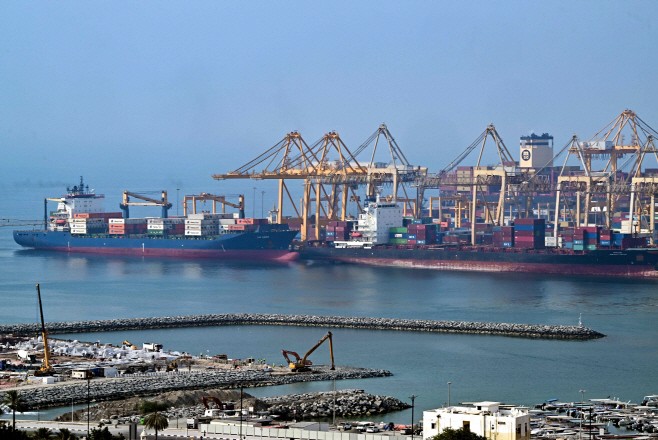 |
| Vessels dock at the berths of the Khor Fakkan Container Terminal on July 14 (local time), one of the main container ports in the Emirate of Sharjah along the Gulf of Oman and the only natural deep-water harbor in the region. / Photo courtesy of AFP, Yonhap News |
Strait of Hormuz transit drops to 10 ships daily and Brent crude rises 1.7% to 84.73 dollars
Due to these ongoing clashes the number of vessels passing through the Strait of Hormuz plummeted to just 10 on July 13. This is only about 8% of the pre-war level of approximately 130 ships a day. Even with the toll proposal dropped, the maritime blockade and tanker attacks continue, delaying any quick normalization of traffic in the strait. Currently, Iran is targeting any vessel that veers off its designated shipping lanes, while the U.S. has restricted its blockade only to ships linked to Iranian ports and cargo.
Reflecting this tension, Brent crude for September delivery rose 1.7% to 84.73 dollars (126,332 won) per barrel. Meanwhile, U.S. West Texas Intermediate (WTI) for August delivery increased 1.5% to 79.34 dollars (118,296 won).
Senate Democrats block debate on 1.14-trillion-dollar defense budget in 50-to-46 vote
At home, President Trump is facing a major political backlash. Senate Democrats, protesting the war with Iran, blocked the start of floor debate on the 1.14-trillion-dollar (1,699.17 trillion won) National Defense Authorization Act (NDAA). The procedural vote ended 50 to 46, failing to reach the 60 votes required to move the bill forward.
Chuck Schumer, the Senate Democratic Leader, criticized the defense bill, saying it must not become a "permission slip" for President Trump's reckless military actions in Iran. On the other side, Republicans blasted the Democrats for tying a vital national security bill to the conflict with Iran.
Ha Man-joo
Most Read
-
1
Celltrion’s Omlyclo gains ground in major European..

-
2
Trump demands rates fall below 1% as Fed hikes for..

-
3
Trump makes $1 trillion bet ahead of midterm elect..

-
4
Iran resumes ballistic missile production, assembl..

-
5
Samsung Electronics, Mistral AI to jointly develop..

-
6
Trump warns countries not helping U.S. must pay re..

-
7
Apple launches first foldable, 1 million won prici..

PEOPLE






HEADLINE NEWS
- Trump to roll out ‘unprecedented welcome’ for Xi with B-2 bombers, F-22 fighters
- S. Korea, U.S., and Japan form united front on Taiwan and economic coercion..
- Trump administration moves to impose sweeping sanctions on International Cr..
- Xi to make state visit to U.S. Sept. 23-25, dispelling rumors over his heal..

-
Address : In-Young Bldg., 34, Uisadang-daero 1-gil, Yeongdeungpo-gu, Seoul
Copyright by ASIATODAY CO., LTD. All rights resereved