



The question raised by Samsung’s bonuses: How far should companies share excess profits?
Jul 15, 2026, 09:45 am


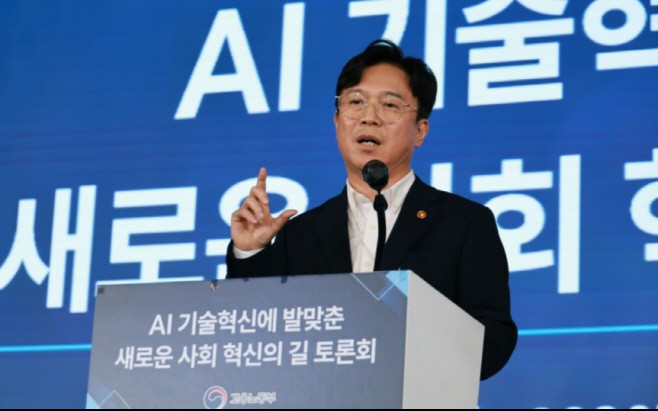 |
| Minister of Employment and Labor Kim Young-hoon delivers opening remarks during a forum titled "The Path to New Social Innovation in Step with AI Technological Innovation" held at Peace & Park Convention in Seoul on the afternoon of July 14. / Photo by Reporter Kim Bo-young |
An official forum has been launched to address how to socially share the excess profits and achievements generated by the expansion of Artificial Intelligence (AI), including the distribution of excess semiconductor profits—a debate sparked by the recent bonus conflict between Samsung Electronics' management and labor.
The Ministry of Employment and Labor held a forum under the theme "The Path to New Social Innovation in Step with AI Technological Innovation" at Peace & Park Convention in Seoul on the afternoon of July 14.
The forum was organized to identify and bring to public attention the questions our society must answer. It brought together labor, management, and experts from various fields—including economics, management, welfare, and labor—along with lawmakers to discuss tasks in diverse areas such as labor, welfare, industry, and social safety nets amidst the civilizational shift of the AI era.
"It is difficult to encompass the new era with the existing grammar established during the industrialization era," Minister of Employment and Labor Kim Young-hoon said in his opening remarks. "We need a new social contract for humanity tailored to the AI era. In discussions for this new social contract, the government will not act as a referee holding the correct answer, but as a facilitator of dialogue to bring forth creative alternatives."
He further stressed, "We must build this through social dialogue that includes not only labor and management circles, but also youth, unorganized workers, and people in new forms of work who have previously struggled to make their voices heard."
The discussion was moderated by Kang Sung-jin, president of the Korean Economic Association and economics professor at Korea University. Presentation sessions were led by Representative Cha Ji-ho of the Democratic Party of Korea, Professor Jeong Heung-jun of Seoul National University of Science and Technology, and Professor Yoon Dong-yeol of Konkuk University, followed by panel discussions among labor, management, and experts.
"In the industrial structure transforming through AI, mega-corporations with technological prowess are now able to generate massive profits, making the redistribution of corporate gains difficult through traditional collective bargaining alone," said Professor Jeong Heung-jun of Seoul National University of Science and Technology during his presentation. "We need a new social contract on how to share the excess profits of corporations."
He added, "Special taxes collected from specific industries can be used solely for designated purposes, such as R&D investment within the industry, modernization of industrial complexes, youth employment, and improving the welfare of subcontracted and small business workers, thereby enhancing industrial competitiveness."
Professor Jeong also proposed reviewing a special purpose tax on excess manufacturing profits to realize the spirit of a social solidarity wage, considering the establishment of a national wage committee, fleshing out the principle of equal pay for equal work, and distributing bonuses based on net income.
Conversely, Professor Yoon Dong-yeol of Konkuk University agreed with the view that the arrival of the AI era could exacerbate polarization between industries and the dual structure of the labor market. However, he pointed out that the proposed social solidarity wage is highly likely to cause side effects rather than solve problems, given Korea's complex industrial structure and labor-management realities. He emphasized, "Instead of unilaterally accepting either side's demands, we must build a package deal that exchanges flexibility for security."
Meanwhile, the Ministry of Employment and Labor plans to continue gathering feedback from the field regarding industrial and labor transitions in the AI era, using this forum as a starting point. On July 15, the Ministry of Trade, Industry and Energy will host a forum titled "Corporate Investment and the Future of Labor in the AI Era."
Furthermore, starting next month, a discussion body consisting of labor and management groups, experts, youth, and platform workers will be formed to intensively discuss various issues that may arise in the era of AI-driven industrial transition. Additionally, the ministry plans to establish a green paper discussion body to publish a question-oriented document by the end of the year and promote related social dialogue. A green paper is a public consultation document issued by the government to propose policy agendas and gather feedback before finalizing policy directions.
Kim Bo-young
Most Read
-
1
Celltrion nears additional contract with major U.S..

-
2
Putin proposes trilateral U.S.-China-Russia summit..

-
3
U.S. weighs dropping MOAB, world's most powerful n..

-
4
"Aren't those foreigners on welfare?": M..

-
5
Attention centers on APEC for possible Trump-Xi-Pu..

-
6
Saudi Arabia, Iran hold first diplomatic talks to..

-
7
China tightens grip on boosting domestic demand an..

PEOPLE







-
Address : In-Young Bldg., 34, Uisadang-daero 1-gil, Yeongdeungpo-gu, Seoul
Copyright by ASIATODAY CO., LTD. All rights resereved