



Next year's minimum wage set at 10,700 won, up 3.7 percent from this year
Jul 15, 2026, 09:36 am


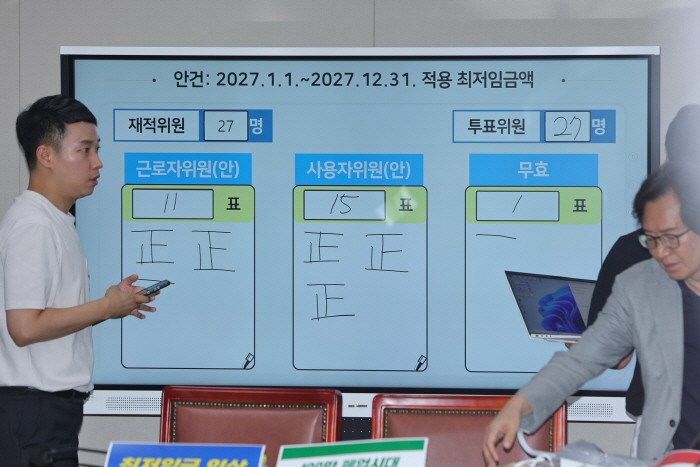 |
| The voting results are displayed on the screen inside the meeting room at the government complex in Sejong on July 14, after next year's minimum wage was finalized at 10,700 won per hour during the 14th plenary session of the Minimum Wage Commission. |
The minimum wage for next year has been set at 10,700 won per hour, an increase of 380 won, or 3.7 percent, from this year.
The Minimum Wage Commission held its 14th plenary session at the government complex in Sejong on July 14 and voted to set the minimum wage for 2027 at 10,700 won per hour. Based on a 40-hour workweek and 209 hours per month, this translates to a monthly wage of 2,236,300 won, representing an increase of 79,420 won from this year's monthly figure of 2,156,880 won.
In their initial proposals, the labor circle demanded 12,000 won, a 16.3 percent increase from this year, while the management circle proposed a freeze at 10,320 won. The initial gap of 1,680 won was narrowed down to 130 won through twelve rounds of revised proposals. In the 12th revision, labor proposed 10,770 won, while management proposed 10,640 won.
To facilitate an agreement between the two sides, the public interest members recommended an hourly rate of 10,720 won, a 3.9 percent increase from this year, but no consensus was reached. Subsequently, the gap narrowed further to 30 won as labor put forward a final offer of 10,730 won and management proposed 10,700 won, leading to a vote on the two final proposals.
The vote resulted in 11 votes for the labor members' proposal and 15 votes for the user members' proposal, with one vote ruled invalid, finalizing the decision at the user members' proposal of 10,700 won. All 27 members, representing labor, management, and public interest, participated in the vote.
"It is highly regrettable that we could not reach an agreement despite the gap between the final proposals being narrowed to 30 won, and I feel a sense of responsibility as the chairperson," said Kwon Soon-won, chairperson of the Minimum Wage Commission. "However, I believe a vote taken with a mere 30-won difference is practically equivalent to reaching an agreement."
The business community evaluated that even a 3.7 percent increase poses a heavy burden considering the payment capabilities of small business owners and small and medium-sized enterprises. "There is a wide gap between the decided figure and the reality on the ground," said Ryu Ki-jung, executive director of the Korea Enterprises Federation. "While 3.7 percent is still a high level, we respected the process of negotiation between labor and management."
The labor circle protested the decision, arguing that it fails to reflect the livelihood realities of low-wage workers. "Given the recent inflation and rising cost of living felt by citizens, a 3.7 percent increase is practically close to a freeze," said Ryu Ki-seop, secretary general of the Federation of Korean Trade Unions. "It falls far short of restoring the livelihood-guaranteeing function of the minimum wage." Lee Mi-seon, vice president of the Korean Confederation of Trade Unions, also remarked, "This figure does not even reach the compromise proposal suggested by the public interest members. We have no choice but to evaluate that the public interest members have represented the position of the business community."
The minimum wage proposal approved by the commission will be submitted to the Minister of Employment and Labor. The minister will finalize and officially announce next year's minimum wage by August 5, following a process for filing objections.
Kim Nam-hyeong
Most Read
-
1
Celltrion nears additional contract with major U.S..

-
2
Putin proposes trilateral U.S.-China-Russia summit..

-
3
U.S. weighs dropping MOAB, world's most powerful n..

-
4
"Aren't those foreigners on welfare?": M..

-
5
Attention centers on APEC for possible Trump-Xi-Pu..

-
6
Saudi Arabia, Iran hold first diplomatic talks to..

-
7
China tightens grip on boosting domestic demand an..

PEOPLE






-
Address : In-Young Bldg., 34, Uisadang-daero 1-gil, Yeongdeungpo-gu, Seoul
Copyright by ASIATODAY CO., LTD. All rights resereved