



Tapping into retirement funds for the stock rally: Pension insurance cancellations surge 62%
Jul 14, 2026, 09:45 am


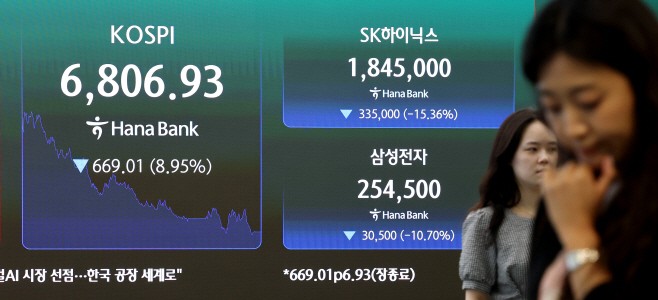 |
| The stock prices of KOSPI, SK Hynix, and Samsung Electronics are displayed at the Hana Bank dealing room in Jung-gu, Seoul, on July 13. / Photo courtesy of Yonhap News Agency |
Cancellations of pension savings insurance and redemptions of investment funds have broken records this year. The number of pension savings insurance cancellations surged by more than 60% compared to the same period last year, with the total amount of surrendered cash values exceeding 1.7 trillion won. Concerns are growing that the drainage of long-term retirement assets amid heightened stock market volatility could undermine individual investors' wealth-building foundations.
According to data submitted by Representative Song Un-seok of the People Power Party—a member of the National Assembly’s National Policy Committee—to the Financial Supervisory Service and the Korea Securities Depository on July 14, the total number of pension savings insurance cancellations from January to May this year reached 72,477. This marks a 62.7% increase from the 44,554 cases recorded during the same period last year. The total amount of surrender values paid out also jumped sharply by 54.8%, rising from 1.1252 trillion won in the first five months of last year to 1.7421 trillion won during the same period this year.
Fund redemptions saw a similar upward trend. The number of fund redemptions between January and May hit 1,809,183 cases, up 47.3% from the previous year’s 1,228,186 cases. During the same period, the total redemption value spiked by 146.1%, skyrocketing from 1,132 trillion won to 2,786.2 trillion won.
The massive capital outflow is largely interpreted as a shift toward the stock market, driven by high expectations surrounding the sustained KOSPI rally during the first half of the year. Retail investors' net purchases on the KOSPI from January to June exploded by 1,423.7% to 161.12 trillion won, compared to just 10.574 trillion won the previous year. This catalyzed a distinct "money move" phenomenon, drawing liquidity away from bank deposits and savings into the stock market.
The primary issue is that the recent spike in domestic market volatility has heightened the risk of losses for retail investors. Out of 13 circuit breakers triggered in the history of the domestic bourse, seven were concentrated in the first half of this year alone. Sidecars were activated a total of 35 times on the KOSPI (17 buy sidecars and 18 sell sidecars) and 18 times on the KOSDAQ (11 buy sidecars and 7 sell sidecars), reflecting the highly unstable trading environment. In fact, the KOSPI, which had crossed the 9,000 threshold through June, plummeted to close at 6,806.63 on July 13, while the KOSDAQ fell below the 800 mark to finish at 799.36.
"Lately, many citizens have canceled their pension savings insurance and redeemed their funds to dive into the stock market, yet the market's swelling volatility is now threatening their retirement security," Rep. Song stated. "Instead of clinging to short-term stock market stimulus measures, the government must foster a stable investment climate through consistent policies that can win the market's trust."
Han Sang-wook
Most Read
-
1
Celltrion’s Omlyclo gains ground in major European..

-
2
Trump demands rates fall below 1% as Fed hikes for..

-
3
Hyundai Motor Group breaks ground on integrated st..

-
4
U.S. strikes 3 Iranian oil tankers, Iran vows reta..

-
5
Trump makes $1 trillion bet ahead of midterm elect..

-
6
Iran resumes ballistic missile production, assembl..

-
7
Samsung Electronics, Mistral AI to jointly develop..

PEOPLE







-
Address : In-Young Bldg., 34, Uisadang-daero 1-gil, Yeongdeungpo-gu, Seoul
Copyright by ASIATODAY CO., LTD. All rights resereved