



U..S-Japan-ROK SMR alliance counters China and Russia, drawing support from Indo-Pacific states
Jul 14, 2026, 09:11 am


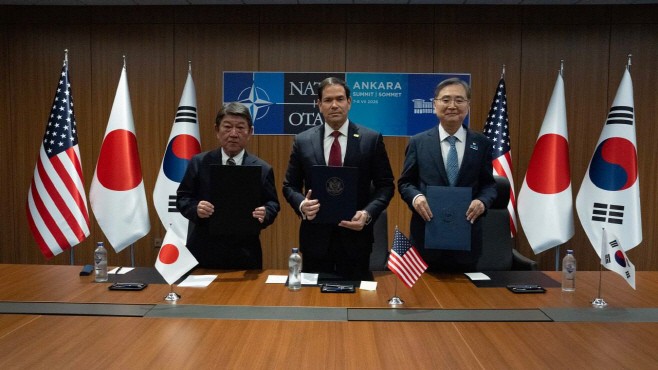 |
| Foreign Ministers from the U.S., Japan, and South Korea signed a Memorandum of Cooperation (MOC) regarding the deployment of Small Modular Reactors (SMRs) on the sidelines of the NATO summit on July 7 (local time). / Courtesy of the Ministry of Foreign Affairs |
U.S.-Japan-ROK forge 'SMR strategic alliance' against China and Russia, welcomed by some Indo-Pacific nations
Immediately following the signing of a Memorandum of Cooperation (MOC) on Small Modular Reactor (SMR) deployment during a trilateral foreign ministers' meeting at the NATO summit, several nations in the Indo-Pacific region have reportedly expressed keen interest.
"Following the signing of this MOC, we have confirmed welcoming responses through multiple diplomatic channels," a Ministry of Foreign Affairs official told reporters on July 13. "Discussions are currently underway with one specific Indo-Pacific nation regarding the U.S.-Japan-ROK consortium."
The trilateral agreement, which has been under discussion since the first half of last year and culminated at the recent NATO summit, primarily aims to provide government-level support for enterprises entering the SMR market. As a next-generation power source, SMRs offer shorter construction periods and lower initial investment burdens compared to conventional large-scale nuclear plants. The SMR market is projected to more than double by 2040, accounting for over 30% of global nuclear power demand.
"This MOC focuses on establishing a governmental foundation to support corporate activities, and it will not interfere with any ongoing civil nuclear projects pursued by individual nations or companies," the ministry official explained. "Furthermore, it does not create any new domestic or international legal obligations."
Analysts suggest that the swift signing of the SMR cooperation memorandum by the U.S., Japan, and South Korea was heavily driven by energy security considerations, particularly to counter the market dominance of Russia and China in the nuclear sector. The strategic alliance aims to preemptively respond before Russia and China expand their grip into the next-generation SMR field. The calculations likely include the premise that like-minded nations in the Indo-Pacific region will find SMR tech from the U.S., Japan, and South Korea more trustworthy than alternatives from Moscow or Beijing.
According to diplomatic sources, Russia's state-owned Rosatom—the world's largest nuclear energy enterprise—holds an unrivaled position, managing the entire lifecycle of nuclear reactors and fuel. By overseeing every stage required for nuclear power generation, including financing, construction, operation, waste disposal, fuel mining, enrichment, and reprocessing, Rosatom maintains highly competitive pricing. This comprehensive approach is credited for Russia securing a 90% share of the international nuclear export market. China is also reportedly building about half of the nuclear reactors currently under construction worldwide.
Consequently, some observers note that the U.S. likely felt the pressure of this growing energy bloc formed by Russia and China, prompting Washington to spearhead the signing of this SMR memorandum.
The U.S. leads in foundational SMR design technologies and intellectual property but has not engaged in actual plant construction for nearly three decades. Japan's supply chain weakened as it pivoted away from nuclear energy following the 2011 Fukushima disaster. In contrast, South Korea boasts over 40 years of continuous construction expertise since Kori Unit 1, with a proven track record of delivering projects "on time and on budget," perfectly complementing the capabilities of the U.S. and Japan.
The foreign ministry official also evaluated that while this memorandum is not directly linked to discussions on enrichment and reprocessing within the U.S.-ROK Joint Fact Sheet, it signifies a major step forward in how Washington views Seoul. "What is highly encouraging is that the U.S., which previously viewed South Korea primarily through the lens of 'non-proliferation,' has now begun to see us as a vital nuclear energy partner," the official noted. "We are also actively emphasizing to the U.S. the necessity of having a reliable ally for supply chain and energy security within the Asian region."
Mok Yong-jae
Most Read
-
1
Celltrion nears additional contract with major U.S..

-
2
Putin proposes trilateral U.S.-China-Russia summit..

-
3
U.S. weighs dropping MOAB, world's most powerful n..

-
4
"Aren't those foreigners on welfare?": M..

-
5
Attention centers on APEC for possible Trump-Xi-Pu..

-
6
U.S., Israel plan to resume strikes on Iran after..

-
7
Saudi Arabia, Iran hold first diplomatic talks to..

PEOPLE







-
Address : In-Young Bldg., 34, Uisadang-daero 1-gil, Yeongdeungpo-gu, Seoul
Copyright by ASIATODAY CO., LTD. All rights resereved