



KEPCO E&C sets sights on 7 trillion won Southwest offshore wind project
Jul 10, 2026, 09:43 am


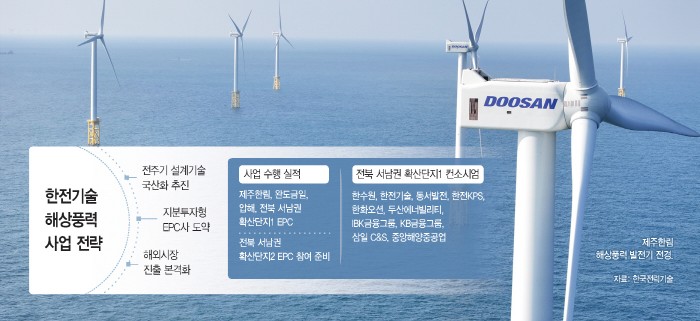 |
As the domestic offshore wind power market grows rapidly backed by the government's renewable energy expansion policy, KEPCO Engineering & Construction (KEPCO E&C)—an institution specialized in nuclear power plant design—is accelerating the expansion of its business scope. Moving beyond its traditional role confined to nuclear design and engineering, the company is securing future growth engines by broadening its participation to front-end engineering design (FEED), engineering, procurement, and construction (EPC), and project management. Recently, it has begun pushing to join a public power generation consortium for the Jeonbuk Southwest offshore wind expansion phase 2 project—valued at approximately 7 trillion won—officially launching its foray into the large-scale domestic offshore wind market.
According to industry sources on July 9, KEPCO E&C is nurturing offshore wind power as a next-generation core business, utilizing the technical prowess accumulated in nuclear design. The core strategy is to expand its execution scope from simple design consulting to early-stage FEED, EPC, project management (PM), and owner's engineering.
Last year, the company secured EPC execution experience by completing the Jeju Hanlim offshore wind project, one of the first commercial offshore wind farms in Korea. Currently, it is performing FEED and EPC for the Aphae and Wando Geumil offshore wind projects. For the Wando Geumil project, responsibilities are shared, with KEPCO E&C handling turbine procurement and supply contract negotiations with the turbine supplier Vestas, while Hyundai E&C takes charge of installation and construction.
The Jeonbuk Southwest project, the largest public offshore wind venture in Korea, is also serving as a springboard for its expanding competitiveness. KEPCO E&C recently participated in a consortium led by Korea Hydro & Nuclear Power (KHNP) and was selected as the preferred bidder for the 800-megawatt (MW) Southwest offshore wind expansion phase 1 project. In this project, it plans to conduct EPC alongside making an equity investment in the special purpose company (SPC). Furthermore, for the 1-gigawatt (GW) phase 2 project whose bidding commenced this month, the company plans to secure an additional contract by joining a consortium of public power generation companies centered around Korea Western Power.
The industry views these moves as a strategy to diversify a business structure heavily focused on nuclear power. While the nuclear business experiences high market volatility depending on policy shifts, the offshore wind sector is projected to form a market worth tens of trillions of won in tandem with the government's renewable energy drive. In particular, KEPCO E&C is attempting to differentiate itself from other engineering firms by scaling up its large-scale project management experience gained from nuclear design into offshore wind power.
However, many challenges remain to be addressed. The domestic offshore wind market faces successive schedule delays due to lagging permits, local community acceptance issues, and grid shortages. As a design firm expands its business territory to EPC and equity investments, it is simultaneously required to demonstrate project risk management capabilities. The industry also points out that low design fees in the domestic engineering industry and securing specialized talent are hurdles to overcome for long-term competitiveness.
A KEPCO E&C official stated, "Based on the engineering technology accumulated in the power plant sector, we will strengthen our capability to participate across the entire project lifecycle from design to EPC. We also plan to expand our footprint into the global offshore wind market based on our track record in domestic projects."
Jeong Soon-young
Most Read
-
1
Celltrion nears additional contract with major U.S..

-
2
Putin proposes trilateral U.S.-China-Russia summit..

-
3
U.S. weighs dropping MOAB, world's most powerful n..

-
4
"Aren't those foreigners on welfare?": M..

-
5
Attention centers on APEC for possible Trump-Xi-Pu..

-
6
Saudi Arabia, Iran hold first diplomatic talks to..

-
7
China tightens grip on boosting domestic demand an..

PEOPLE






-
Address : In-Young Bldg., 34, Uisadang-daero 1-gil, Yeongdeungpo-gu, Seoul
Copyright by ASIATODAY CO., LTD. All rights resereved