



European intelligence warns Russian banks face crisis due to war
Jul 07, 2026, 01:24 pm


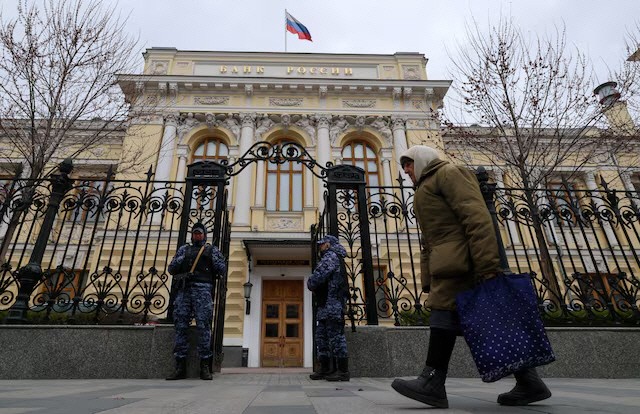 |
| A key interest rate decision meeting was held at the headquarters of the Central Bank of the Russian Federation in Moscow on April 24 (local time). / Courtesy of Reuters, Yonhap News |
Russia's financial sector has been left highly exposed to a systemic crisis due to a mounting pile of non-performing loans and surging household debt under the country's wartime economy, according to a European intelligence report obtained by Reuters on July 6 (local time). The warnings arrive just as the European Union prepares to finalize its latest sweeping sanctions.
The two-page internal document, titled "Note on the Probability of a Banking Crisis in Russia in 2026," outlines that Russian financial institutions have become increasingly vulnerable to further Western curbs due to deteriorating loan quality and expanding risks associated with backing the defense industry.
The report notes that as the prolonged war in Ukraine drains state coffers, the Kremlin has shifted the burden of corporate lending and state-backed financing onto commercial banks. In particular, government-sponsored preferential credit initiatives for defense contractors and home buyers have created a temporary illusion of economic dynamism, while in reality masking a dangerous buildup of toxic assets that may never be recovered.
According to intelligence estimates, roughly 10% of total credit in Russia has been classified as questionable or non-performing, with the retail bad loan ratios at several major lenders reaching as high as 15% last year.
Furthermore, more than 500,000 Russian citizens declared personal bankruptcy last year, marking a spike of over 30% compared to the previous year. Data also reveals that more than 13 million people currently hold at least three loans simultaneously.
Compounding these worries, the Russian Ministry of Economic Development sharply downgraded its gross domestic product (GDP) growth forecasts, slashing the 2026 outlook from 1.3% to 0.4%, and the 2027 projection from 2.8% to 1.4%.
Against this volatile backdrop, the EU is set to finalize its 21st sanctions package later this month, directly targeting Russian financial entities, cryptocurrency networks, and drone manufacturing facilities. The upcoming round of sanctions is expected to blacklist nearly 90 additional lenders, bringing the total number of sanctioned Russian banks to over 100, which effectively accounts for more than half of the country's internationally connected financial institutions.
However, Russian authorities and some market analysts brushed off the downbeat findings, downplaying the likelihood of an imminent collapse.
Filipp Gabunia, deputy governor of the Central Bank of Russia, pushed back against the report, asserting that financial sector vulnerabilities are not critical. He noted that the capital cushions of domestic banks remain at their highest level in three years, and that corporate non-performing loan ratios have hovered stably at around 4% for the past 18 months.
Chris Weafer, chief analyst at macroeconomic consultancy Macro-Advisory, shared a similar view. "While it is true that the Russian economy is entering a period of stagnation, the massive state-led military spending continues to drive employment and wage growth," Weafer assessed. "An outright financial crisis remains unlikely in the near term."
Lee Jeong-eun
Most Read
-
1
Celltrion’s Omlyclo gains ground in major European..

-
2
Trump demands rates fall below 1% as Fed hikes for..

-
3
Trump makes $1 trillion bet ahead of midterm elect..

-
4
Iran resumes ballistic missile production, assembl..

-
5
Samsung Electronics, Mistral AI to jointly develop..

-
6
Trump warns countries not helping U.S. must pay re..

-
7
Apple launches first foldable, 1 million won prici..

PEOPLE






HEADLINE NEWS
- Trump to roll out ‘unprecedented welcome’ for Xi with B-2 bombers, F-22 fighters
- S. Korea, U.S., and Japan form united front on Taiwan and economic coercion..
- Trump administration moves to impose sweeping sanctions on International Cr..
- Xi to make state visit to U.S. Sept. 23-25, dispelling rumors over his heal..

-
Address : In-Young Bldg., 34, Uisadang-daero 1-gil, Yeongdeungpo-gu, Seoul
Copyright by ASIATODAY CO., LTD. All rights resereved