



Revised Network Act takes effect: How to prevent a muzzle on free speech
Jul 07, 2026, 09:40 am


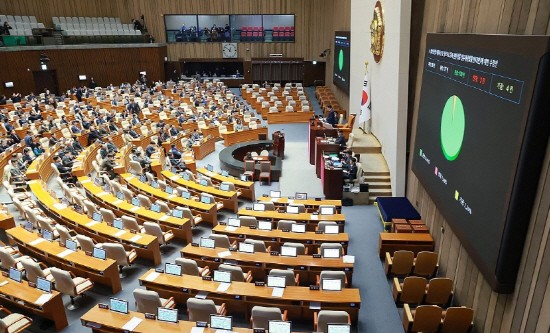 |
| Led by the main opposition Democratic Party of Korea, the amendment to the Information and Communications Network Act passed the National Assembly's plenary session on December 24 last year. / Courtesy of Yonhap News |
The revised Information and Communications Network Act, heavily strengthening regulations on online fake news, manipulated information, and hate speech—the so-called 'Fake News Eradication Act'—takes effect on July 7. The legislative intent is to eliminate legal blind spots for acts that were previously punished in a scattered manner through defamation laws or the Act on Press Arbitration. However, the potential for the law to be used as an arbitrary yardstick by specific groups due to still ambiguous criteria remains unresolved. This raises concerns that it could turn into a 'muzzle law' that contradicts its original purpose.
The core of the amendment is 'punitive damages' for distributing illegal or falsely manipulated information. If an entity whose business involves delivering facts or opinions to an unspecified majority intentionally spreads illegal or manipulated information, causing harm to others, they can be held liable for damages up to five times the actual loss. The amendment defines fake and manipulated information as "information intended to infringe upon another person's personality rights, property rights, or the public interest." It also adds a new category to illegal information: "information that instigates discrimination or fosters hatred against specific individuals or groups based on race, nationality, region, gender, disability, age, social status, income level, or wealth status."
This differs somewhat from recent concerns voiced by some online users. First of all, ordinary individuals will not be punished or fined simply for posting posts expressing mere opinions. The Broadcasting, Media and Communications Commission (BMCC), which prepared the enforcement decree, limited the scope of application to YouTubers and influencers who have posted information at least three times in the preceding three months and have 10,000 or more subscribers, or whose monthly average combined views over three months reach 100,000 or more. Established media outlets and content creators with high public influence will face sanctions if they generate profits by repeatedly distributing information—at least twice—that has been finalized as illegal, false, or manipulated by a court.
Furthermore, the government emphasizes 'intent' and 'purposefulness' in its criteria for sanctions. The distributor must have been aware that the information was illegal, false, or manipulated at the time of distribution, and must have repeatedly posted it with the purpose of causing harm to others or gaining unjust profits. On the surface, the intention appears to target 'cyber wreckers' who cause actual social issues, rather than traditional news coverage or personal posts.
However, the biggest flaw of this amendment lies in its ambiguous standards. The government and the ruling party, which led the passage of the bill, specified "information that infringes on the public interest" despite criticism from civic groups and the media sector. Previously, in 2010, the Constitutional Court ruled that freedom of expression cannot be restricted based on the standard of public interest, noting that vague and abstract concepts leave ample room for arbitrary judgment. Although the government explains that it does not make these judgments directly, critics view this as shifting the burden onto the judiciary and private fact-checking organizations. Moreover, the amendment mandates self-regulation for large-scale platform operators like Google, Meta, and Naver, but the criteria for this remain unclear. There is a possibility that corporations might implement heavy preemptive measures out of deference to the government. This is where concerns over virtual 'indirect censorship' arise.
Some point out that the law itself is problematic as it leaves room to directly run counter to democratic values. Even now, fake news can be charged with defamation, violation of the Framework Act on Telecommunications, or obstruction of business, depending on intent and the affected party. Regarding hate speech, an anti-discrimination act has been under continuous discussion. However, regulating these issues collectively under the comprehensive concept of 'information distribution'—without sufficient social consensus on individual matters—goes against the spirit of existing laws. Critics point out that when interpreting the 'true intent' behind someone's post, the broad variance in legal interpretation could ultimately lead to a 'muzzle law.' For this reason, follow-up measures for future revisions or clearer specification of the law will be crucial moving forward.
Kim Hong-chan
Most Read
-
1
Celltrion nears additional contract with major U.S..

-
2
Putin proposes trilateral U.S.-China-Russia summit..

-
3
U.S. weighs dropping MOAB, world's most powerful n..

-
4
"Aren't those foreigners on welfare?": M..

-
5
Attention centers on APEC for possible Trump-Xi-Pu..

-
6
Saudi Arabia, Iran hold first diplomatic talks to..

-
7
China tightens grip on boosting domestic demand an..

PEOPLE







-
Address : In-Young Bldg., 34, Uisadang-daero 1-gil, Yeongdeungpo-gu, Seoul
Copyright by ASIATODAY CO., LTD. All rights resereved