



NATO Secretary General urges rapid arms and troop boost amid industrial bottlenecks
Jul 06, 2026, 10:23 am


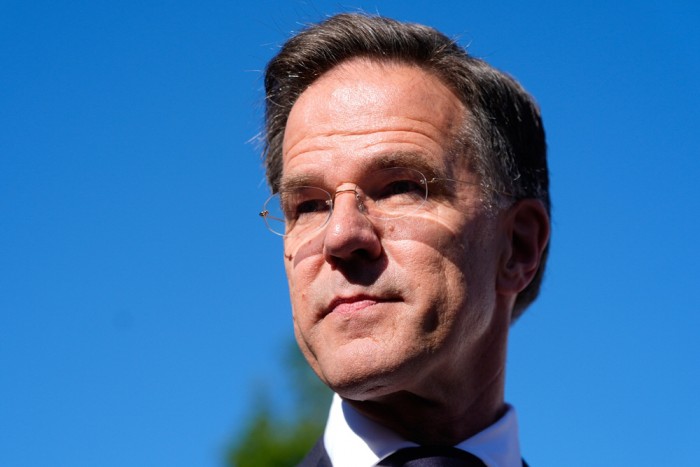 |
| NATO Secretary General Mark Rutte speaks with reporters in front of the White House in Washington, D.C., on June 24 (local time). / Courtesy of AP-Yonhap |
NATO Secretary General Mark Rutte emphasized that as allies continue to increase their defense spending, they must rapidly translate those funds into actual weapons and military capability.
In an interview with The Wall Street Journal published on July 5 (local time), Rutte noted that while NATO member states have significantly boosted military expenditures, they are struggling to quickly convert those funds into enhanced combat power and expanded weapons production due to industrial bottlenecks.
"A year ago, the core was promising to spend more," Rutte said. "This year is about delivering the actual results."
NATO has long faced pressure from external developments to ramp up defense spending. Russia continues to fortify its military might, while the United States has questioned NATO's role and repeatedly warned of plans to drawdown American forces stationed in Europe.
Against this backdrop, the speed and scale of increased spending by European nations are showing signs of outpacing the production capacities of local defense contractors.
Rutte pointed out that approximately 300 billion dollars (about 460 trillion won) worth of weapons have already been ordered from U.S. defense firms, stating, "We have effectively run into the limits of production capacity."
He added that governments are actively working to address two primary bottlenecks: industrial capacity constraints and a lack of infrastructure for recruiting and training new soldiers.
The strain on NATO has intensified as production facilities were already overloaded by the Russia-Ukraine war, a situation further compounded by the massive expenditure of ammunition by the U.S. and its allies during conflicts with Iran, which now requires significant stockpiles to be replenished.
Furthermore, nations have engaged in inefficient, redundant investments—such as developing different types of armored vehicles to protect domestic defense industries—which in turn has drained budgets that could otherwise be invested in critical assets like air defense systems or long-range strike missiles.
There is also a risk that large-scale integration projects designed to link militaries across Europe into a single network could be sidelined in investment priorities.
"The key task that we absolutely must discuss next week is tackling these issues," Rutte emphasized. "Now that the money is coming in and the defense industrial base is scaling up, we need to accelerate that pace."
The NATO summit is scheduled to take place over two days starting July 7 in Ankara, Türkiye. NATO plans to host an industrial forum during the summit, inviting defense executives and government planners to discuss strategies for boosting production.
NATO officials expect a series of multi-billion-dollar weapons contracts, preliminary agreements, and joint production pacts to be announced during the event.
Kim Hyun-min
Most Read
-
1
Celltrion’s Omlyclo gains ground in major European..

-
2
Trump demands rates fall below 1% as Fed hikes for..

-
3
Trump makes $1 trillion bet ahead of midterm elect..

-
4
Iran resumes ballistic missile production, assembl..

-
5
Samsung Electronics, Mistral AI to jointly develop..

-
6
Trump warns countries not helping U.S. must pay re..

-
7
Apple launches first foldable, 1 million won prici..

PEOPLE






HEADLINE NEWS
- Trump to roll out ‘unprecedented welcome’ for Xi with B-2 bombers, F-22 fighters
- S. Korea, U.S., and Japan form united front on Taiwan and economic coercion..
- Trump administration moves to impose sweeping sanctions on International Cr..
- Xi to make state visit to U.S. Sept. 23-25, dispelling rumors over his heal..

-
Address : In-Young Bldg., 34, Uisadang-daero 1-gil, Yeongdeungpo-gu, Seoul
Copyright by ASIATODAY CO., LTD. All rights resereved