



Samsung SDI to invest 16 tn won in Ulsan to build solid-state
Jul 06, 2026, 09:54 am


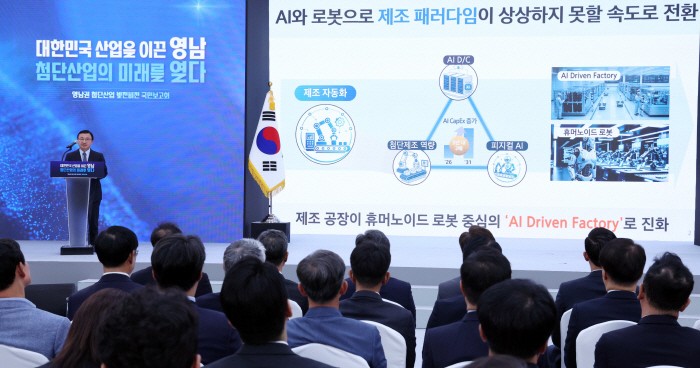 |
| Samsung Electronics President Roh Tae-moon announces the company's investment plans during a national report session on the development vision for advanced industries in the Yeongnam region, presided over by President Lee Jae-myung, in Jinju, South Gyeongsang Province, on July 3. / Courtesy of Yonhap News |
Samsung SDI is investing approximately 16 trillion won in its Ulsan site by 2040 to establish a manufacturing base for next-generation batteries. This follows an announcement just a day prior detailing a 9 trillion won capital injection into its Cheonan facility to expand research and development (R&D) infrastructure, bringing the company's total domestic investment across battery manufacturing and research hubs to 25 trillion won.
Samsung SDI disclosed in a regulatory filing on July 3 that it will inject around 16 trillion won into its Ulsan plant through 2040, aimed at strengthening competitiveness in next-generation batteries.
Through this initiative, the company intends to secure a mass-production foundation for solid-state batteries targeted at electric vehicles and humanoid robots, alongside lithium iron phosphate (LFP) and sodium-ion batteries optimized for energy storage systems (ESS). Samsung SDI highlighted that the investment will secure a global manufacturing base for next-generation batteries.
The investment blueprint was unveiled during a national report session on the development vision for advanced industries in the Yeongnam region, held in Jinju, South Gyeongsang Province. At the event, Samsung Group announced a separate 60 trillion won investment scheme to build a manufacturing AI ecosystem across the Yeongnam area, which encompasses Samsung SDI's Ulsan capital deployment.
On July 2, Samsung SDI announced a 9 trillion won investment plan through 2040 for its Cheonan plant to build mother lines and R&D facilities dedicated to next-generation battery technology verification. Under this dual-track strategy, Cheonan will function as the central research and development hub, while Ulsan serves as the primary mass-production base for next-generation batteries.
Nam Hyun-soo
Most Read
-
1
Kia Sportage outperforms Mazda CX-5 in German auto..

-
2
Houthis launch successive attacks on Saudi airport..

-
3
Saudi Arabia, Iran hold first diplomatic talks to..

-
4
U.S. deploys carrier, 10,000 more troops to Middle..

-
5
Saudi airport in Riyadh struck again, leaving at l..

-
6
Japan tracks Ukraine fiber-optic drones, bolsters..

-
7
Putin's ally visits China on the 8th ahead of APEC..

PEOPLE






HEADLINE NEWS

-
Address : In-Young Bldg., 34, Uisadang-daero 1-gil, Yeongdeungpo-gu, Seoul
Copyright by ASIATODAY CO., LTD. All rights resereved