



KCC shifts focus to high-value materials
Jul 06, 2026, 09:36 am


 |
Amidst a prolonged slowdown in the construction industry, KCC is accelerating its efforts to secure future growth engines by steadily increasing its investment in research and development (R&D). As the company continuously yields R&D achievements across diverse business sectors including cosmetics ingredients, coatings, and construction materials, it is bolstering its competitiveness in technology-backed, high-value-added products. However, given that its construction materials and coatings businesses remain heavily tied to the downstream construction market, and its high-value materials business—such as silicon—is exposed to global chemical market cycles and raw material price volatility, bridging the gap between R&D success and actual revenue growth as well as profitability improvements remains a primary task ahead.
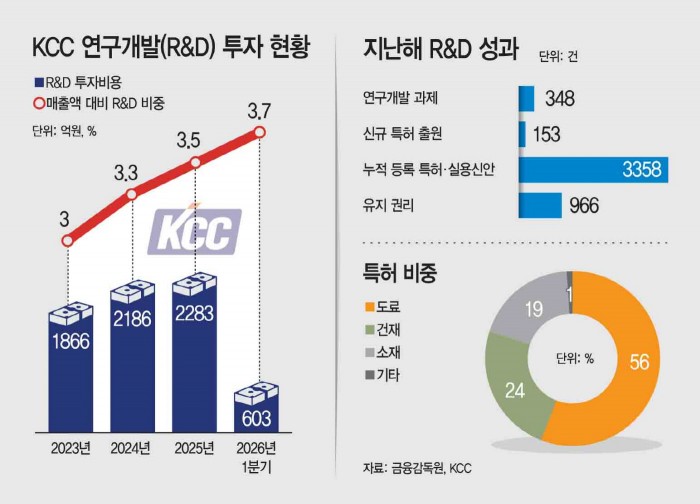
According to the electronic disclosure system of the Financial Supervisory Service on July 5, KCC invested 60.3 billion won into R&D during the first quarter of this year. This figure accounts for 26.4% of its total R&D expenditure from last year (228.3 billion won). The ratio of R&D investment relative to total revenue has climbed steadily from 3% in 2023, to 3.3% in 2024, 3.5% in 2025, and reached 3.7% in the first quarter of this year.
Last year, the company carried out 348 R&D projects and filed 153 new domestic and international patents. KCC holds a cumulative total of 3,358 registered patents and utility models, maintaining active rights over 966 of them. By technological field, coatings account for the largest share of patents at 56%, followed by construction materials at 24%, and advanced materials at 19%.
This sustained investment is directly translating into product competitiveness. Recently, KCC Silicone's cosmetic silicone ingredient "SeraSense RBS 12" won the Silver Award in the Best Functional Ingredient category in the Innovation Zone at in-cosmetics Korea 2026, a global cosmetics ingredients exhibition. Designed to help cosmetic formulations apply evenly to the skin while enhancing adhesion and longevity, the functional silicone ingredient utilizes a proprietary resin blend technology to optimize both sensory texture and formulation stability. As the cosmetics industry increasingly prioritizes user experiences—such as spreadability, adhesion, and lasting power—alongside product efficacy, this accolade highlights KCC Silicone's technological edge in the sector.
In the coatings sector, the company is reinforcing its premium product strategy. A prime example is "Royal Enamel Plus," KCC's premium enamel paint for buildings, which features enhanced hiding power, roller workability, and film build compared to previous products to boost on-site efficiency. It has also received an indoor environmental mark certification for meeting low-emission standards for indoor air quality, making it suitable for residential spaces. This move is interpreted as a strategy to bolster its premium lineup in response to expanding demand for DIY interior design and remodeling.
Development of functional construction materials is also ongoing. The recently launched "Soundwin Zero," a full-surface perforated sound-absorbing gypsum board, upgrades both acoustic performance and aesthetics. Engineered with full-surface perforations, the board allows patterns to flow seamlessly across joints, and it improves installation convenience by maintaining the same installation methods as standard gypsum boards. The product also secured environmental credibility by earning the highest rating under the standard certification (SPS) of the Korea Air Cleaning Association.
Industry observers note that despite the construction market downturn, KCC is strengthening its business competitiveness around high-performance materials and premium products by sustaining its R&D investments. Analysts suggest that the company is fast-tracking the acquisition of future growth drivers by diversifying its technological portfolio beyond traditional coatings and construction materials into high-value-added material fields like silicon.
"Our decision to expand R&D investments despite the construction slowdown is a strategic choice aimed at securing a foundation for future growth rather than focusing on short-term market conditions," a KCC official stated. "We plan to continuously increase the share of high-value-added products by sharpening our technological edge in eco-friendly and high-performance products, as well as in silicon, coatings, and advanced materials."
However, some experts note that it remains to be seen whether increased R&D investments will immediately translate into improved financial performance. Because the construction materials and coatings sectors remain heavily vulnerable to domestic construction cycles and remodeling demand, a delayed recovery in downstream industries could limit the market impact of new product rollouts. While high-performance and eco-friendly product lines yield higher unit prices and profitability than standard products, expanding their market penetration typically requires a certain window of time.
Above all, while the high-value-added materials business—such as silicon—is positioned as a core pillar for the company's future growth, volatility driven by global chemical market conditions, raw material prices, and fluctuations in overseas demand remains a key variable. Given the high technological entry barriers for functional materials, KCC's future competitiveness will hinge largely on its ability to convert R&D breakthroughs into client adoption and actual profitability gains.
Jang Ji-young
Most Read
-
1
Kia Sportage outperforms Mazda CX-5 in German auto..

-
2
Houthis launch successive attacks on Saudi airport..

-
3
Saudi Arabia, Iran hold first diplomatic talks to..

-
4
U.S. deploys carrier, 10,000 more troops to Middle..

-
5
Saudi airport in Riyadh struck again, leaving at l..

-
6
Japan tracks Ukraine fiber-optic drones, bolsters..

-
7
Putin's ally visits China on the 8th ahead of APEC..

PEOPLE






HEADLINE NEWS

-
Address : In-Young Bldg., 34, Uisadang-daero 1-gil, Yeongdeungpo-gu, Seoul
Copyright by ASIATODAY CO., LTD. All rights resereved