



Cuba bets on economic reform amid U.S. sanctions
Jul 03, 2026, 10:13 am


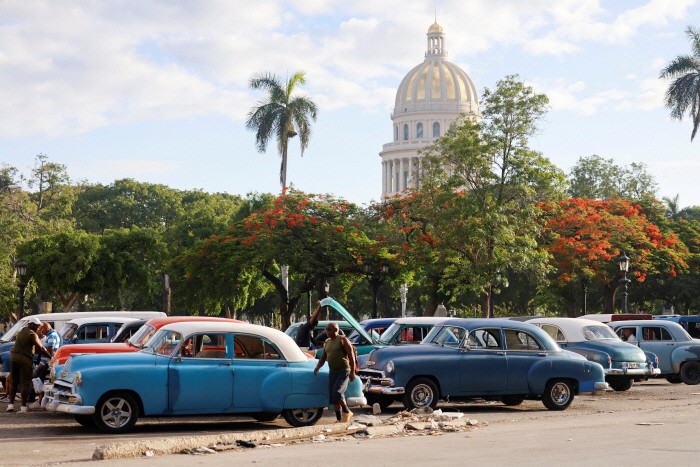 |
| A man walks past a parked taxi in Havana, Cuba, on June 17 (local time). / Reuters Yonhap |
Cuba, currently under economic sanctions from the United States, has signaled its intention to step up survival strategies focused on attracting foreign investment and expanding the private sector.
In an interview with the Wall Street Journal (WSJ) published on July 1 (local time), Oscar Perez-Oliva Fraga, Cuba's Deputy Prime Minister, emphasized that the US is trying to force Cuba into economic dependence. He stated that the US has always underestimated the nation, but emphasized that they can endure.
The US initiated an oil blockade against Cuba in January while imposing strict sanctions on its state-owned enterprises. In May, US prosecutors indicted former Cuban President Raul Castro on murder charges related to the 1996 shootdown of civilian aircraft.
Deputy Prime Minister Perez-Oliva also detailed the country's ongoing economic reforms, noting that the government announced 176 economic measures last month to attract foreign investment, expand the small-scale private sector, and prevent both economic collapse and potential US military action. He stressed that these changes are not a smokescreen but are serious and well-designed.
The 176 economic measures introduced by Cuba last month include lifting the cap on corporate headcount—which previously banned firms with more than 100 employees—allowing entrepreneurs to operate multiple businesses, removing price controls, permitting private banking operations, and opening state-owned enterprises to privatization and partnership with foreign investors.
Severe energy shortages have dealt a blow to Cuba's tourism industry, a foundational pillar of its economy, leading foreign operators managed hotels to exit the country.
Deputy Prime Minister Perez-Oliva stated that Cuba is actively seeking new partners to manage these hotels, emphasizing that tourism remains the sector most open to foreign investment.
Park Jin-sook
Most Read
-
1
Trump shares map on social media labeling Strait o..

-
2
Kia Sportage outperforms Mazda CX-5 in German auto..

-
3
Houthis launch successive attacks on Saudi airport..

-
4
U.S. deploys carrier, 10,000 more troops to Middle..

-
5
Trump rejects Iran's offer to open Strait of Hormu..

-
6
N. Korea conducts first swarm attack drill with dr..

-
7
U.S.-China summit falls short on substance as Trum..

PEOPLE





HEADLINE NEWS
- Seoul dismisses Ukraine's claim of 'S. Korean support for Russia' as "inaccurate and inappropriate"
- S. Korea, Japan race to develop nuclear-powered submarines
- Henri Kagan, Kenso Soai win Nobel Prize in Chemistry for uncovering how mol..
- Vance says Alaska LNG cooperation will move forward with Seoul's current or..

-
Address : In-Young Bldg., 34, Uisadang-daero 1-gil, Yeongdeungpo-gu, Seoul
Copyright by ASIATODAY CO., LTD. All rights resereved