



Schools to designate daily book-reading time for students
Jul 03, 2026, 09:32 am


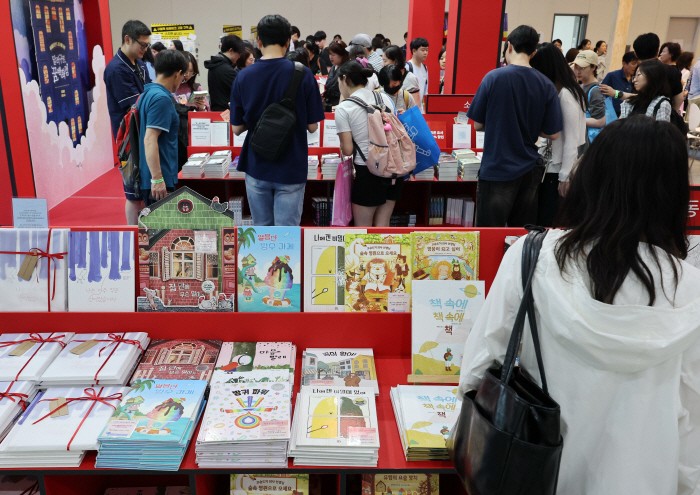 |
| Visitors look at books on display at the 2026 Seoul International Book Fair held at COEX in Gangnam-gu, Seoul, on June 28. / Yonhap News |
Plans are underway to increase book-reading time in schools for students who have grown accustomed to digital media, such as short-form content. Third and fourth graders in elementary school, first graders in middle school, and first graders in high school will be designated for "Intensive Reading Education Years," receiving support through tailored programs encompassing reading, discussion, and writing.
The Ministry of Education announced this "Plan to Revitalize School Reading Education" on July 2. The initiative aims to strengthen reading education within school classes and daily routines amid declining student reading rates and rising concerns over deteriorating literacy skills.
According to the Ministry of Culture, Sports and Tourism's "2025 National Reading Survey," the annual number of books read by students decreased from 41.0 in 2019 to 31.5 in 2025. In the Organisation for Economic Co-operation and Development's (OECD) Programme for International Student Assessment (PISA) 2022, South Korean students' "ability to distinguish facts from opinions in information" stood at 25.6%, falling well short of the OECD average of 47.4%.
The Ministry of Education will first link classes with reading. To enable students to read curriculum-related books during class and engage in post-reading activities like inquiry and discussion, the ministry will contest and identify 1,000 reading-linked curriculum class models every year until 2030. The identified programs will be uploaded to the digital reading activity platform "Readingro" by subject and achievement standards for teachers to utilize.
Lead schools for class-centered reading education will also operate. Existing reading education lead schools will transition into class-centered models, with 40 schools designated annually until 2030. Lead schools must operate reading-based classes within the curriculum and run at least 16 periods of curriculum-linked reading project classes.
Starting next year, third and fourth graders in elementary school, first graders in middle school, and first graders in high school will be designated for intensive reading education years. The decision is based on the assessment that third and fourth grades represent the transition from "learning to read" to "reading to learn," first grade in middle school requires reading connected to subject learning, and first grade in high school demands in-depth reading spanning careers and subjects.
Tailored programs will be provided for third and fourth graders who show low interest in reading or struggle with academic reading. For first graders in middle school, the ministry will support reading, discussion, and writing programs linked to the free semester system, expanding support for reading clubs from 500 schools in 2027 to all middle schools by 2030. First graders in high school will receive support through online career reading mentoring and visiting reading and humanities education to explore career paths while reading books in their fields of interest.
Book-reading time in schools will also be expanded. The Ministry of Education decided to foster a school culture of reading through autonomous programs at each school, such as "Reading Books Together for 10 Minutes Every Morning." The ministry will support 1,000 elementary, middle, and high schools this year and expand the initiative to all schools by 2030.
The ministry is also planning to link students' reading activities recorded on "Readingro" with the National Education Information System (NEIS) so that they are automatically entered into the reading activity status section of school records. To ensure reading activities continue during vacations, support will be provided for all students to borrow up to five e-books per month starting in 2027.
Relevant laws and systems will be overhauled to ensure the stable implementation of reading education. The Ministry of Education plans to push for an amendment to the Framework Act on Education to define reading education as a responsibility of the state and local governments, while also restructuring the School Library Promotion Act.
Choi Kyo-jin, Minister of Education, stated, "Helping our children experience the inherent joy of reading amidst the flood of digital media is the most crucial role of reading education." He added, "We will support systematic reading education centered on school classes so that the joy of reading books can become a part of students' daily lives."
Kim Nam-hyeong
Most Read
-
1
Celltrion nears additional contract with major U.S..

-
2
Putin proposes trilateral U.S.-China-Russia summit..

-
3
U.S. weighs dropping MOAB, world's most powerful n..

-
4
"Aren't those foreigners on welfare?": M..

-
5
Attention centers on APEC for possible Trump-Xi-Pu..

-
6
Saudi Arabia, Iran hold first diplomatic talks to..

-
7
China tightens grip on boosting domestic demand an..

PEOPLE







-
Address : In-Young Bldg., 34, Uisadang-daero 1-gil, Yeongdeungpo-gu, Seoul
Copyright by ASIATODAY CO., LTD. All rights resereved