



Vance, Rubio show subtle differences over their approach to Iran
Jul 02, 2026, 01:02 pm


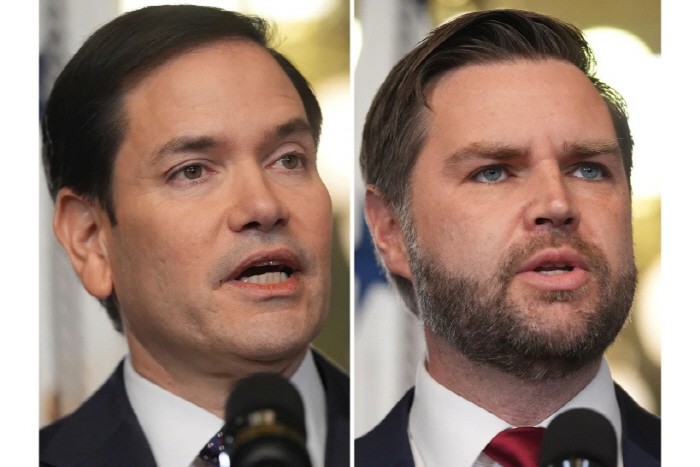 |
| US Secretary of State Marco Rubio (left) and US Vice President J.D. Vance. /AP, Yonhap |
An analysis has emerged suggesting that Vice President J.D. Vance and Secretary of State Marco Rubio are taking differing approaches in executing President Donald Trump's national security agenda. The Associated Press (AP) reported on July 1 (local time) that some observers view these moves by the two individuals, both considered potential future presidential contenders, as the beginning of a rivalry to secure future leadership.
Secretary Rubio, an immigrant from Cuba, has focused on traditional Latin American foreign policy based on his long career in the Senate. Vice President Vance, a Marine veteran from the American Midwest, was selected as the vice presidential candidate after just two years in the Senate and has consistently advocated for a non-interventionist and isolationist foreign policy stance.
The two figures show the most distinct difference in their approach to handling Middle East issues, particularly concerning Iran and Lebanon.
Vice President Vance criticized Israel's military actions, pointing out that Israel's operations in Lebanon provoked Iran and made negotiations more difficult. On the other hand, Secretary Rubio, who led the diplomacy regarding Lebanon and recently brokered the Israel-Lebanon peace agreement, has consistently supported Israel and remained tight-lipped regarding its military actions in Lebanon.
White House Press Secretary Anna Kelly dismissed rumors of a feud, stating, "The entire administration fully supports the President's goal of preventing Iran from acquiring nuclear weapons, and there are no factions within the government."
However, according to sources familiar with the administration's internal affairs, Secretary Rubio was skeptical about the possibility of reaching a deal with Iran and reportedly turned down the role of chief negotiator at the ceasefire talks held in Islamabad, Pakistan, last April.
Vice President Vance viewed this as an opportunity to prove his diplomatic capabilities and personally requested the President to appoint him as the chief negotiator. He subsequently led the delegation at the Swiss talks as well, but is currently facing difficulties in implementing the agreement as sporadic clashes continue even after the recent signing of the US-Iran end-of-war Memorandum of Understanding (MOU).
Ian Kelly, who served as a diplomat and ambassador during the first Trump administration, explained regarding the unusual situation of a vice president serving as chief negotiator that Secretary Rubio likely conceded the position willingly because "it is a risky role with an uncertain outcome, and one that carries a high likelihood of taking all the blame if things go wrong."
While both the Vice President and the Secretary of State have moved to defuse rumors of conflict through the media, stating that they are cooperating to assist the President, the general consensus is that the difference in their diplomatic worldviews remains clear, AP reported.
Lee Jeong-eun
Most Read
-
1
Trump shares map on social media labeling Strait o..

-
2
Kia Sportage outperforms Mazda CX-5 in German auto..

-
3
Houthis launch successive attacks on Saudi airport..

-
4
U.S. deploys carrier, 10,000 more troops to Middle..

-
5
Trump rejects Iran's offer to open Strait of Hormu..

-
6
N. Korea conducts first swarm attack drill with dr..

-
7
U.S.-China summit falls short on substance as Trum..

PEOPLE






HEADLINE NEWS
- Seoul dismisses Ukraine's claim of 'S. Korean support for Russia' as "inaccurate and inappropriate"
- S. Korea, Japan race to develop nuclear-powered submarines
- Henri Kagan, Kenso Soai win Nobel Prize in Chemistry for uncovering how mol..
- Vance says Alaska LNG cooperation will move forward with Seoul's current or..

-
Address : In-Young Bldg., 34, Uisadang-daero 1-gil, Yeongdeungpo-gu, Seoul
Copyright by ASIATODAY CO., LTD. All rights resereved