



SpaceX unveils AI device prototypes to investors amid growing warnings of AI overheating
Jul 02, 2026, 10:34 am


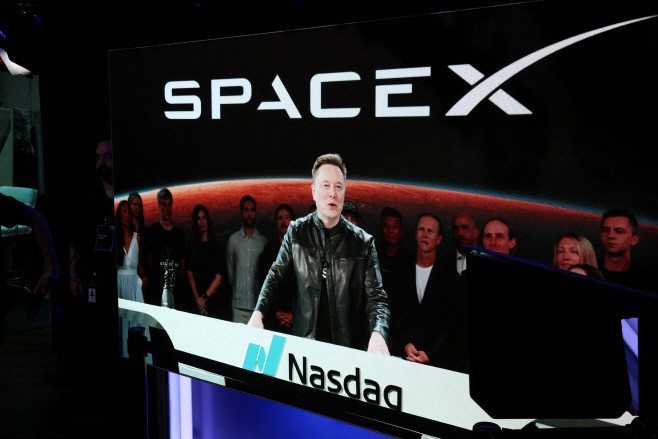 |
| Elon Musk, founder, CEO, chairman, and chief engineer of SpaceX and CEO of Tesla, delivers a speech via video link at the NASDAQ MarketSite in New York on June 12 (local time), the day of SpaceX's initial public offering (IPO). /Reuters, Yonhap |
SpaceX, led by Tesla CEO Elon Musk, has presented prototypes of a handset-type device integrating artificial intelligence (AI) technology to select investors and stakeholders, the US daily Wall Street Journal (WSJ) reported on July 1 (local time).
This initiative aligns with Musk's "everything app" (super app) strategy. However, investors and economists have pointed to overheating AI investments, expanding debt, and employment shocks as new risks.
SpaceX presents AI device prototypes combining xAI and Qualcomm chipsets
SpaceX has developed prototypes of a slim, handset-type device that is thinner than an iPhone and presented them to some investors and stakeholders, the WSJ reported, citing multiple sources familiar with the matter.
The prototype is designed to feature a Qualcomm Snapdragon chipset, run on a proprietary operating system (OS), and integrate technology from xAI, Musk's AI firm. SpaceX informed some investors that the project is in its early stages, the design is subject to change, and it remains uncertain whether the product will actually be launched.
While Musk stated in October last year that "the idea of making a phone makes me want to die" but added "if necessary, we will make one," he denied it this past February via the social media platform X (formerly Twitter), saying, "We are not developing a phone."
 |
| The silhouette of Tesla CEO Elon Musk and the Tesla logo are featured in an illustration taken on June 11 (local time). /Reuters, Yonhap |
Musk seeks proprietary AI platform, but hardware entry remains a wildcard
The prototype embodies the device version of the "everything app" philosophy that Musk put forward when acquiring Twitter in 2022, sources familiar with the matter told the WSJ.
SpaceX's Starlink already sells antennas for internet access and collaborates with carriers like T-Mobile to provide cell phone service in dead zones, indicating that a business foundation for this device concept is already in place. However, the WSJ pointed out that it is challenging for a new entrant to jump into the hardware business.
While China's WeChat and Alipay are evolving to combine their super-app models—which offer payments, food delivery, travel bookings, and gaming on a single platform—with AI, OpenAI has also embarked on developing a lineup of AI devices. Meanwhile, China's ByteDance launched a smartphone powered by its AI model "Doubao" but is facing difficulties due to competitors restricting access to their services.
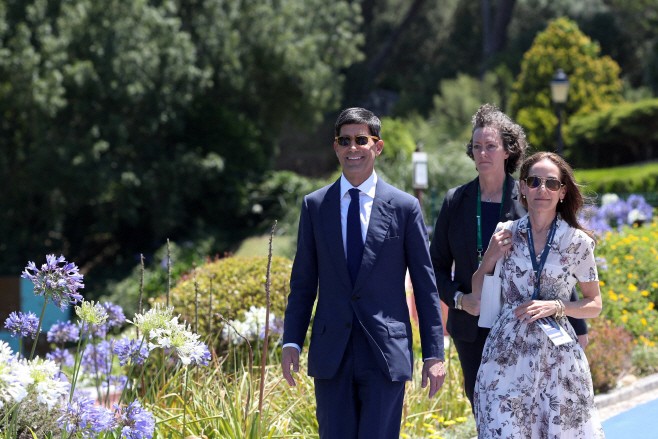 | ||||
US Federal Reserve Chairman Kevin Warsh, accompanied by his wife Jane Lauder, walks to attend the afternoon session of the European Central Bank (ECB) annual forum in Sintra, Portugal, on July 1 (local time). /Reuters, Yonhap
IMF, BIS warn of AI leverage and recession risks, while BOE points to cyber vulnerabilities
At the European Central Bank (ECB) annual forum held in Sintra, Portugal, economists and central bank governors focused on warning about the impact that AI overheating could have on the global economy, the WSJ reported.
The Bank for International Settlements (BIS) warned the day before the symposium that some economies risk falling into recession if the surge in AI spending reverses. Tobias Adrian, Director of the Monetary and Capital Markets Department at the International Monetary Fund (IMF), stated, "Leverage is building up on both the borrower side and the investor side, and leverage on both sides is highly concerning for financial stability."
Torsten Sløk, chief economist at Apollo Global Management, presented two risk scenarios: even if AI achieves massive success, job displacement could raise unemployment, leading to a recession through reduced consumer spending. Conversely, if AI falls short of expectations, current investments could become "problem investments" in terms of productivity and profitability.
The WSJ analyzed that the concentration of capital in AI-linked firms could amplify potential shocks, noting that AI-related investment-grade bond issuances account for nearly half of this year's total, and 87% of all venture capital investment. Furthermore, the top 10 companies in the S&P 500 index on the New York stock market now make up about 40% of the index.
Sarah Breeden, Deputy Governor of the Bank of England (BOE), pointed out that while AI models can detect corporate cybersecurity vulnerabilities, not all companies have access to these models, and applying patches takes time, leaving opportunities for malicious actors to exploit these vulnerabilities through reverse engineering. Isabel Schnabel, Executive Board Member of the ECB, warned, "It is not difficult to imagine a scenario where a cyberattack on a major cloud provider simultaneously paralyzes numerous financial institutions." Tiff Macklem, Governor of the Bank of Canada, also cautioned, "The internet has advanced beyond anyone's imagination, yet the dot-com bubble still occurred. There is no reason to believe that markets will not experience a phase of running ahead of themselves." However, US Federal Reserve Chairman Kevin Warsh dismissed the pessimism, predicting greater prosperity by stating, "We are in the first or second inning of this revolution."
Burry warns on Samsung, SK Hynix investments; increases bets on Tesla, SOXX declines Michael Burry, head of Scion Asset Management—who famously bet against the US housing market before the 2008 financial crisis and served as the real-life inspiration for the movie "The Big Short"—pointed to the recent announcement at the Blue House on June 29 regarding Samsung and SK Hynix's plan to invest over 500 dollars billion (775.75 trillion won) in a Honam semiconductor hub as a sign of AI overheating. On June 30, the day after the two companies announced their investment, as chip-related stock prices surged, Burry wrote on his Substack, "The direct cause of today's rally is the massive spending announcement out of South Korea. I view this as the beginning of the end." The WSJ reported that Burry has added new short positions against Tesla, Caterpillar, Applied Materials, and the SOXX Exchange-Traded Fund (ETF), which tracks semiconductor indices, while maintaining a short position on Nvidia for several months. Burry's put options on the SOXX ETF are structured to become profitable if it drops to about one-third of its peak, and his bet against Tesla comes with a price target of 416.22 dollars (645,765 won). While Nvidia's stock price sits about 5% lower than the day Burry announced his short position and Palantir's stock has tumbled around 40%, Nvidia denied the circular financing issues raised by Burry, and Palantir CEO Alex Karp strongly criticized him. The backdrop to Burry's short selling also includes factors such as the US government intervening in Anthropic's release of its Mythos-class AI model due to national security concerns, and Microsoft offering lower-cost options in response to the shock of mounting AI licensing fees. Ha Man-joo |
Most Read
-
1
Trump shares map on social media labeling Strait o..

-
2
Kia Sportage outperforms Mazda CX-5 in German auto..

-
3
Houthis launch successive attacks on Saudi airport..

-
4
U.S. deploys carrier, 10,000 more troops to Middle..

-
5
Trump rejects Iran's offer to open Strait of Hormu..

-
6
N. Korea conducts first swarm attack drill with dr..

-
7
U.S.-China summit falls short on substance as Trum..

PEOPLE






HEADLINE NEWS
- Seoul dismisses Ukraine's claim of 'S. Korean support for Russia' as "inaccurate and inappropriate"
- S. Korea, Japan race to develop nuclear-powered submarines
- Henri Kagan, Kenso Soai win Nobel Prize in Chemistry for uncovering how mol..
- Vance says Alaska LNG cooperation will move forward with Seoul's current or..

-
Address : In-Young Bldg., 34, Uisadang-daero 1-gil, Yeongdeungpo-gu, Seoul
Copyright by ASIATODAY CO., LTD. All rights resereved