



GS E&C overhauls decarbonization roadmap
Jul 02, 2026, 09:53 am


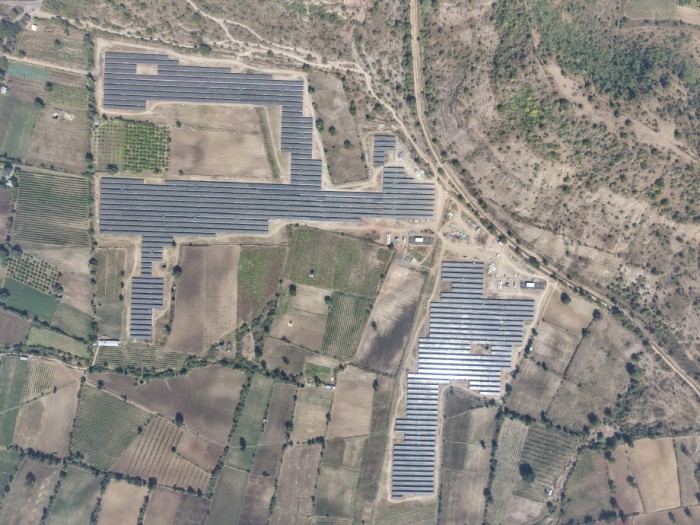 |
View of the Patur solar power plant in India completed by GS Engineering & Construction.
GS Engineering & Construction (GS E&C) has made a strategic move as massive, long-term investments in decarbonization are expected worldwide. The company is set to advance and commercialize technology that can replace petroleum with carbon dioxide, while accelerating its future technology development timeline by up to eight years. It has also laid out plans to discover new growth engines using these initiatives.
According to industry sources on July 1, GS E&C, in collaboration with Hanwha TotalEnergies Petrochemical and the Korea Research Institute of Chemical Technology, has developed a technology that converts carbon dioxide (CO2) into liquid hydrocarbons such as gasoline. Late last year, they built a CO2 direct hydrogenation pilot plant capable of producing 50 kg of liquid hydrocarbons per day. Their goal is to create a commercial process design capable of producing more than 100,000 tons (t) annually. While the initial target was over 50,000 tons annually by 2030, they have doubled their production target.
This technology can replace petroleum, which is used to make gasoline for vehicles or naphtha for plastic production, with carbon dioxide. South Korea's daily oil consumption stands between 2.5 million and 2.9 million barrels. Given that one barrel typically weighs about 136 kg, 100,000 tons equates to roughly 735,294 barrels.
While this is still far short of daily oil consumption, it amounts to 58.4 million dollars based on a simple arithmetic calculation with Dubai crude, the most heavily used type in South Korea, which traded at 79.45 dollars per barrel for June delivery on the New York Mercantile Exchange.
GS E&C's technology development is largely aimed at achieving "carbon neutrality," which ultimately means reducing net carbon dioxide emissions to zero. In this process, the company plans to keep pace with the global trend toward green initiatives and decarbonization, while discovering new growth engines.
In fact, the eco-friendly technology development currently pursued by GS E&C falls into four categories: carbon reduction and climate change response, low-carbon construction materials, energy efficiency, and water quality and water reuse. In the carbon reduction and climate change sector, the company is developing technologies to convert carbon dioxide into liquid hydrocarbons or methane. In the low-carbon construction materials sector, it is working on technologies to secure targeted strength even during the winter season.
Including these developments, the company is carrying out national and in-house projects on liquefied hydrogen storage and transport infrastructure, CCUS, and clean hydrogen production. This aims to build a foundation for entering the energy transition market by simultaneously securing track records in new energy engineering, procurement, and construction (EPC) businesses, such as eco-friendly fuels, hydrogen/ammonia, and CCUS.
The keyword for the company's research and development (R&D) strategy this year is "speed." Due to rapid changes in the external environment, the company has decided to push forward its existing target timelines as much as possible.
First, it plans to discover business opportunities in hydrogen, carbon capture, utilization, and storage (CCUS), and bioenergy by next year. After that, it aims to secure technologies to expand its decarbonization business by 2030 while landing new energy storage businesses. CCUS is a technology that captures carbon dioxide not only from the atmosphere but also from industrial processes, to either utilize or store it.
Initially, the company planned to build a technology portfolio and discover new business opportunities in CCUS and hydrogen by 2035 at the latest, but it revised its strategy. It has also moved up its climate change response targets, such as aging pipelines and drainage tunnels which were originally set for 2030, to next year to foster its business portfolio.
Expectations that CCUS will emerge as a key pillar of the decarbonization industry, alongside the government's policy and institutional support, are among the reasons why GS E&C has engaged in this "speed battle." Wood Mackenzie, a global energy market research firm, projected that the carbon offset and CCUS market size will reach at least 1 trillion dollars by 2050.
As the prolonged real estate downturn and rising raw material costs continue to dent the profitability of builders, finding new growth engines has become essential. This applies not only to GS E&C but also to other major builders like Hyundai E&C, Samsung C&T's construction division, and DL E&C. Pushing forward with energy businesses along with decarbonization is a common denominator among these companies.
An official from GS E&C stated, "While we utilized smart technologies to improve housing quality last year, we will focus on securing competitiveness in smart construction technologies linked with OSC this year." The official added, "We will also strengthen future-ready technologies related to social infrastructure reinforcement, water resources, and resource circulation to respond to climate change."
Lee Soo-il |
Most Read
-
1
Kia Sportage outperforms Mazda CX-5 in German auto..

-
2
Houthis launch successive attacks on Saudi airport..

-
3
Saudi Arabia, Iran hold first diplomatic talks to..

-
4
U.S. deploys carrier, 10,000 more troops to Middle..

-
5
Saudi airport in Riyadh struck again, leaving at l..

-
6
Japan tracks Ukraine fiber-optic drones, bolsters..

-
7
Putin's ally visits China on the 8th ahead of APEC..

PEOPLE






HEADLINE NEWS

-
Address : In-Young Bldg., 34, Uisadang-daero 1-gil, Yeongdeungpo-gu, Seoul
Copyright by ASIATODAY CO., LTD. All rights resereved