



Amid hacking threats, banking sector faces security challenge as network separation eases
Jul 02, 2026, 09:29 am


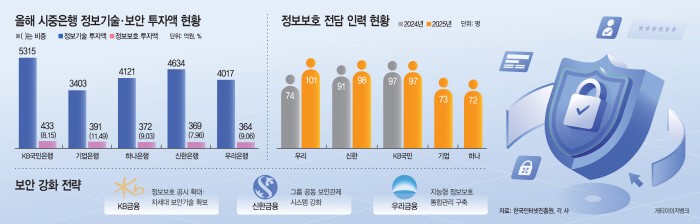 |
As deregulation of financial network isolation gains full momentum, competition among commercial banks to scale up information security investments is intensifying. This year, South Korea's five major commercial banks are channeling a combined total of over 200000000000 won into their information security sectors. This surge comes as the widespread adoption of new digital technologies, such as generative AI and cloud services, elevates customer data protection and advanced security infrastructure to critical management priorities. Among the institutions, KB Kookmin Bank ranked first in total security spending, while IBK Industrial Bank of Korea led in terms of security investment relative to its overall IT budget.
The banking sector's cybersecurity capabilities are expected to become even more pivotal moving forward. While the easing of network separation rules opens wider doors for digital innovation, hacking attempts targeting financial institutions persist, and highly advanced AI systems like Mythos are emerging as new threats capable of exploiting security vulnerabilities. Experts emphasize the need to expand information security disclosures to map out latent vulnerabilities across financial firms while simultaneously establishing collaborative frameworks to share threat intelligence.
According to the information security disclosure database released by the Korea Internet & Security Agency (KISA) on the 1st, the combined information security investment of KB Kookmin, Shinhan, Hana, Woori, and IBK Industrial Bank of Korea for this year reached 192.9 billion won. This represents roughly 9.0% of the 2.1929 trillion won these five banks allocated for their overall information technology (IT) budgets this year.
KB Kookmin Bank topped the list in total security spending, allocating 43.3 billion won to information security this year. Although its overall IT budget shrank by approximately 30 billion won compared to last year, its cybersecurity investment actually increased by nearly 1 billion won. IBK was the sole institution among the five to see its security investment cross the 10% threshold relative to its total IT budget. This is attributed to the bank continuing its aggressive security push this year, following last year's extensive upgrades to its overall security architecture, which included automating threat intelligence collection and enhancing vulnerability scanning systems. "We plan to transition to a Zero Trust-based security architecture through specialized consulting aimed at establishing three core digital financial security innovation strategies," an IBK official stated.
Woori Bank maintained the largest dedicated security workforce with 101 personnel, a sharp increase of 27 employees from the 74 reported last year. "This expansion is the result of a governance reshuffle between Woori Bank and Woori FIS last year, which transferred IT operations personnel from the subsidiary directly into the bank," a Woori Bank official explained. Shinhan Bank also added seven dedicated positions to its workforce to strengthen its cyber terror response mechanisms and bolster capabilities in AI-driven security.
Lately, corporate responses to security threats are expanding to a group-wide level. While individual subsidiaries previously handled security threats independently, financial groups are shifting toward building unified security control centers to boost operational efficiency and seamlessly share vulnerability data among affiliates. KB Financial Group is currently working on expanding security disclosures across its subsidiaries and securing next-generation security tech, while Shinhan Financial and Woori Financial also plan to upgrade their security monitoring systems with emerging technologies in line with their respective information security roadmaps.
The driving force behind financial firms hyper-focusing on strengthening security stems from a series of high-profile hacking incidents that shook the sector last year. Cyber attacks targeting prominent financial firms—including a massive breach at Lotte Card that leaked the data of roughly 3 million customers, alongside incidents at Welix F&I and SGI Seoul Guarantee—fueled deep consumer anxiety. According to KISA, cyber infringement incidents surged 26.3% year-on-year to reach 2,383 cases last year. This triggered widespread concern that the financial sector was failing to cope with increasingly sophisticated hacking methods, despite having operated under stringent security mandates like mandatory network separation.
Security risks across the banking sector are projected to grow as network separation guidelines loosen. Financial regulators are pushing ahead with deregulation to allow financial institutions to leverage cutting-edge technologies like generative AI for daily operations. However, concerns persist that expanding contact points between internal corporate networks and the external internet will inevitably heighten exposure to cyber threats. Industry insiders point out that if highly advanced AI models like Mythos are weaponized to conduct automated hacking and exploit software flaws, managing security risks with current investment and staffing levels will become increasingly difficult.
"Financial firms must independently strengthen their risk assessment protocols and diversify their network openness and security controls based on data sensitivity," said Youm Heung-yeol, an honorable professor of information security at Soonchunhyang University. "Since a vulnerability discovered at one financial firm is highly likely to exist at another, it is critical for the financial sector as a whole to cooperate and build an integrated ecosystem for sharing cyber threat intelligence."
Han Sang-wook
Most Read
-
1
Celltrion’s Omlyclo gains ground in major European..

-
2
Trump demands rates fall below 1% as Fed hikes for..

-
3
Trump makes $1 trillion bet ahead of midterm elect..

-
4
Iran resumes ballistic missile production, assembl..

-
5
Samsung Electronics, Mistral AI to jointly develop..

-
6
Trump warns countries not helping U.S. must pay re..

-
7
Apple launches first foldable, 1 million won prici..

PEOPLE






HEADLINE NEWS
- Trump to roll out ‘unprecedented welcome’ for Xi with B-2 bombers, F-22 fighters
- S. Korea, U.S., and Japan form united front on Taiwan and economic coercion..
- Trump administration moves to impose sweeping sanctions on International Cr..
- Xi to make state visit to U.S. Sept. 23-25, dispelling rumors over his heal..

-
Address : In-Young Bldg., 34, Uisadang-daero 1-gil, Yeongdeungpo-gu, Seoul
Copyright by ASIATODAY CO., LTD. All rights resereved