



U.S.-Iran Doha talks close: Oil sinks to 4-month low amid 10M barrel daily surge through Hormuz
Jul 02, 2026, 09:09 am


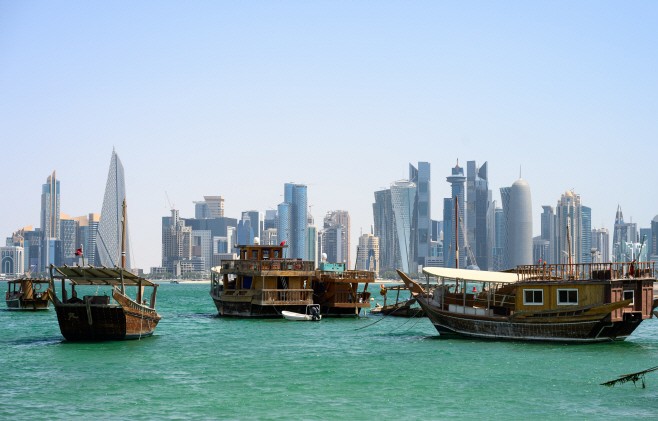 |
| The skyline of Doha's West Bay district in Qatar, captured on June 30 (local time) / Xinhua, Yonhap News |
Working-level delegations from the United States and Iran concluded indirect technical talks in Doha, Qatar, on the 1st (local time) to discuss navigation through the Strait of Hormuz and the unfreezing of assets, Reuters reported, citing diplomatic sources.
While U.S. President Donald Trump claimed that Iran's denuclearization is progressing smoothly, Reuters noted that the nuclear program was not actually addressed during these technical meetings. Meanwhile, shipping traffic through the Strait of Hormuz is nearing levels seen before the war against Iran, which was triggered by U.S. and Israeli airstrikes on February 28, and international oil prices continue to slide.
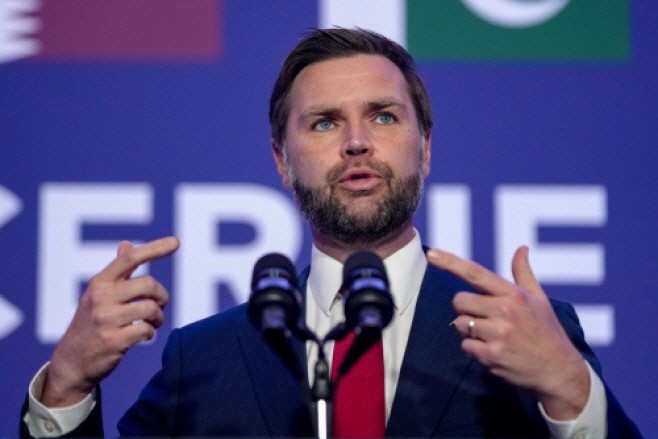 |
U.S. Vice President J. D. Vance speaks about the ceasefire negotiations with Iran at the Bürgenstock Resort near Lucerne, Switzerland, on June 22 (local time). / Reuters·Yonhap. |
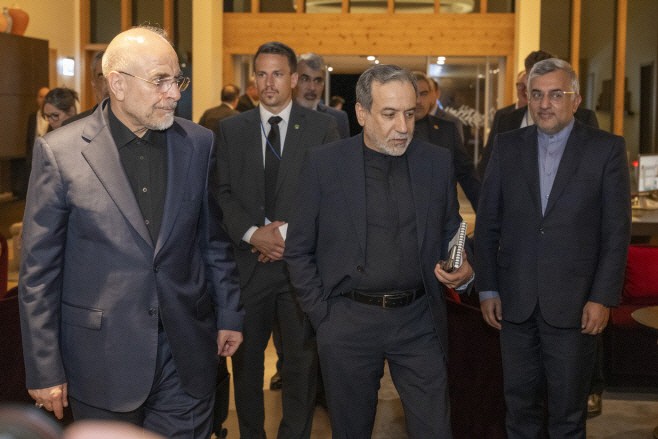 |
| Iranian Parliament Speaker Mohammad Bagher Ghalibaf (left) and Foreign Minister Abbas Araghchi (center) attend a four-party meeting at the Bürgenstock Resort in Obbürgen, near Lucerne, Switzerland, on June 21 (local time). / EPA·Yonhap. |
U.S.-Iran indirect talks conclude in Doha with no direct contact, mediators shuttle between sides
The Iranian negotiating team, led by Deputy Foreign Minister Kazem Gharibabadi, met with Qatari Prime Minister and Foreign Minister Mohammed bin Abdulrahman Al Thani before holding two joint meetings with Qatari and Pakistani mediators. There was no direct contact with the U.S. delegation, according to Iran's state-run IRNA news agency.
Gharibabadi said the discussions focused primarily on Lebanon and options for releasing frozen assets. He added that the participating parties agreed to establish a communication channel by the 2nd to report and document any violations of the memorandum of understanding (MOU).
Reuters reported that the indirect talks began on the 30th of last month and continued into a second day. President Donald Trump's son-in-law Jared Kushner and Middle East envoy Steve Witkoff separately met with Qatari Emir Tamim bin Hamad Al Thani and Prime Minister Al Thani but did not participate in the working-level negotiations, sources said.
Reuters assessed that the Doha talks showed no sign of progress toward a lasting peace, noting that negotiators had instead returned to issues widely believed to have been settled two weeks earlier.
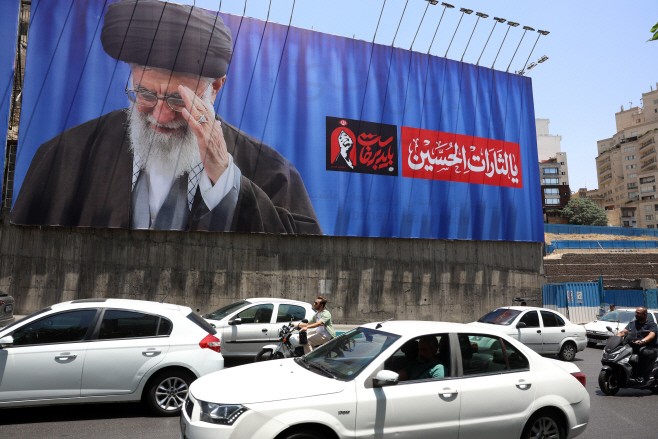 |
| Iranian citizens ride past a large roadside poster of the late Supreme Leader Ali Khamenei along a highway in Tehran on the 1st (local time). / EPA·Yonhap. |
Trump says Iran denuclearization "on track"; Reuters says nuclear issue excluded from working-level agenda
President Donald Trump told reporters at Joint Base Andrews in Maryland that "Iran's denuclearization is progressing smoothly. They had very good talks, and we'll see what happens."
"We put a lot of pressure on them over the past three days, but we're getting along very well," he said. "Denuclearization is moving forward, and everything is going well."
However, Reuters, citing sources with direct knowledge of the negotiations, reported that the nuclear issue was not discussed during the latest working-level talks. U.S. Vice President J. D. Vance told active-duty service members at Naval Air Station Virginia Beach that technical negotiators were meeting with Iranian and Qatari counterparts in Doha to discuss details, including freedom of navigation through the Strait of Hormuz, adding that discussions on the nuclear issue would begin later.
Bloomberg reported that President Trump had internally considered resuming full-scale military action against Iran before opting for negotiations. Responding to the report, Trump said, "They've changed a lot. We hit them hard last week, and we're getting along well," reiterating that "Iran cannot have a nuclear weapon."
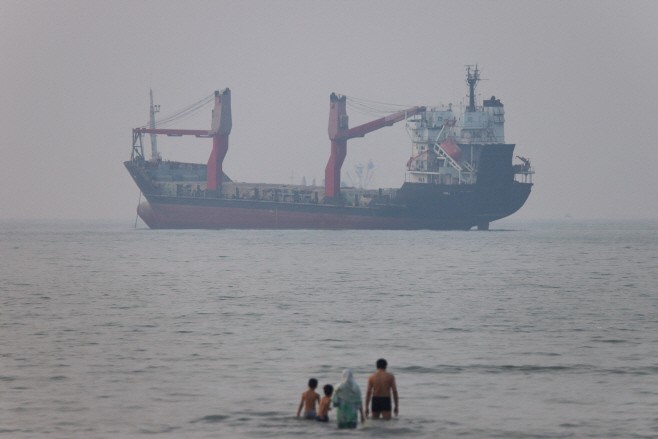 |
| A ship is anchored in the Strait of Hormuz off the coast of Bandar Abbas on June 30 (local time). / Reuters·Yonhap. |
More than 10 million barrels pass through Hormuz daily as Iran asserts control and seeks transit fees
Traffic through the Strait of Hormuz is gradually recovering to prewar levels. Bloomberg, citing Trump administration officials, reported that commercial crude oil shipments transiting the strait have exceeded 10 million barrels per day under air and naval protection provided by the United States Central Command (CENTCOM).
Before the war, about 20 million barrels of crude oil and liquefied natural gas (LNG) passed through the strait each day. Bloomberg said that adding more than 10 million barrels moving through the strait to an additional 5 million barrels transported via alternative routes brings overall energy flows close to normal levels.
The official said Iran only belatedly realized the extent of shipping movements in waters farther from the strait, exposing the limits of its ability to control maritime traffic, which he said helped trigger last week's attack.
However, Iran's chief negotiator and Parliament Speaker Mohammad Bagher Ghalibaf reiterated in a state television interview that "sovereignty over the strait belongs to Iran and Oman," maintaining Tehran's claim to control over the waterway.
Although the United States and Gulf states oppose the move, Associated Press reported that Iran still plans to begin charging transit fees for ships in mid-August after a 60-day fee-free period expires.
Iranian state television reported that a foreign container ship ran aground in shallow waters after failing to follow an Iranian-approved shipping route. AP said the report appeared intended to reinforce Iran's claims of authority over the strait.
Thailand's Foreign Ministry said 10 of 11 Thai-flagged or Thai-operated vessels had safely departed the strait. South Korean authorities also said 24 of the 26 South Korean-linked ships that had been stranded had now exited the area.
Brent falls to $71.57 as war risk premium fades from oil market
Global oil prices continued to decline as shipping through the Strait of Hormuz resumed. On London's Intercontinental Exchange, Brent crude futures for September delivery fell 1.9% to $71.57 per barrel, the lowest level since Feb. 26, before the outbreak of the war. On the New York Mercantile Exchange (NYMEX), August West Texas Intermediate (WTI) crude futures dropped 1.3% to $68.58 per barrel.
Bloomberg reported that Mars, the U.S. benchmark for heavy sour crude, fell this week to a discount of $3 per barrel relative to NYMEX futures, its weakest level since January 2023. At the height of the conflict, Mars had traded at a premium of about $18 per barrel over futures, but that premium has now completely disappeared.
According to the U.S. Energy Information Administration (EIA), U.S. commercial crude inventories fell by 3.8 million barrels during the week ending June 26 to 408.4 million barrels, the lowest level since September 2018.
Despite lower oil prices, the Trump administration is proceeding with plans to release 172 million barrels from the Strategic Petroleum Reserve (SPR). Bloomberg said the additional supply has also contributed to weakness in Mars crude prices.
Neil Crosby, head of research at Sparta Commodities, told Bloomberg that "virtually the entire crude market has turned bearish," adding that increasing supplies of heavy crude flowing through the Strait of Hormuz are putting downward pressure on U.S. and Latin American crude grades.
Ha Man-joo
Most Read
-
1
Alteogen secures European patent for Keytruda SC,..

-
2
Trump shares map on social media labeling Strait o..

-
3
Celltrion seeks rheumatoid arthritis indication ex..

-
4
Kia Sportage outperforms Mazda CX-5 in German auto..

-
5
Chinese e-commerce giants AliExpress, Temu and She..

-
6
U.S. deploys carrier, 10,000 more troops to Middle..

-
7
Trump rejects Iran's offer to open Strait of Hormu..

PEOPLE







-
Address : In-Young Bldg., 34, Uisadang-daero 1-gil, Yeongdeungpo-gu, Seoul
Copyright by ASIATODAY CO., LTD. All rights resereved