



Asian stock markets record strongest quarterly gains in 17 years on AI and chip surge
Jul 01, 2026, 05:08 pm


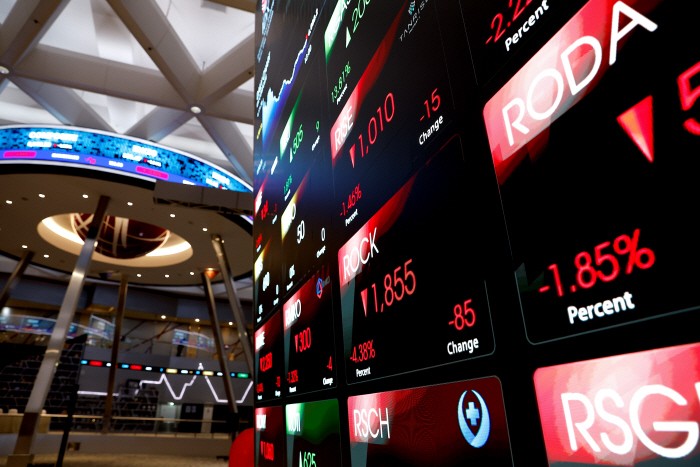 |
A stock market display board inside the Indonesia Stock Exchange in Jakarta on the 24th / EPA, Yonhap News
Asian stock markets are poised to sustain their upward momentum into the third quarter, following a spectacular second-quarter rally driven by semiconductor and artificial intelligence (AI) equities that delivered the region's best quarterly performance in 17 years since 2009, Bloomberg News reported on the 30th (local time).
During the second quarter, Taiwan’s equity market surged approximately 35% to 40% compared to the previous quarter, led primarily by a stellar 30% jump in TSMC’s share price.
In South Korea, memory chipmakers SK Hynix and Samsung Electronics exhibited robust growth. On the 22nd, SK Hynix achieved a market capitalization of 2,080 trillion won, overtaking Samsung Electronics to claim the top spot in market value on the KOSPI. On that day, the combined market capitalization of the two tech giants reached 2.69 trillion dollars (approximately 4,146 trillion won).
Over the same period, Japanese equities joined the upward trend as a weakening yen fueled optimism over exporter earnings. In China, despite persistent economic uncertainties, a rebound in select technology and internet firms helped lift market sentiment.
Following a tech-led rally that pushed U.S. markets higher on the day, stock index futures in Japan and South Korea also advanced. A broader semiconductor stock index jumped roughly 4%, anchoring a historic quarterly gain.
Expectations remain high for further gains in the third quarter. Because the performance of Wall Street directly impacts Asian bourses, the ongoing rally in U.S. tech stocks is triggering a chain reaction across Asian futures and spot markets, reinforcing investor appetite for risk assets.
"The market is showing an incredible ability to rally and ultimately shake things off, despite deep sell-offs and external factors like the war involving Iran," noted JJ Kinahan, vice president at Cboe Global Markets.
In Taiwan and South Korea, the semiconductor and AI supply chains are projected to maintain their strength, buoyed by recovering memory chip demand and robust export momentum. Continued expansion in demand for data center and server chips provides an additional positive outlook.
In Japan, the yen's slide to a 40-year low is expected to keep bolstering exporter corporate earnings. Furthermore, the stabilization of global oil prices following the recent ceasefire agreement between the United States and Iran has eased cost pressures on the manufacturing and transportation sectors, serving as a supportive backdrop for Asian equities as a whole.
"While we saw brief movements in energy markets due to intermittent friction in the Middle East, investors are looking toward a relatively orderly reopening of the Strait of Hormuz and a gradual normalization of global oil flows," explained Daniela Hathorn, senior market analyst at Capital.com.
Park Jin-sook |
Most Read
-
1
Trump shares map on social media labeling Strait o..

-
2
Kia Sportage outperforms Mazda CX-5 in German auto..

-
3
Houthis launch successive attacks on Saudi airport..

-
4
U.S. deploys carrier, 10,000 more troops to Middle..

-
5
Trump rejects Iran's offer to open Strait of Hormu..

-
6
N. Korea conducts first swarm attack drill with dr..

-
7
U.S.-China summit falls short on substance as Trum..

PEOPLE






HEADLINE NEWS
- Seoul dismisses Ukraine's claim of 'S. Korean support for Russia' as "inaccurate and inappropriate"
- S. Korea, Japan race to develop nuclear-powered submarines
- Henri Kagan, Kenso Soai win Nobel Prize in Chemistry for uncovering how mol..
- Vance says Alaska LNG cooperation will move forward with Seoul's current or..

-
Address : In-Young Bldg., 34, Uisadang-daero 1-gil, Yeongdeungpo-gu, Seoul
Copyright by ASIATODAY CO., LTD. All rights resereved