



U.S. Supreme Court blocks Trump’s executive order restricting birthright citizenship
Jul 01, 2026, 03:56 pm


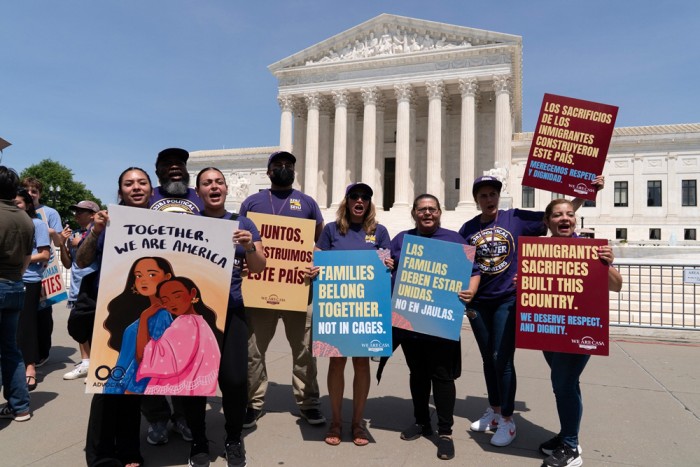 |
| Social activists gather in front of the U.S. Supreme Court on Capitol Hill in Washington, D.C., on June 30 (local time) to celebrate the ruling that struck down executive efforts to restrict birthright citizenship / AP, Yonhap News |
The U.S. Supreme Court on the 30th (local time) struck down President Donald Trump’s plan to restrict birthright citizenship—a cornerstone of his hardline immigration agenda—ruling the measure unconstitutional. Birthright citizenship is a long-standing system that automatically grants citizenship to individuals born on U.S. soil.
Bloomberg News reported that the high court found the executive order, signed by President Trump in January last year, incompatible with the 14th Amendment of the U.S. Constitution, which guarantees citizenship to nearly everyone born within the United States.
The justices voted 6-3 to invalidate the executive order. Justice Brett Kavanaugh, while joining the majority, noted that although he disagreed with certain aspects of the constitutional interpretation, the order must be struck down because it violated federal law.
"Citizenship, then and now, means the right to have rights—the right to participate freely in our political community," Chief Justice John Roberts wrote in the majority opinion. "The framers of the 14th Amendment extended that promise to all persons born free on this soil, and we uphold that promise today."
President Trump criticized the decision on social media, stating, "The Supreme Court's ruling upholding birthright citizenship is an unfortunate development for our country, but it can easily be corrected through legislation in Congress with presidential support. A long and cumbersome constitutional amendment is not required."
He added, "Congress must immediately begin work to abolish the birthright citizenship system, which imposes massive costs on our nation and is profoundly unfair. I will fully back these efforts in Congress."
The U.S. Department of Justice expressed disapproval of the ruling on social media, stating it would make the criminal prosecution of birth-tourism networks nationwide a top priority.
Potential measures under consideration by the Justice Department include prosecuting individuals who falsify their reasons for entering the United States on visa applications.
Cecillia Wang, national legal director of the American Civil Liberties Union (ACLU), which represented the plaintiffs challenging the executive order, welcomed the decision. "The court's ruling today reaffirms America’s foundational promise: if you are born here, you are a citizen," Wang said. "A president cannot alter the Constitution through an executive order."
Immigrant rights organizations and Democratic state attorneys general lauded the ruling, noting that it prevents infants born to individuals seeking a better life in the United States from effectively being rendered stateless.
Lower courts had unanimously ruled the executive order unlawful. Following an initial ruling by the U.S. District Court for the District of New Hampshire, the Trump administration bypassed the federal appeals circuit to petition the Supreme Court directly.
Kim Hyun-min
Most Read
-
1
Trump shares map on social media labeling Strait o..

-
2
Kia Sportage outperforms Mazda CX-5 in German auto..

-
3
Houthis launch successive attacks on Saudi airport..

-
4
U.S. deploys carrier, 10,000 more troops to Middle..

-
5
Trump rejects Iran's offer to open Strait of Hormu..

-
6
N. Korea conducts first swarm attack drill with dr..

-
7
U.S.-China summit falls short on substance as Trum..

PEOPLE





HEADLINE NEWS
- Seoul dismisses Ukraine's claim of 'S. Korean support for Russia' as "inaccurate and inappropriate"
- S. Korea, Japan race to develop nuclear-powered submarines
- Henri Kagan, Kenso Soai win Nobel Prize in Chemistry for uncovering how mol..
- Vance says Alaska LNG cooperation will move forward with Seoul's current or..

-
Address : In-Young Bldg., 34, Uisadang-daero 1-gil, Yeongdeungpo-gu, Seoul
Copyright by ASIATODAY CO., LTD. All rights resereved