



UK increases defense spending by 31 trillion won
Jul 01, 2026, 12:57 pm


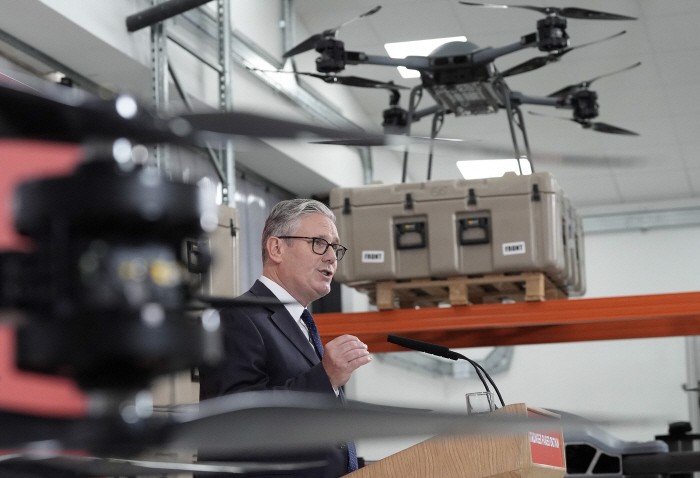 |
British Prime Minister Keir Starmer delivers a keynote address positioned directly beneath a military drone in Berkshire, England, on June 30. During the event, Starmer officially launched the long-delayed Defence Investment Plan to dramatically ramp up spending on drone warfare and autonomous systems. / AFP, Yonhap News
British Prime Minister Keir Starmer unveiled a comprehensive defense investment plan on the 30th (local time), injecting an additional 15 billion pounds (approximately 30.8 trillion won) to modernize the nation's military. Under this blueprint, the UK’s annual defense expenditure is projected to scale up to 79 billion pounds (approximately 162.7 trillion won) by 2029.
Prime Minister Starmer is scheduled to present the outline during the upcoming NATO summit in Ankara, Turkey, on July 7–8. The move is designed to fulfill the UK’s existing pledge to raise its defense spending to 3.5% of gross domestic product (GDP) by 2035.
NATO Secretary General Mark Rutte welcomed the announcement, calling it "progress toward last year’s Hague agreement."
In response to mounting pressure from the United States to increase defense contributions, NATO allies previously agreed to invest 5% of their GDP into defense and security by 2035, splitting the allocation into 3.5% for direct defense spending and 1.5% for broader national security costs. With this new investment initiative, Starmer aims to lift the UK's direct defense budget to 3% of GDP by 2029.
The newly minted package earmarks 5 billion pounds (approximately 10.3 trillion won) for the development of drones and autonomous weapons systems, alongside funding for the creation of a hybrid navy, enhancements to army firepower, and sustained support for the nuclear deterrent and next-generation stealth fighter programs. The strategic ramp-up aims to bolster the UK's wartime readiness amid stark warnings from military intelligence regarding a potential Russian assault on NATO by 2030.
While the figures announced by Starmer represent an increase from earlier drafts, the plan faced a rollout delay of over nine months and still falls short of the 28 billion pounds (approximately 57.8 trillion won) initially demanded by military chiefs. Reuters reported that debates persist over funding mechanisms and the overall efficacy of the package.
Tom Sharpe, a retired Royal Navy commander, dismissed the spending as a mere "sticking-plaster solution," warning of chronic underfunding particularly within the hybrid navy initiative. Defense analysts also cautioned that budget shortfalls could delay procurement of certain military hardware or lead to spending cuts in troop training and infrastructure maintenance.
With the incoming prime minister candidate Andy Burnham expected to take office as early as July 20, Starmer urged policy continuity, stating, "This blueprint provides a solid foundation for the next government to steadily expand our national defense capabilities." Consequently, the complex challenges of securing funding sources and managing the fiscal strain on public investments will fall squarely on the shoulders of the next administration.
Lee Jeong-eun |
Most Read
-
1
Trump shares map on social media labeling Strait o..

-
2
Kia Sportage outperforms Mazda CX-5 in German auto..

-
3
Houthis launch successive attacks on Saudi airport..

-
4
U.S. deploys carrier, 10,000 more troops to Middle..

-
5
Trump rejects Iran's offer to open Strait of Hormu..

-
6
N. Korea conducts first swarm attack drill with dr..

-
7
U.S.-China summit falls short on substance as Trum..

PEOPLE






HEADLINE NEWS
- Seoul dismisses Ukraine's claim of 'S. Korean support for Russia' as "inaccurate and inappropriate"
- S. Korea, Japan race to develop nuclear-powered submarines
- Henri Kagan, Kenso Soai win Nobel Prize in Chemistry for uncovering how mol..
- Vance says Alaska LNG cooperation will move forward with Seoul's current or..

-
Address : In-Young Bldg., 34, Uisadang-daero 1-gil, Yeongdeungpo-gu, Seoul
Copyright by ASIATODAY CO., LTD. All rights resereved