



Hanoi hosts 7th Korea-Vietnam Future Forum
Jul 01, 2026, 10:09 am


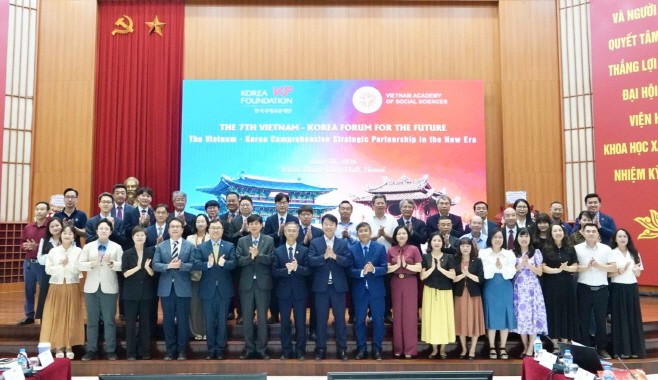 |
| Participants pose for a group photo at the 7th Korea-Vietnam Future Forum held at the Vietnam Academy of Social Sciences (VASS) in Hanoi on June 30 / Courtesy of VASS |
The Korea-Vietnam Future Forum, a joint public-private consultative body, convened its seventh meeting in Hanoi on the 30th of last month (local time). During the session, the forum adopted "Hanoi Message 2026," a policy consensus proposing a paradigm shift in bilateral cooperation—moving from the traditional division of labor where South Korea invests and Vietnam manufactures toward a model of "co-creation" in advanced and strategic sectors such as semiconductors, artificial intelligence (AI), and critical minerals. This shift stems from a shared understanding that amidst intensifying U.S.-China rivalry and weakening international norms, the 30-year-old formula of relying solely on an investor-to-production base relationship is no longer sufficient to propel both middle-power nations into the next stage of growth.
Co-hosted by Guido Song, President of the Korea Foundation (KF), and Le Van Loi, President of the Vietnam Academy of Social Sciences (VASS), the forum took place at the Thang Long Hall of VASS. The event drew roughly 120 attendees, including an 18-member South Korean delegation, a 15-member Vietnamese delegation, and key figures from the government, academia, business, and media sectors of both nations.
Launched in 2012 to mark the 20th anniversary of diplomatic ties, the Korea-Vietnam Future Forum is a Track 1.5 consultative body co-organized by the KF and VASS. Under the overarching theme of "A New Era for the Korea-Vietnam Comprehensive Strategic Partnership," this year's forum was structured into four sessions covering foreign policy and security, economy, science and technology, and joint policy recommendations.
In his opening remarks, Dang Xuan Thanh, Vice President of VASS, stated that bilateral relations have entered an era of "new thinking, long-term vision, and concrete actions," adding that Vietnam is currently building the "Red River Miracle" by drawing on South Korea's experience with the "Han River Miracle." The forum set out to evaluate the achievements and limitations of over three decades of diplomatic ties, identify priority areas and new growth engines for the 2026–2035 period, and chart a course toward a long-term vision for 2045.
The messages delivered by key dignitaries aligned toward a single vision. Nguyen Minh Vu, Permanent Vice Minister of Foreign Affairs of Vietnam, noted that the core commonality between the two nations lies not in resources or territory, but in their shared aspiration for development and their capacity for innovation and adaptation, citing these traits as the foundation for their next phase of partnership. Choi Young-sam, South Korean Ambassador to Vietnam, highlighted cooperation opportunities in strategic technology fields—including AI, semiconductors, logistics, energy, and infrastructure—expressing optimism that the discussions would culminate fruitfully in "Hanoi Message 2026." KF President Guido Song and lawmaker Moon Jin-seok, who serves as President of the Korea-Vietnam Parliamentarian's Friendship Association, also agreed that bilateral relations have advanced into a more substantive stage centered on cutting-edge technologies and future industries.
The recommendations began with an assessment of the current international order. Nguyen Thi Tham, Director of the Center for Korean and North Korean Studies at VASS, and Lee Jae-hyon, Senior Fellow at the Asan Institute for Policy Studies, characterized the all-encompassing spread of U.S.-China competition into the economy, technology, and supply chains—coupled with the waning binding power of international organizations and norms—as a strategic dilemma confronting both nations. As two middle powers heavily dependent on trade and global supply chains, both countries face mounting pressure to choose sides between global superpowers.
Against this backdrop, the forum proposed "co-creation" as the optimal solution. This entails breaking away from the established structure where South Korea supplies capital and technology while Vietnam handles assembly and manufacturing. Instead, the focus will pivot toward conducting joint research and development and fostering technological self-reliance in next-generation industries like semiconductors, AI, batteries, critical minerals, renewable energy, and biotechnology. The recommendation emphasized that this pivot aims to reanchor bilateral ties from a "trade and investment" axis onto a "strategic partnership geared toward autonomy, sustainability, and shared prosperity."
The forum crystallized this transition into five core action items. In the realm of diplomacy, it proposed establishing a "2+2 Dialogue Mechanism" involving the foreign and defense ministers of both countries, suggesting that strategic dialogues between the two middle powers be institutionalized to avoid being swept up in superpower rivalries. Regarding investment, the forum urged the formulation of policies and incentives to shift South Korea's foreign direct investment (FDI) in Vietnam away from labor-intensive, low-value-added sectors toward high-tech and strategic industries, while increasing local sourcing by major South Korean conglomerates to integrate Vietnamese firms deeper into global supply chains.
The remaining three tasks focused on closing the gap between policy consensus and actual implementation. For green and non-traditional security sectors, the forum advised drawing up technical guidelines for Direct Power Purchase Agreements (DPPA) and setting up an independent oversight body to monitor implementation performance. In infrastructure, the scope of cooperation will expand beyond roads and railways to include 5G and 6G telecommunication networks, data centers, and offshore wind power, alongside commencing full operations at a joint critical minerals supply chain center, including rare earth elements. To cultivate talent, plans were laid out to establish an AI and Digital Subcommittee and launch an AI and semiconductor training package centered around the Vietnam-Korea Institute of Science and Technology (V-KIST).
This shifting dynamic is driven by the rapid progress in bilateral relations over recent years. After elevating their ties to the highest level of a Comprehensive Strategic Partnership in 2022, the two nations broadened their framework for cooperation across nuclear energy, infrastructure, and science and technology, reinforced by General Secretary and President To Lam's visit to South Korea last August and President Lee Jae-myung's state visit to Vietnam this past April. The two countries have set a target to expand their bilateral trade volume from 94.6 billion dollars last year to 150 billion dollars by 2030.
Participants from both nations concluded by proposing a summit meeting in 2027 to coincide with the 35th anniversary of diplomatic ties, providing a platform to comprehensively review the outcomes and future tasks of this cooperation. They emphasized that the remaining challenge is no longer about signing more agreements, but rather about translating existing commitments into actual projects and tangible on-site results.
Jeong Ri-na
Most Read
-
1
Trump shares map on social media labeling Strait o..

-
2
Kia Sportage outperforms Mazda CX-5 in German auto..

-
3
Houthis launch successive attacks on Saudi airport..

-
4
U.S. deploys carrier, 10,000 more troops to Middle..

-
5
Trump rejects Iran's offer to open Strait of Hormu..

-
6
N. Korea conducts first swarm attack drill with dr..

-
7
U.S.-China summit falls short on substance as Trum..

PEOPLE





HEADLINE NEWS
- Seoul dismisses Ukraine's claim of 'S. Korean support for Russia' as "inaccurate and inappropriate"
- S. Korea, Japan race to develop nuclear-powered submarines
- Henri Kagan, Kenso Soai win Nobel Prize in Chemistry for uncovering how mol..
- Vance says Alaska LNG cooperation will move forward with Seoul's current or..

-
Address : In-Young Bldg., 34, Uisadang-daero 1-gil, Yeongdeungpo-gu, Seoul
Copyright by ASIATODAY CO., LTD. All rights resereved