



From 'radical leftist' to Democratic kingmaker: Mamdani's 6 months
Jun 30, 2026, 10:41 am


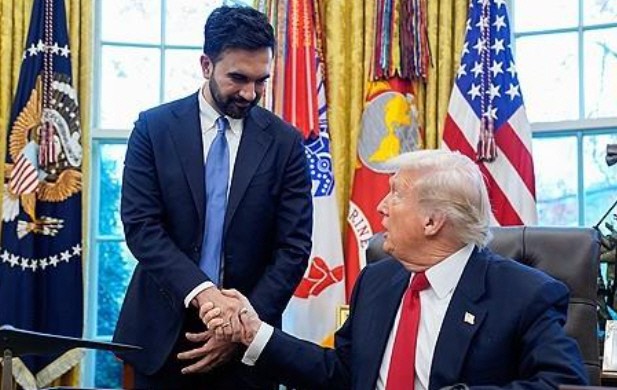 |
| Mayor Mamdani, who visited the Oval Office after being elected Mayor of New York City in November 2025, is talking with US President Donald Trump. / Courtesy of UPI and Yonhap News Agency |
US New York City Mayor Zohran Mamdani (34), who received fierce criticism from the conservative bloc at the time of inauguration for 'making New York a socialist city,' marks his 6 months in office on the 1st of next month (local time).
Standing at the center of controversy for his short political career and radical image, he is now emerging as a new symbol and 'kingmaker' of the Democratic progressive bloc, receiving the attention of US political circles.
Synthesizing the New York Times (NYT) and Wall Street Journal (WSJ) on the 29th, Mayor Mamdani has risen as a fresh politician in the progressive bloc since his days as a New York State lawmaker, putting forward the expansion of housing rights and reform of the establishment. In the New York City mayoral election in November last year, he caused a sensation by defeating former New York Governor Andrew Cuomo, a political bigwig. Concerns over whether it is right to entrust the largest economic city in the US where Wall Street is located to a politician in his 30s with democratic socialist tendencies also continued right after the election.
However, the municipal administration assessment in New York was actually different from expectations. In a survey announced by Siena College on the 25th, Mayor Mamdani's positive assessment was 58%, greatly exceeding the negative assessment (26%). As the positive assessment became higher and the negative assessment became lower compared to the April survey, analysis comes out that the municipal administration operation in the early phase of his term has settled relatively stably.
His political influence also became even greater. In the New York State US House of Representatives Democratic primary recently held, all three candidates whom Mayor Mamdani publicly endorsed won. The WSJ evaluated on the 24th, "Leftist candidates linked with the Democratic Socialists of America (DSA) defeated mainstream incumbents in the most progressive congressional districts in the US," adding, "With this result, Mamdani scored a victory, and he firmly secured his status as a powerful kingmaker who can lead congressional elections."
Analysis notes that behind this kind of change is pragmatism choosing compromise with realpolitik. Although he strongly asserted tax hikes on the wealthy and welfare expansion during the election process, he showed a appearance of adjusting policies to match political reality after taking office. The introduction of a wealth tax that he consistently asserted fell through due to the opposition of New York Governor Kathy Hochul, and the New York City property tax increase pursued as an alternative was also withdrawn, accepting citizen backlash and city council opposition.
Meeting with President Donald Trump twice at the White House is also interpreted in the same context. The assessment is that unlike the hardline image during the election, he chose cooperation and practical benefits in municipal administration operation, showing a appearance closer to a 'pragmatic administrator' rather than a 'radical politician.'
The fact that he did not give up core pledges is also picked as a primary cause of the positive assessment. Since taking office, he pursued housing cost burdens, childcare support, and public service expansion as core tasks. Especially, as the New York City Rent Guidelines Board decided on the 25th to freeze rents for rent-stabilized apartments applied to approximately 1 million households, he realized one of his representative pledges.
However, these policies still see mixed pros and cons. Landlord groups are rebelling that the rent freeze will distort the private rental market, and the taxation on ultra-expensive second homes also brought about conflict with billionaires. The corresponding tax bill passed the New York State Legislature last month, but the conservative bloc is criticizing it as 'leftist populism.'
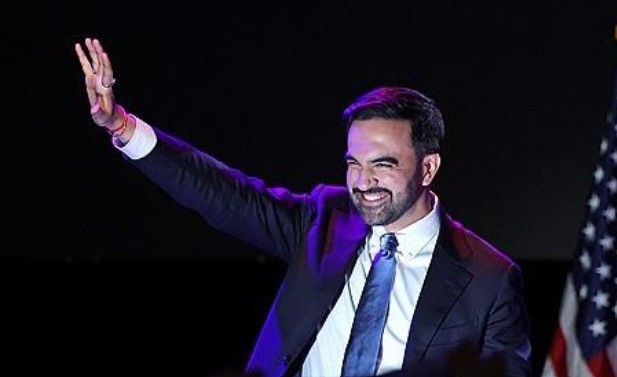 |
Newly elected New York City Mayor Mamdani waves joyfully after winning the election in November last year. / Courtesy of AFP and Yonhap News Agency |
Foreign affairs and national security issues also remain a political burden. As approximately 1.6 million Jewish people reside in New York, Mayor Mamdani's pro-Palestinian tendency is the most sensitive item of controversy. He maintains the position that although he clearly opposes antisemitism, criticizing the Israeli government's Palestinian policy is a separate matter. However, some Jewish groups and conservative political circles are continuing their offensive, claiming that he is virtually side-taking with Hamas.
In just half a year since taking office, Mayor Mamdani is positioning himself beyond a local politician of New York into the new face of the Democratic progressive bloc. However, whether his rise to a national political star will end as a temporary gust or become a new model of the Democratic Party based on actual administrative achievements is expected to be decided by his future municipal administration operation.
Nam Mi-Kyung
Most Read
-
1
Trump shares map on social media labeling Strait o..

-
2
Kia Sportage outperforms Mazda CX-5 in German auto..

-
3
Houthis launch successive attacks on Saudi airport..

-
4
U.S. deploys carrier, 10,000 more troops to Middle..

-
5
Trump rejects Iran's offer to open Strait of Hormu..

-
6
N. Korea conducts first swarm attack drill with dr..

-
7
U.S.-China summit falls short on substance as Trum..

PEOPLE






HEADLINE NEWS
- Seoul dismisses Ukraine's claim of 'S. Korean support for Russia' as "inaccurate and inappropriate"
- S. Korea, Japan race to develop nuclear-powered submarines
- Henri Kagan, Kenso Soai win Nobel Prize in Chemistry for uncovering how mol..
- Vance says Alaska LNG cooperation will move forward with Seoul's current or..

-
Address : In-Young Bldg., 34, Uisadang-daero 1-gil, Yeongdeungpo-gu, Seoul
Copyright by ASIATODAY CO., LTD. All rights resereved