



Bureaucratic blind spot leaves 1.75 million eligible seniors without basic pension
Jun 30, 2026, 09:24 am


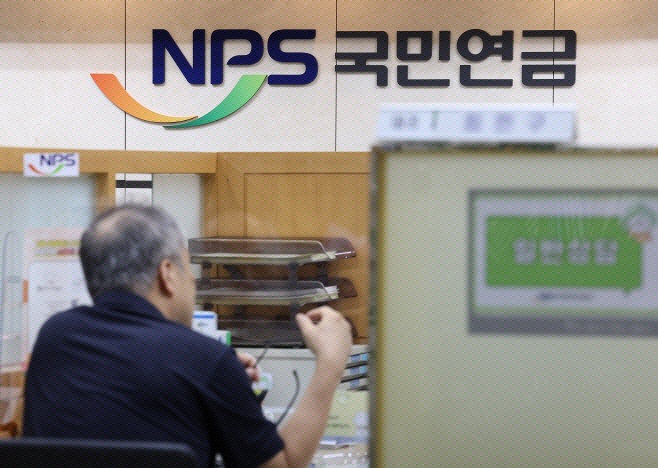 |
| A citizen consults with a counselor at the Seoul Northern Regional Headquarters of the National Pension Service in Seodaemun-gu, Seoul. / Courtesy of Yonhap News |
It has been revealed that the number of elderly individuals aged 65 and over who fail to receive the pension despite satisfying the government’s basic pension recognized income criteria reaches up to 1.75 million. Pointed out arises that this is the result of a complex interplay of occupational pension exclusions, benefit reductions following linkage with the national basic livelihood security system, and administrative blind spots stemming from the application-only principle.
According to the 'Study on the Current Status and Characteristics of Non-recipients of Basic Pension' released on the 30th by Research Fellow Oh Jong-seok and Associate Research Fellow Hong Seong-un of the National Pension Research Institute, as of 2024, among approximately 8.3 million seniors who fall below the basic pension selection criteria threshold, the number of individuals who actually received the basic pension stands at 6.55 million. The remaining 1.75 million were classified as non-recipients who meet the income and asset criteria but do not receive the basic pension.
According to the analysis results, the recognized income of non-recipients displayed a "double-peak structure" concentrating in two specific sections. Approximately 200,000 individuals crowded into the monthly 0 to 90,000 won bracket where income is close to none, and approximately 100,000 individuals also concentrated in the monthly 1.9 million to 1.99 million won bracket close to the selection criteria threshold.
A significant portion of non-recipients near the selection criteria threshold turned out to be recipients of special occupational pensions—such as the public official pension, private school schoolteachers pension, military personnel pension, and private post office pension—and their spouses. The current Basic Pension Act excludes these individuals from the eligibility pool in principle, even if their income and asset levels are low.
As of 2024, low-income occupational pension recipients and their spouses numbered over 403,000, accounting for 3.9% of the total elderly population. The research team analyzed that as the basic pension selection criteria threshold rises every year, occupational pension recipients who meet the income criteria but are legally excluded are continuously increasing.
The linkage structure with the national basic livelihood security system was pointed out as the primary cause for non-recipients in the lowest-income bracket. As of 2024, single elderly recipient households who received basic livelihood security livelihood benefits but did not apply for the basic pension were estimated at over 69,000.
The non-application issue of vulnerable groups who have mobility difficulties or face hardships in information access was also confirmed. Among seniors not receiving basic livelihood security, those who have disabilities but do not receive the basic pension were estimated at over 64,000, and seniors who did not apply for the basic pension despite receiving a long-term care grade also reached up to 105,000. The research team analyzed that a substantial number of individuals belonging to classes facing difficulties undergoing application procedures due to cognitive decline and mobility restrictions are included.
In addition to this, individuals who lost National Health Insurance eligibility—such as deceased individuals and overseas emigrants—were estimated at over 123,000, and misclassified individuals due to differences in analysis models were calculated at over 91,000.
Furthermore, the research team viewed that achieving the government target of a 70% recipient rate is not easy through the method of continuously raising only the basic pension selection criteria threshold. This is because as long as the application-only principle and legal exclusion structures are maintained even if the income criteria are expanded, the blind spots of the low-income bracket and vulnerable groups who need actual help will not be resolved.
Accordingly, the research team suggested that it is necessary to review support plans for low-income occupational pension recipients and improve the benefit reduction structure occurring through linkage with the basic livelihood security system. Along with this, they emphasized that only when a system is arranged to preemptively discover vulnerable groups facing difficulties applying directly—such as individuals with disabilities and long-term care grade holders—utilizing administrative information and provide automatic payments, can the basic pension function as a substantial retirement income security system.
Kim Se-mi
Most Read
-
1
Celltrion’s Omlyclo gains ground in major European..

-
2
Trump demands rates fall below 1% as Fed hikes for..

-
3
Hyundai Motor Group breaks ground on integrated st..

-
4
U.S. strikes 3 Iranian oil tankers, Iran vows reta..

-
5
Trump makes $1 trillion bet ahead of midterm elect..

-
6
Iran resumes ballistic missile production, assembl..

-
7
Samsung Electronics, Mistral AI to jointly develop..

PEOPLE






-
Address : In-Young Bldg., 34, Uisadang-daero 1-gil, Yeongdeungpo-gu, Seoul
Copyright by ASIATODAY CO., LTD. All rights resereved