



S. Korea joins space race late: How much of the final frontier can Seoul claim?
Jun 30, 2026, 09:18 am


 |
President Lee Jae-myung held the 'Future New Security Innovation Enterprise Fostering Strategy Meeting' on the past 26th and stated, "We will introduce an innovation-promoting contract system in non-defense sectors such as aerospace, and newly create an advanced technology-type acquisition system in the defense sector." This is interpreted as viewing space as a realm of security and building a structure to cooperate with the private sector—which previously led the industry—thereby connecting it to the strengthening of national security. The Korea Aerospace Administration (KASA) announced guidelines for the private utilization of the Naro Space Center on the 29th—immediately after President Lee's remarks—and decided to support enterprises' use of the launch site starting next year.
The determination to comprehensively support related enterprises at the national level stems from the judgment that space should not be viewed merely as a realm of industry. In modern warfare, space is evaluated as an 'ownerless space' where fierce sovereignty disputes take place, and a 'warfare base' that will determine the victory or defeat of ground wars. Military powerhouses such as the United States and China have already jumped into the space hegemony competition a long time ago. South Korea also came to view the 'space domain' as official security through the revision of the National Intelligence Service Act in 2021 and subsequently achieved the enactment of guidelines, but unfortunately, it is counted as a latecomer when it comes to space security.
Satellites quintuple in 6 years in ownerless space; South Korea is a 'latecomer'
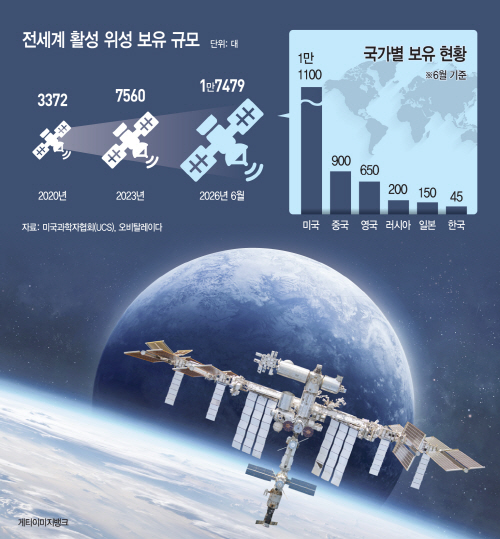
The core of space security is satellites. According to the satellite tracking platform Orbital Radar, as of the 29th, the total number of satellites sent into space by each country worldwide is 28,871. Among these, the satellites currently performing missions number 17,479. This is a level that increased by jumping over fivefold in six years from 3,372 in 2020. Considering that they were limited to a mere 7,560 until 2023, it amounts to a sharp increase over the past three to four years. By country, the United States is in an overwhelming lead with over 11,100, followed by China with over 900, the United Kingdom with over 650, Russia with over 200, and Japan with over 150. South Korea stops at 45, falling short of even 50.
The reason why countries around the world are jumping into the satellite business is clear. Satellites are sent to different distances depending on their purpose, and the number reaching nearly 90% of all satellites worldwide consists of low Earth orbit (LEO) and geostationary orbit (GEO) satellites. LEO satellites are closest to Earth and perform missions to clearly observe the ground surface, mainly used for military reconnaissance. GEO satellites are the second closest satellites, with broadcasting and communication as their primary missions. Most are capable of military functions such as reconnaissance and communication, meaning they intend to secure the eyes and ears that will take the upper hand in ground wars in times of emergency.
The National Intelligence Service (NIS), together with KASA, plans to additionally launch 10 constellation satellites through the Nuri rocket by 2027, but actual satellite operation is still in an early stage. Satellites represent a field where various materials and complex technologies combine, into which capital and manpower are relatively heavily injected. This is the reason why the government emphasized a 'one team' with private enterprises.
In fact, among the U.S. satellites that occupy the majority currently, over half—surpassing 10,000 units—consist of LEO satellites launched by SpaceX, led by Elon Musk. 'Starlink'—a high-speed satellite communication service utilizing these—even played an active role on actual battlefields. Ukraine, whose national communication network was neutralized by Russia's missiles and cyberattacks during the early phase of the Russia-Ukraine war, became capable of communication and mission execution again through the U.S. support of Starlink. This is a case where striking ground infrastructure did not lead to an advantage on the battlefield. It means the preemptive occupation of space domain determines even ground hegemony. In fact, Elon Musk arbitrarily stopped the operation of Starlink terminals in the Ukrainian region in September 2022, and this soon led to the suspension of the entire military's operations.
The place chasing this closely is China. Recently, the Washington think tank 'Information Technology and Innovation Foundation (ITIF)' evaluated in a report that China gets ahead of the United States in the fields of remote sensing and satellite imagery. Indeed, this past April, a commercial satellite of China photographed a U.S. airbase stationed in the Middle East, and analyzed and disclosed the predicted movement path of the U.S. military. The foundation stated, "Most of China's commercial space technology has high military utility." China plans to overcome even the satellite communication field—where it is relatively lagging behind—by 2030 through the 'Qianfan (A Thousand Sails)' project, which launches 15,000 LEO satellites.
On the other hand, the LEO satellites South Korea is operating number a mere 20 or so. Even at this very moment, thousands of satellites are passing through the orbit above the Korean Peninsula. In particular, from the standpoint of our country, which is pursuing the transition of wartime operational control (OPCON), observations emerge indicating that this new security fostering policy could become a 'turning point.' Kang Gun-jak, first deputy director of the National Security Office, stated at the Hongneung Defense Forum on the past 23th, "If we fail to secure the sovereignty of LEO satellite communication networks, data-based sources, the Korean version of MSS (an AI-based military intelligence analysis platform), and the practical operation of OPCON could all become empty words."
Even North Korean cyberattacks; South Korea must stake its all on space
As it becomes possible to collect even the classified intelligence of enemy states utilizing space domain, cyber battlefields are also moving outside the Earth. This involves hacking the enemy state's satellites in space domain or jamming radio waves. Indeed, in the early phase of the Russia-Ukraine war in 2022, Russia hacked the U.S. satellite network service enterprise 'Viasat' and paralyzed communication infrastructure across Europe. The NIS analyzed that 'Salt Typhoon'—a hacking organization linked with China—is targeting only satellite communication operators for its attacks.
In particular, North Korea is deploying radio wave attacks aiming at South Korean satellites. The North Korean military is identified to have conducted GPS disruptions several times with the purpose of interfering with our satellites' missions from the early 2010s to mid-2024. Recently, along with technology advancement through Russian support, it is planning the 'acquisition of an electronic warfare weapon system for attacking enemy satellites.' The purpose is to block satellite missions such as our military's grasping of North Korean nuclear trends. The Korea Institute for Defense Analyses (KIDA) foresaw that North Korea will build a 'direct-ascent anti-satellite system' that directly destroys satellites with missiles in space domain in the future, and will parallel attacks such as jamming, spoofing, cyberattacks, and EMP.
Kim Hong-chan
Choi Min-jun
Most Read
-
1
Celltrion’s Omlyclo gains ground in major European..

-
2
Trump demands rates fall below 1% as Fed hikes for..

-
3
Hyundai Motor Group breaks ground on integrated st..

-
4
U.S. strikes 3 Iranian oil tankers, Iran vows reta..

-
5
Trump makes $1 trillion bet ahead of midterm elect..

-
6
Iran resumes ballistic missile production, assembl..

-
7
Samsung Electronics, Mistral AI to jointly develop..

PEOPLE







-
Address : In-Young Bldg., 34, Uisadang-daero 1-gil, Yeongdeungpo-gu, Seoul
Copyright by ASIATODAY CO., LTD. All rights resereved