



France's worst heatwave deals massive blow to agriculture
Jun 29, 2026, 04:40 pm


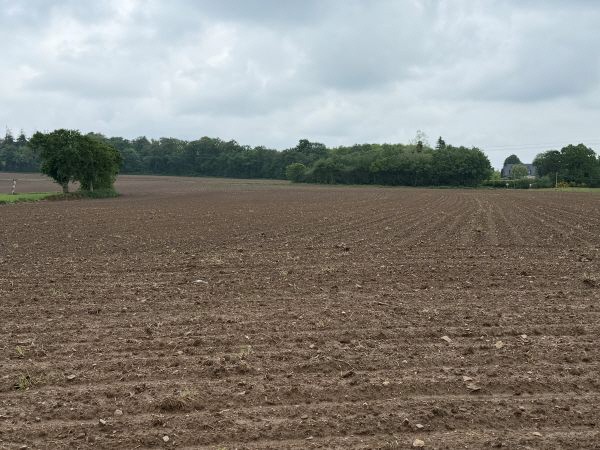 |
| A panoramic view of a cultivated field in Brittany, France, captured on the 6th of last month (local time). / Courtesy of Lim Yu-jung, Paris Correspondent |
It has been identified that severe losses occurred in the agricultural sector due to the ongoing heatwave in France. Although the heatwave that began on the 17th (local time) eased in most regions on the 28th—11 days later—the situation is one where confidence is premature as additional weather deteriorations are feared.
Franceinfo reported on the 28th that the French agricultural sector is suffering difficulties due to the heatwave that blanketed the entire local territory, leading to the mass death of poultry, decreases in crop yields, and drops in milk production from dairy cows.
The place where the damage turned out to be most prominent is Cotes-d'Armor, where poultry farms are concentrated. Thierry Houal, president of the farmers' union in this region, explained on the 24th, "Approximately 10,000 poultry perished overnight," adding, "Poultry in the final finishing stage ahead of shipping are particularly vulnerable to high temperatures." On this day, the highest temperature in Saint-Brieuc, located in the Cotes-d'Armor region, was 37 degrees Celsius.
Due to this mass death, companies that process animal carcasses also fell into an overloaded state. The Brittany regional government formed an emergency task force (TF) to support farms experiencing mass deaths and temporarily implemented measures to ease regulations on processing livestock carcasses.
The heatwave also inflicted damage on the dairy sector of France, where dairy industries such as cheese and butter are developed. As dairy cows consumed energy—which they would use to produce milk—for body temperature regulation, milk production decreased sharply.
Edwige Pfeffer, a livestock farmer in Franche-Comte, explained in an interview with France 3, "When the temperature exceeds 30 degrees Celsius, the milk production of dairy cows can drop by up to 30%."
Fruit farms that recently began harvesting also sustained a blow. In production areas, the 'hairdryer effect'—where hot and dry air forms through the combination of ultra-high temperatures, low humidity, and strong winds—occurred, drying out cultivated lands below mountains, which caused the harvest yields of melons and other fruits to plummet and fears of wildfires to grow.
Myriam Martineau, president of the Melon and Watermelon Producers Association, expressed concern, noting, "Melons at farms in the mid-western region ahead of market launch sustained tremendous damage, and especially for farms not well-equipped with irrigation facilities, the harvest yield will decrease by half."
Vineyards, the core of French agriculture, passed through one crisis for now, but the degree of precipitation next month is projected to become the biggest variable for grape growth. If rain does not fall sufficiently, grape growth will slow down, which could cause a decrease in harvest yields. Due to the frequent heatwaves, the grape harvest timing is scheduled to be brought forward compared to usual years.
Bernard Farges, president of the National Wine Producers Association, explained, "The grapevines currently in the growth stage are fine, but young grapevines whose roots are not deep could experience damage."
Experts are concerned that the French agricultural sector was not properly prepared for abnormal climates caused by global warming. Agroclimatologist Serge Zaka pointed out on his social media, "We are experiencing a massive agricultural catastrophe, but the industry's countermeasures against climate change are in a state of being woefully insufficient compared to the difficulties ahead."
Lim Yu-jung
Most Read
-
1
Trump shares map on social media labeling Strait o..

-
2
Kia Sportage outperforms Mazda CX-5 in German auto..

-
3
Houthis launch successive attacks on Saudi airport..

-
4
U.S. deploys carrier, 10,000 more troops to Middle..

-
5
Trump rejects Iran's offer to open Strait of Hormu..

-
6
N. Korea conducts first swarm attack drill with dr..

-
7
U.S.-China summit falls short on substance as Trum..

PEOPLE






HEADLINE NEWS
- Seoul dismisses Ukraine's claim of 'S. Korean support for Russia' as "inaccurate and inappropriate"
- S. Korea, Japan race to develop nuclear-powered submarines
- Henri Kagan, Kenso Soai win Nobel Prize in Chemistry for uncovering how mol..
- Vance says Alaska LNG cooperation will move forward with Seoul's current or..

-
Address : In-Young Bldg., 34, Uisadang-daero 1-gil, Yeongdeungpo-gu, Seoul
Copyright by ASIATODAY CO., LTD. All rights resereved