



Miracle rescues continue in Venezuela earthquake ruins despite passing of golden time
Jun 29, 2026, 10:33 am


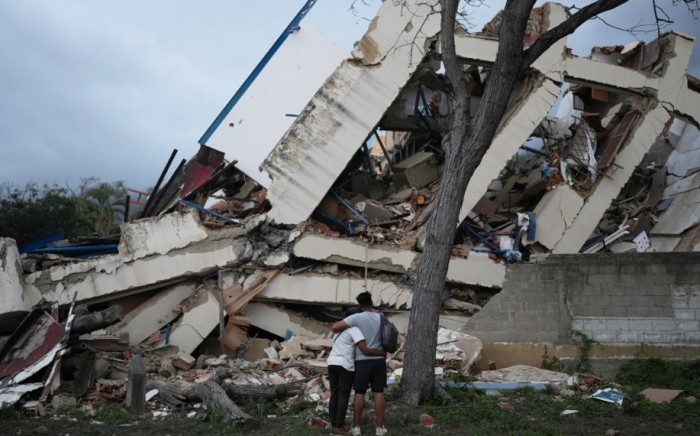 |
| As the earthquake disaster enters its fourth day on the 27th (local time) and the critical 72-hour golden time—considered the turning point for saving lives—has passed, Venezuelan residents look at a building collapsed by the powerful earthquake. / Courtesy of Yonhap News |
As the earthquake disaster enters its fourth day, marking the worst earthquake in 126 years for Venezuela, the death toll is spiking rapidly as the 72-hour "golden time"—considered the turning point for saving lives—has passed. While miracles of survivors being continuously rescued from the ruins also carry on, concerns emerge that the damage will grow even larger due to overlapping rescue delays and a lack of support.
Miraculous survivals continue, but aftershocks hamper rescue
According to AP and other media outlets on the 27th (local time), Jorge Rodriguez, the President of the National Assembly of Venezuela, announced that the death toll from the consecutive powerful earthquakes has increased to 1,430. This is an increase of more than 500 from 920 a day earlier.
The number of missing persons registered on private missing person reporting websites reached 68,900. However, foreign media outlets reported that this is a private compilation rather than an officially confirmed figure by the government.
As the 72 hours with the highest probability of survival have passed since the earthquake occurred, rescue operations are becoming even more difficult. Nevertheless, cases of rescuing survivors from the ruins continued. According to CNN, an El Salvadoran rescue team safely rescued a 15-year-old girl and her pet dog who were trapped beneath a collapsed building in La Guaira State near the capital Caracas. The girl, who was rescued in a healthy state, expressed her gratitude toward the rescue workers by forming a heart shape with her hands.
A Spanish rescue team also succeeded in rescuing a woman who had been trapped in the ruins for approximately 72 hours. As the woman, covered in soil dust, showed her appearance outside the rubble, cheers from rescue workers erupted at the scene.
Amid continuous aftershocks, government control at the scene causes rescue delays
However, aftershocks continue in the affected areas. The American Red Cross reported that both rescue workers and residents are continuing operations amidst extreme anxiety.
It is not only aftershocks that are blocking rescue activities. As the Venezuelan government allows only personnel with permits to enter the scene, the rescue work of volunteers is also being delayed. Some volunteers criticized the government's response, saying, "We have to wait for a permit even when saving people."
Residents' dissatisfaction regarding the government's belated response is also growing. In La Guaira State, where damage was heavily concentrated, military troops were deployed, but residents complained, saying, "It is difficult to find any government officials." Residents who participated in rescue operations claimed that authorities did not respond properly even when informed of the locations of survivors and bodies within the ruins.
In some areas, clashes also broke out, such as residents blocking vehicles when officials who arrived with rescue equipment attempted to withdraw after looking around the scene. Foreign media reported that looting targeting shops and residences is also occurring one after another amidst a vacuum in public security.
The international community is extending a helping hand to Venezuela, which has suffered immense human and material damage. More than 1,600 rescue workers from about 10 countries, including the United States, Mexico, Spain, and Colombia, have arrived at the scene and are conducting search operations. As Simon Bolivar International Airport, which had been closed due to the powerful earthquake, partially resumed operations on a portion of its runway, additional relief personnel and equipment are arriving one after another.
Economic damage placed at 6% of GDP, a catastrophic level
A provisional evaluation by the United Nations emerged indicating that the direct damage suffered by Venezuela reaches 6% of its gross domestic product (GDP). The United Nations Development Programme (UNDP) estimated the scale of physical losses from the earthquake that occurred on the 24th at 6.7 billion dollars (approximately 10.3 trillion won) in a statement released the previous day.
The UNDP stated that this estimation was conducted centering on damage to housing and assets, excluding public infrastructure restoration costs and economic spillover effects. Concurrently, it foresaw that the total scale of damage could reach up to three times the amount of direct damage.
The International Rescue Committee (IRC) projected, "This disaster will not be a matter that ends in a short period, but will instead become a disaster that requires long-term recovery and reconstruction."
Nam Mi-kyung
Most Read
-
1
Trump shares map on social media labeling Strait o..

-
2
Kia Sportage outperforms Mazda CX-5 in German auto..

-
3
Houthis launch successive attacks on Saudi airport..

-
4
U.S. deploys carrier, 10,000 more troops to Middle..

-
5
Trump rejects Iran's offer to open Strait of Hormu..

-
6
N. Korea conducts first swarm attack drill with dr..

-
7
U.S.-China summit falls short on substance as Trum..

PEOPLE






HEADLINE NEWS
- Seoul dismisses Ukraine's claim of 'S. Korean support for Russia' as "inaccurate and inappropriate"
- S. Korea, Japan race to develop nuclear-powered submarines
- Henri Kagan, Kenso Soai win Nobel Prize in Chemistry for uncovering how mol..
- Vance says Alaska LNG cooperation will move forward with Seoul's current or..

-
Address : In-Young Bldg., 34, Uisadang-daero 1-gil, Yeongdeungpo-gu, Seoul
Copyright by ASIATODAY CO., LTD. All rights resereved