



Southeast Asia battles deadly 'wet-bulb' heatwaves
Jun 29, 2026, 10:20 am


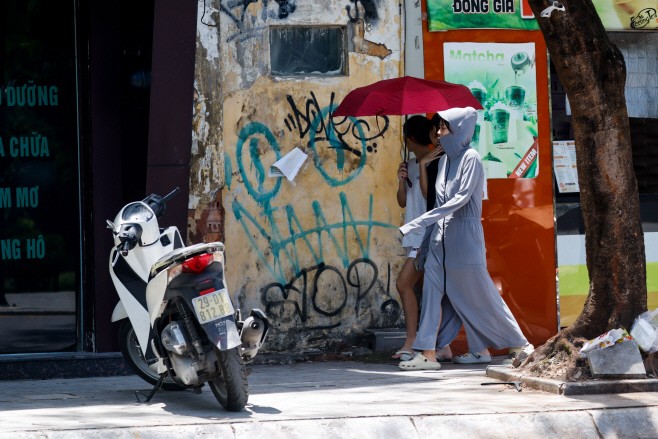 |
Citizens walk along a street under the blazing sun in Hanoi, Vietnam, on the 23rd (local time). An extreme heatwave continues to grip northern and central Vietnam, with recent temperatures soaring above 37 degrees Celsius. / Courtesy of EPA-Yonhap News
While Europe suffers from intense heatwaves, humid heatwaves—interlocked with high humidity—are pushing people to human limits in Southeast Asia. Some regions in Southeast Asia have come to spend more than six months of the year amidst this type of heatwave.
According to the South China Morning Post (SCMP) on the 28th (local time), Climate Central, a non-profit climate analysis organization, recently released a report containing these details. The report stated that the duration of extreme climate across the globe has more than doubled over the past 50 or so years, rising from an annual average of 10 days in the 1970s to 23 days at present. Southeast Asia, South America, and parts of the West African coast were already cited as regions experiencing dangerous humid heatwaves for more than six months out of the year.
A "dangerous" humid heatwave refers to days when the wet-bulb temperature exceeds 25 degrees Celsius. The wet-bulb temperature is an index that reflects both heat and humidity together, and once this line is crossed, the human body's self-cooling function through sweat secretion reaches its limit. Climate Central climate scientist Zack Labe explained, "In this case, the human body's primary cooling system fails to function properly, forcing the heart to beat harder to regulate body temperature."
The report picked human-caused climate change as the primary cause of these humid heatwaves. It analyzed that approximately two-thirds of the dangerous humid heatwave days worldwide originated from climate change. In the case of Hong Kong, an annual average of 144 days of dangerous humid heatwaves appeared over the past decade, and among these, about 33 days were analyzed to be caused by human-induced climate change.
Southeast Asia is already boiling due to heatwaves. According to local media outlets, northern and central regions of Vietnam, including the capital Hanoi, have suffered from extreme heatwaves over the past few days, and in Thailand, the perceived temperature (heat index) in the Bang Na area of Bangkok soared up to 54 degrees. The situation is identical in South Asia as well, where temperatures in various parts of India exceeded 45 degrees last month.
Southeast Asia inevitably faces a much larger impact from heatwaves due to its economic structure. The McKinsey Global Institute analyzed through a report last month that Southeast Asia is more vulnerable to climate disasters because it relies heavily on outdoor labor. Agriculture, where productivity is directly dictated by the climate, accounts for 8 to 15% of the economy in Cambodia, Indonesia, and Thailand, which sits at a level more than doubling the global average (4%).
According to McKinsey, 15% of the land within the Southeast Asian region bears heat stress, and 10% faces risks of river flooding. Furthermore, approximately half of Southeast Asia’s total area and population are exposed to at least one or more climate disasters. McKinsey diagnosed that the money Southeast Asia spends on climate adaptation—such as air conditioning, rainwater drainage networks, irrigation, and early warning systems—is 12 billion dollars (approximately 18.42 trillion won) annually, but to equip themselves with readiness at the level of developed nations, they must increase it more than threefold to 37 billion dollars (approximately 56.795 trillion won) per year.
Jeong Ri-na |
Most Read
-
1
Trump shares map on social media labeling Strait o..

-
2
Kia Sportage outperforms Mazda CX-5 in German auto..

-
3
Houthis launch successive attacks on Saudi airport..

-
4
U.S. deploys carrier, 10,000 more troops to Middle..

-
5
Trump rejects Iran's offer to open Strait of Hormu..

-
6
N. Korea conducts first swarm attack drill with dr..

-
7
U.S.-China summit falls short on substance as Trum..

PEOPLE






HEADLINE NEWS
- Seoul dismisses Ukraine's claim of 'S. Korean support for Russia' as "inaccurate and inappropriate"
- S. Korea, Japan race to develop nuclear-powered submarines
- Henri Kagan, Kenso Soai win Nobel Prize in Chemistry for uncovering how mol..
- Vance says Alaska LNG cooperation will move forward with Seoul's current or..

-
Address : In-Young Bldg., 34, Uisadang-daero 1-gil, Yeongdeungpo-gu, Seoul
Copyright by ASIATODAY CO., LTD. All rights resereved