



Hanwha Qcells maps out 2029 commercialization blueprint for next-gen tandem solar tech
Jun 29, 2026, 09:34 am


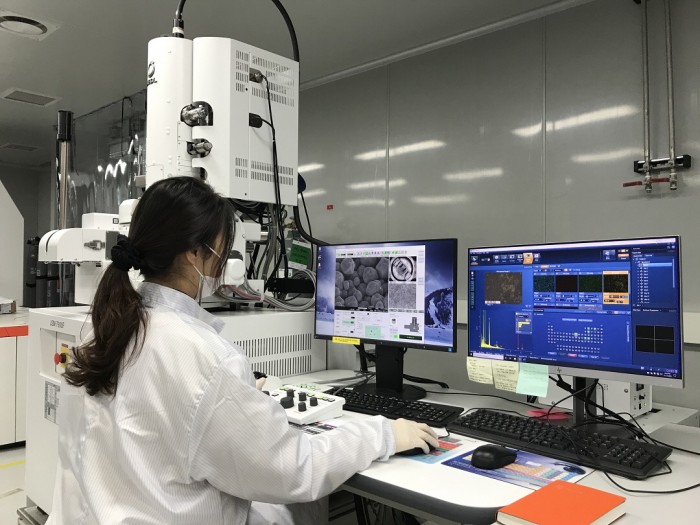 |
| Researchers conducting experiments at the Hanwha Qcells Pangyo R&D Center. / Courtesy of Hanwha Qcells |
The competition to commercialize perovskite tandem technology, regarded as the "game changer" for next-generation solar cells, is moving into the validation phase. This transition comes as Hanwha Qcells takes charge of a government research and development (R&D) project to initiate the verification of mass production feasibility and economic viability. Consequently, the acquisition of competitiveness for the domestic next-generation solar industry is anticipated to gather momentum.
On the 29th, Hanwha Qcells announced that it has signed an agreement for the R&D project titled "Development and Validation of Commercial-Scale Perovskite-Crystalline Silicon Tandem Module Technology" and will participate as the lead institution for the state-run energy technology development initiative. This project is supervised exclusively by the Korea Institute of Energy Technology Evaluation and Planning, and a total of nine institutions—including Hanwha Qcells, alongside domestic enterprises, research institutes, and universities—will jointly perform the research.
The consortium will proceed with the development and validation of commercial-scale tandem modules for three years starting from April this year. The target is to realize a commercial product featuring a module efficiency of 28% or higher and a surface area of 1.7 square meters or greater. Hanwha Qcells plans to concentrate on developing manufacturing technologies that factor in suitability for mass production, alongside core processes, modularization technologies, and reliability verifications. The company will concurrently conduct outdoor validations and business feasibility analyses to verify the potential for actual market application.
This project holds significance in that it goes beyond mere R&D to confirm the feasibility of transitioning into mass production. Hanwha Qcells envisions establishing manufacturing technologies capable of securing performance, reliability, and economic viability simultaneously, while also expanding cooperation with materials, parts, and equipment enterprises to elevate the competitiveness of the domestic solar industry ecosystem.
Tandem cells are next-generation solar cells that stack perovskite and silicon cells to absorb light across different wavelength bands. Because they can significantly elevate power generation efficiency compared to conventional silicon cells, they are evaluated as a core next-generation technology in the global solar market. According to Hanwha Qcells, the theoretical limit efficiency of a tandem cell stands at 44%, which is approximately 1.5 times higher than the 29% theoretical limit efficiency of conventional silicon cells. Furthermore, because it boasts high power generation efficiency relative to weight and can lower manufacturing costs, expectations are high for its potential expansion into new markets such as space-based solar power in the future.
Hanwha Qcells intends to accumulate commercial-scale module validation data and secure a technological foundation for the mass production transition by linking this national project with the tandem pilot lines it operates in South Korea and Germany. The company targets the commercialization of tandem technology by 2029.
Moon Su-jin, head of the Hanwha Qcells Pangyo R&D Center, stated, "This project serves as a major turning point to officially validate the commercialization feasibility of next-generation tandem solar cells," adding, "Leveraging our accumulated cell and module technical prowess alongside our mass production capabilities, we will bring forward the timeline for commercialization and contribute to strengthening the global competitiveness of the domestic solar industry ecosystem."
Kim Seo-yeon
Most Read
-
1
Kia Sportage outperforms Mazda CX-5 in German auto..

-
2
Houthis launch successive attacks on Saudi airport..

-
3
Saudi Arabia, Iran hold first diplomatic talks to..

-
4
U.S. deploys carrier, 10,000 more troops to Middle..

-
5
Saudi airport in Riyadh struck again, leaving at l..

-
6
Putin's ally visits China on the 8th ahead of APEC..

-
7
Chinese military support and training center opens..

PEOPLE






HEADLINE NEWS

-
Address : In-Young Bldg., 34, Uisadang-daero 1-gil, Yeongdeungpo-gu, Seoul
Copyright by ASIATODAY CO., LTD. All rights resereved